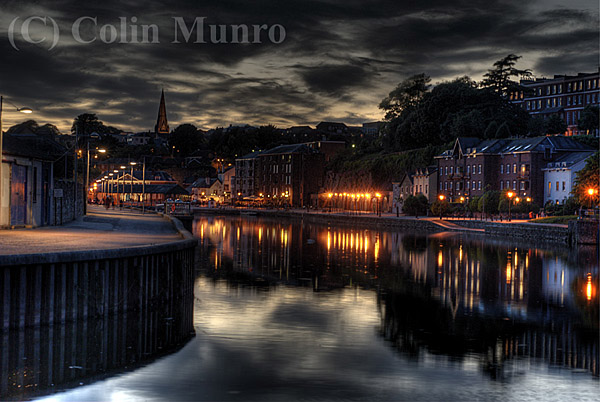
The Port Royal bar reflected on the River Exe at night. Exeter historic quay, Exeter, Devon, England. Image MBI000910.
The Port Royal bar reflected on the River Exe at night. Exeter historic quay, Exeter, Devon, England. image No. MBI000910. Please email me, quoting this number if you’d like to license use of this image or purchase a fine art print.
I took this pic a couple of nights ago. The last of the revellers had staggered home and the quayside was quiet. It was warm and perfectly still, with a clear starry sky overhead. Perfect for this type of image. So a little after midnight I pulled my gear together and climbed out of my boat’s saloon. For a pic such as this, relying solely on distance sodium street lighting and faint starlight the iso needs to be cranked up a bit, but not so much as to make the image very noisy, and, obviously, the shutter speed way down. Depth of field is not an issue as everything in the picture is distant, so the iris can be (and was) wide open. I used an old 20mm prime lens, a favourite of mine. The sodium lighting gives the pub and adjacent buildings an unearthly yellow hue. I rather like it this so did not atempt to change this, feeling it added to the rather surreal look. Clearly the stars and buildings differ massively in brightness. To acheive useable exposure of both required melding two images at very different shutter speeds (four stops difference if memory serves me). Some post processing of the starry sky was also required. The image was converted in to a grey scale image to remove colour noise, then reconverted back to an RGB image before melding.
M’bour, Senegal. Fishermen haul a small fishing pirogue (wooden canoe) up on to the beach at sunset.
In November 2008 I spent two weeks in Senegal, living in M’bour, a dusty transit stop and fishing port halfway between Dakar and the Gambia. I spent this time getting to know the fishermen, going to sea with them, learning how they worked, the risks they took travelling up to 20 miles offshore in leaky open canoes without so much as a compass to guide them. I learned how they spent days at sea in tiny canoes, sleeping in the bottom of them, risking storms or being swept out to sea. As there canoes have no lights they also run the risk of being mown down by trawlers at night. Many do lose their lives each year, but economic pressures are causing a growing number of young men to turn to fishing. This brings its own problems; the fishery is poorly documented, but anecdotal reports suggest this is having a significant impact on stocks of some species. Robust data is hard to come by, given the unregulated nature of this fishery, but the Senegalese Directorate of Marine Fisheries estimated that in 2004 a little over 6000 such canoes were operating along the coast of Senegal. The main species caught are small sardinella (Sardinella aurita and S. maderenis) and horse mackerel (Trachurus trachurus). In 2008 the fishery off M’bour and nearby Joal Fadiouth was considered over-exploited (source FAO,Fisheries Circular No. 1033, 2008).
Our fishing canoe, or pirogue, being lanched off beach on wooden rollers, M’bour, Senegal.
Now fully laden, our ancient outboard is securely fastened with bailing twine. Note the well balanced ice box perched toward the stern of the canoe.
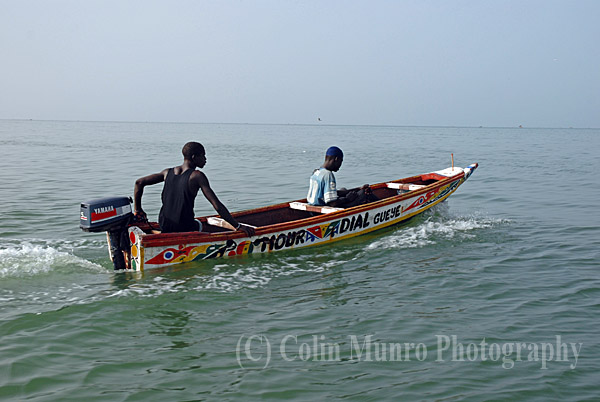
M’bour, Senegal. Two Senegalese fishermen head out to sea in a small pirogue (traditional wooden canoe).
I spent a day at sea on one of these tiny boats. Simply making it through the surf was quite an acheivement; the boat had no ballast and was so top heavy, due to ourselves and the large box of ice we were carrying, that we appeared in imminent danger of capsizing. Fortunately we shipped quite a lot of water quite quickly during a rather sketchy launching. This few inches of seawater inside our boat at least gave us some stability by providing a little ballast, albeit not a recommended way of doing so. Powered by an ancient 15hp, 2-stroke Yamaha outboard engine secured by bailing twine to the transom, we headed out to sea for about three hours, by which time I estimated we were about fifteen miles offshore. For the first 30 minutes or so we saw a few other boats, but they quickly dispersed in different directions; soon we were alone. We had set off in a grey haze that quickly enveloped the land. The sun became a slightly brighter glow penetrating the haze. Both sea and sky were otherwise quite featureless. As we motored steadily along, I watched with growing alarm as the sky changed, growing dark and heavy, with a stiffening breeze springing up. Maybe two hours out we came upon another canoe, similar to ours. This one was drifting aimlessly as their equally ancient outboard engine had died. The delight at our arrival shown by the three fishermen onboard quickly turned to consternation when, Pape, our boats owner and skipper, offered not to towed them to back to shore but to a point at sea where they ‘had a better chance of being spotted’ by a home-bound canoe. So for half and hour or so we towed them further out to sea (or at least it seemed that direction to me) before leaving them to anchor on what appeared an equally deserted and featureless location.as was the spot we had towed them from. We never saw them again. I rather hope this meant that they had indeed been towed ashore.
Our unhappy fishermen drop anchor and start their wait for a passing vessel after we tow them to a ‘better’ location.
At one point Pape asked me which direction I thought M’bour lay. With no visual clues to guide me I based my guess on the heading I thought we had set off on, and pointed on the reciprocal bearing. Apparently I was almost 180 degrees out. I asked Pape how he could tell, with such confidence, with no compass or electronic aids. The wind direction he informed me. So, I enquired cautiously, does it always blow from the same direction this time of year? No, he cheerfully informed me, sometimes we get lost. I rather wished I hadn’t asked.
Eventually we arrived at the fishing grounds. What exactly identified them as ‘the fishing grounds’ I have no idea. There were no surface features; nothing on the horizon. Hooks were baited with little, frozen prawns from our icebox and handlines set. A small stove was fired up in the middle of the canoe and sugary tea the colour and consistency of stockholm tar brewed. A cup was passed around from which we all took small sips; more than this would most likely have resulted in irreversible damage to my intestines. Tea was supplemented by joints also passed around. Tea, reefers and small amounts of rice and peanut porridge (gosi) were pretty much all the crew had to survive on apart from whatever they caught. Around two hours passed, in which time we had caught maybe a dozen fish, mostly sardinella, horse mackerel and a few bigeye grunt (Brachydeuterus auritus). Barely enough to feed us at sea, let alone provide a wage for all three fishermen. Around four in the afternoon, by which time the chop on the sea had risen significantly and little whitecaps had started to appear, we finally decided to head back inshore. Much to my relief, Pape’s sense of direction proved accurate.
The sun was setting when we finally reached M’bour, and there have been few occasions when I’ve been quite so pleased to step on to dry land. Pape and his crew would probably go to sea again tomorrow, maybe staying out for one or two nights this time. I thought that night of the meagre catch we returned with after a day at sea, of the broken down canoe we had come across and of the stories Pape had told me of getting caught in a storm and drifting helplessly for three days before sighting land. Overfishing is a massive problem on the West coast of Africa. Much of this problem is actually due to poorly regulated fishing by large trawlers from outside Senegal: Russian, Korean, Japanese, Chinese and European boats. It has been estimated that a large trawler will, on one good day, catch as much as fifty pirogues will in a year. Vessels are licensed by the Senegalese Government who argue that if they don’t sell licenses then neighbouring countries will; stocks may still suffer and Senegal will lose valuable revenue (Grégoire Allix, le Monde/Worldcrunch, 2011). What is a matter of concern about the long term effects of overfishing for us in the West can be a question of survival for some on the coast of Senegal.
One of our crew hand lining for fish at the ‘fishing grounds’, waiting for a bite.
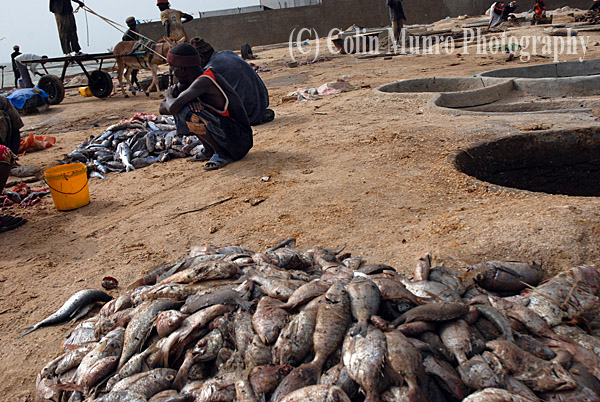
Fish salting pans, M’bour, Senegal.
View more of my images of Senegal and from other regions of the World here at my main Colin Munro Photography website.
Coconut palms trees and white sand beach and blue sky, Tapuaetai island (one foot island), Aitutaki atoll, Cook Islands. Image MBI000566.
.Coconut palms trees and white sand beach and blue sky, Tapuaetai island (one foot island), Aitutaki atoll, Cook Islands. Image MBI000566. Please email me, quoting this number if you’d like to license use of this image or purchase a fine art print.
Aitutaki, Cook Islands, South Pacific.
Position 18° 51? 0? S, 159° 47? 24? W (WGS84).
I wrote recently that bright sunshine and blue skies did not feature in my photography. Okay, i lied! I doesn’t feature that often, but when it comes to South Pacific islands what else can one do? Aitutaki, Cook Islands, must be one of the most idyllic places on earth; sunshine, pristine white beaches, warm clear waters teeming with life, coconut palms and wonderful friendly people. I, like most people who visit I suspect, felt my time there was all too short. I’ve limited this post to a a couple of beach views and pictures of coconut palms (there wil be more). Aitutaki is a coral atoll, the second largest of the Cook Islands (after Roratonga) and also the second most visited. The atoll comprises 22 islands in total; the largest, central island is Arutanga. The remaining islands lie on top of the traingular fringing coral reef that encloses the lagoon. Tapuaetai island (one foot island,) where these images were taken, is located near the southern tip of the fringing reef. it is a small island of sand and coconut palms, less than a kilometre across.
Recently germinated coconut palms trees ( Cocos nucifera) on a white sand beach, Tapuaetai island (one foot island), Aitutaki atoll, Cook Islands, South Pacific. Image MBI000904.
.Recently germinated coconut palms trees ( Cocos nucifera) on a white sand beach, Tapuaetai island (one foot island), Aitutaki atoll, Cook Islands, South Pacific. Image MBI000904. Please email me, quoting this number if you’d like to license use of this image or purchase a fine art print.
The coconut palm, Cocos nucifera, is a member of the family Arecaceae (palm family). It is found around the tropics. The cocnut seed is buoyant and may be distributed widely by ocean currents. Coconut palms flourish in sandy soils and are tolerant of high salt levels. They grow fastes where mean annual temperates are around 80 degree F (27 degrees C).
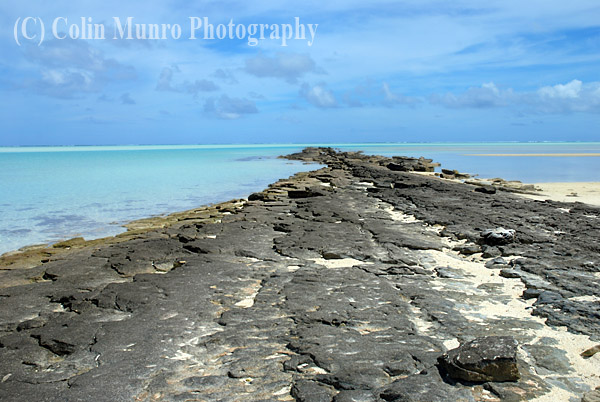
Coral platform, Tapuaetai island (one foot island), Aitutaki atoll, Cook Islands, South Pacific. Image MBI000905.
. Coral platform, Tapuaetai island (one foot island), Aitutaki atoll, Cook Islands, South Pacific. Image MBI000905. Please email me, quoting this number if you’d like to license use of this image or purchase a fine art print.
Coconut palms trees and white sand beach and blue sky, Tapuaetai island (one foot island), Aitutaki atoll, Cook Islands. Image MBI000906.
Coconut palms trees and white sand beach and blue sky, Tapuaetai island (one foot island), Aitutaki atoll, Cook Islands. Image MBI000906. Please email me, quoting this number if you’d like to license use of this image or purchase a fine art print.
Recently germinated coconut ( Cocos nucifera) on a white sand beach. Image MBI000907.
Recently germinated coconut ( Cocos nucifera) on a white sand beach. Image MBI000907. Please email me, quoting this number if you’d like to license use of this image or purchase a fine art print.
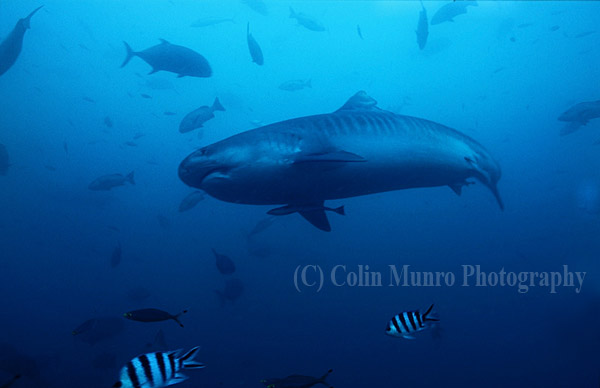
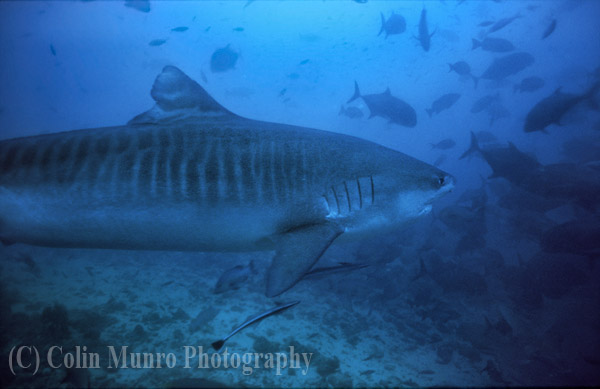
A large female tiger shark, Galeocerdo cuvier, known locally as Scarface due to the long scar down the left-hand side of her face,
Large female tiger shark, Galeocerdo cuvier, known locally as Scarface, Beqa Lagoon, Fiji. Image MBI000479. Please email me, quoting this number if you’d like to purchase a fine art print.
Beqa Lagoon is often described as the World’s best shark diving location and I, for one, would not dispute that. I dived here with Rusi, Papa, Andrew and the team from Beqa Action Divers. I wouldn’t hesitate to recommend these guys, I couldn’t have asked for a more conservation-orientated team with a great laid back attitide. At the same time the whole operation was extremely professional, making the diving run as smooth as clockwork. Above water the location is simply stunning; lush forest and magrove bordering the Navua River which empties into the sheltered lagoon. These are not, however,the crystal clear waters of , say, the Bahamas. In Fiji it rains a lot. A lot! River waters pour in to the lagoon; rarely seriously reducing visibility but just enough to reduce light levels and create slightly gloomy effect at depth. In my opinion this rather adds to the atmosphere of the place; a big tiger or bull shark appearing out of the gloom is somehow more impressive than one cruising across a bright sunlight seabed. The key location for bull sharks and tigers is near the outer edge of the lagoon, where it meets the open ocean, dropping into very deep water indeed. This has the advantage that you are furthest from the freshwater inputs, so the water is much clearer. Bulls and Tigers patrol the lower part of the reef slope, rising up to the ledge at about 30 metres (100 feet) at which the deepest part of the dive is conducted. I was generously allowed to position myself directly behind Tubee, who had the unenviable task of hand-feeding feeding the sharks with large chunks of tuna. I thus had a perfect view as they cruised in, then swept past overhead (sometimes requiring a slight nudge to help them clear me).
Close up of a large female Tiger Shark known as \’Scarface\’ swimming at around 30 metres depth, Beqa Lagoon, Fiji. Image MBI000474.
Close up of a large female Tiger Shark known as Scarface; swimming at around 30 metres depth, Beqa Lagoon, Fiji. Image MBI000474. Please email me, quoting this number if you’d like to license use of this image or purchase a fine art print. The tiger shark in these photographs is a lady known as scarface, due to the long scar running down from the right side of her jaw (the result of a fish hook). She is probably about 4-4.5 metres long (14-15 feet), so is a pretty big fish. She has been returning to the lagoon for several years, so is well known to the divers there. The first sign of her imminent appearance was the moving away of the bulls as they became aware of her presence; she then glided in to view, making a couple of circles to inspect the scene before deciding to head for the food. Although she has an impressive sense of smell her eyesight is not great; so provided you don’t move too much like food, or smell like food (slightly tricky when the water is full of tuna flakes) then you’re pretty much okay.
Large tiger shark, Galeocerdo cuvier, swimming towards diver, Beqa Lagoon, Fiji. Image MBI000486.
Large tiger shark, Galeocerdo cuvier, swimming towards diver, Beqa Lagoon, Fiji. Image MBI000486. Please email me, quoting this number if you’d like to license use of this image or purchase a fine art print.
Large female Tiger Shark \’Scarface\’ swimming at around 30 metres depth, Beqa Lagoon, Fiji. Image MBI000476.
Large female Tiger Shark, Scarface, swimming at around 30 metres depth, Beqa Lagoon, Fiji. Image MBI000476. Please email me, quoting this number if you’d like to license use of this image or purchase a fine art print. I took these shots on film, my last serious trip underwater with a film camera. The plus side is they produced huge images (20+megapixel images). The down side was I only had 100iso film and so was really struggling with light; even with a fast, wide prime lens (20mm) I was still down at 15th of a second shutter speed thus had to be pretty steady to get useable shots. Just to add to my problems, the auto-manual focus switch on my housing stopped working, leaving me stuck in autofocus. In such low light, low contrast conditions the autofocus was hunting like crazy. After losing a couple of perfect shots due to the camera failing to focus in time I resorted to the technique of waiting until a shark was approaching, deciding on the distance I was going to take the pic, then turning and pointing the camera at some coral rubble by my side that was about the same distance, locking focus, then with shutter half depressed turning and shooting once the shark was close enough. Needless to say this drew some curious looks from my Fijian friends; why on earth was I staring at a lump of rock to the side of me when a big shark was heading straight towards me, but hey! It worked.
A large female tiger shark, Galeocerdo cuvier, cruising near the seabed, beqa lagoon, Fiji. Image No. MBI000484
In you enjoyed this blog please consider subscribing. You can do this using the simple subscribe form
Fine Art Landscape and Wildlife Prints
Some of the framed canvas wrap prints on my website. You can also check out my fine art prints and posters.
Yachts silhouetted just before dawn, San Diego harbour. Image MBI000899.
San Diego Harbour just before dawn. San Diego, California, USA. Image No. MBI000889. Please email me, quoting this number if you’d like to license use of this image.
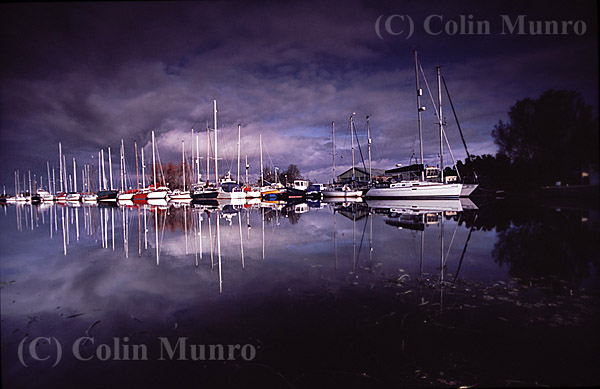
Those of you with way too much time on their hands may have noticed that reflections on water is a recurring theme in my images. I know its a cliche, but hey! Cliche images only become so because they work. The images I’ve uploaded span a good few years; although most were taken in the past four, the Loch Ness image pre-dates that by quite some time. Consequently the pictures include both digital and film originated images. I’ve also chosen pictures from around the World: from San Diego’s bay-side to rural Devon,Southwest England, through to the Navua River creek at the southern tip of Fiji’s largest island Viti Levu, and back to the northern hemisphere to the shores of Loch Ness, northern Scotland during a particularly hard winter. You won’t find a great many bright summer days amongst my pictures. Not that I don’t enjoy the sun as much as anyone else, but it’s rarely dramatic. I much prefer the low light of dusk and dawn or winter days when the sun bobbles along the horizon, creating light and shadow that I can play with. Although I cut my teeth working underwater with a purely mechanical camera devoid of even a light meter, I’m not really a purist and will use Photoshop or whatever tools are at my disposal to enhance an image. To me it is not that different from dodging and burning photographic paper. However, you don’t great create a good image from a mediocre one straight out of the camera. For me at least, what I see through the lens in 95% of the final image and getting that image on to the camera’s sensor is 95% of the work. Everything after that is dressing. Two of the photographs were taken in the 30 minutes or so before dawn. For me that’s a magical time; very still, the World haven not fully woken. A not-so-magical time is when my alarm goes off at 4:30a.m., but if I do force myself out of bed it is often well worth the effort. The final image of Exeter historic quay was actually an evening shot, around 9p.m. on a warm evening in early June. The sun had just set, leaving a dramatic sky but with most of the quayside in deep shadow. To bring out this detail I created an HDR (High Dynamic Range) image as a composite from four seperate images covering (if memory serves me correctly) six full stops. The images were then processed using Photomatix and Photoshop. The hardest part of compilations like these are what to leave out. Thus reflections is a theme I will no doubt return to, with a ‘Reflections’ gallery up soon. All feedback, including reports of any gliches, most welcome.
Colin
The Turf Locks Pub, Turf Lock, Exeter Canal, Devon, England. Image No MBI000900
The Turf Locks Pub, Turf Lock, Exeter Canal, Devon, England. Image No MBI000900. Please email me, quoting this number if you’d like to licence use of this image.
Yachts reflected on the calm waters of Exeter Canal on a winter's day. Image MBI000775.
Yachts reflected on the calm waters of Exeter Canal on a winter’s day Image No. MBI000775. Please email me, quoting this number if you’d like to licence use of this image.
Sunrise over the Navua river near the mouth at Beqa Lagoon, Viti Levu, Fiji. Image MBI000583.
. Sunrise over the Navua River, Viti Levu, Fiji. Image No. MBI000583. Please email me, quoting this number if you’d like to licence use of this image.
Frozen birch trees and snow-capped mountains reflected on the waters of Loch Ness, Scotland,. Image MBI000124
Frozen birch trees and snow-capped mountains reflected on the waters of Loch Ness, Scotland. Image No. MBI000124. Please email me, quoting this number if you’d like to licence use of this image.
Exeter quayside at night. Exeter's historic quayside. Devon, England.
.Exeter quayside at night. Exeter’s historic quayside. Devon, England . Image No. MBI000890. Please email me, quoting this number if you’d like to licence use of this image.
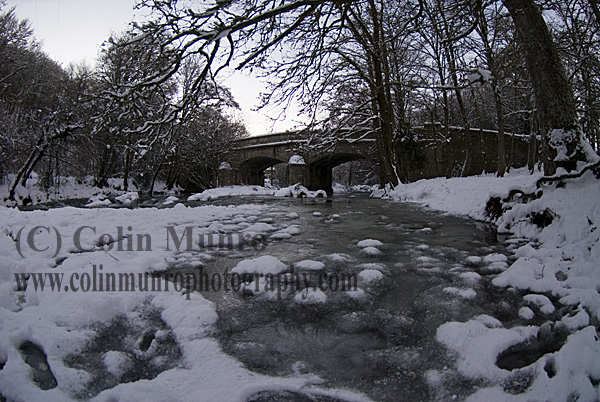
Steps Bridge, River Teign, Dunsford Wood, in mid-winter
This has turned out to be one of the coldest Christmas days on record here in South Devon. Living on a boat, this has not escaped my attention. I haven’t been moving too far from the woodburner stove at night. For the second winter in a row I’ve been locked in ice for weeks on end. Around 2a.m. this morning I was woken by a loud bang and the whole boat shuddering strongly. It was around minus 10 Centigrade (~14deg F) and Maria had shifted as the ice thickened and expanded. Maria weighs around 30 tons. I climbed on to deck to check the thickness of the ice. A few hard thumps with an old wooden oar succeeded only in sending gunshot-like sounds ricocheting through the night and splintering the blade of the oar. I gave up and retired to bed. Maria is very stoutly built with oak frames at 11″ spacing, she wasn’t about to be crushed. I just don’t want the ice to get any thicker.
River Teign partially frozen, Dunsford Wood, South Devon, UK.
Christmas day was perfect: clear blue skies and crisp white snow underfoot. So after doing the family stuff in the morning I decided to take my son Calum walking in the Teign Valley through Dunsford Wood. It would certainly give us an appetite for Christmas dinner. Dunsford Wood is owned by the National Trust and Managed by the Devon Wildlife Trust, with footpaths through the woodland and along the riverbank open to the public. In summer it is a great place to see huge wood ant colonies and the rare High Brown Fritillary butterfly. Year round it’s a great place to walk; light open oak, hazel and ash woodland on one side and on the other the river lazily gliding past (or thundering past, depending on season). As it happened, the river was doing neither along much of the walk on Christmas Day; or if it was drifting past it was doing so beneath a carapace of ice. We were lucky enough spot a couple of dippers (Cinclus cinclus) as we walked ( a first for my son). We watched one for several minutes as it skipped between sheets of ice-covered river, occasionally slipping beneath the surface where it found ice-free water. Unfortunately the sun was already low and the only long lens I had with me was way too slow, so I didn’t bother getting it out. As the sun set and the temperature plumetted we headed back to the landrover hoping that the stove would still be going when we got back to the boat.
River Teign partially frozen, Dunsford Wood, South Devon, UK.
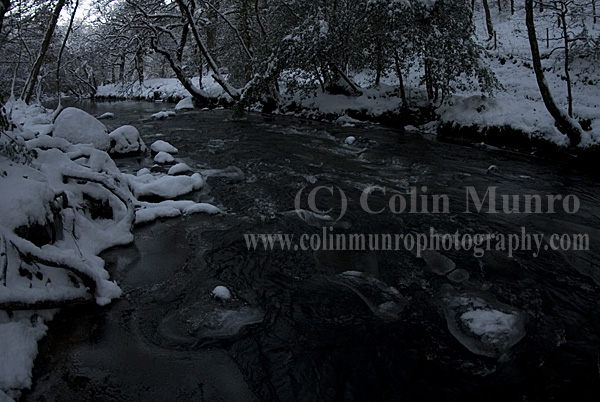
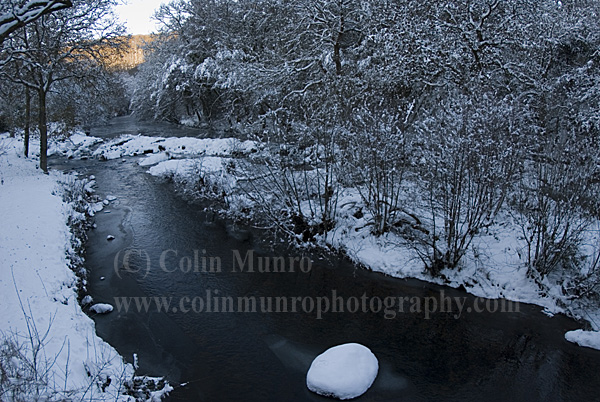
Snow-covered upland oak woodland along banks of the River Teign, Dunsford Wood, South Devon, UK.
As always my images are available to license and as fine art prints. If you’d like to use one of my images for publication please contact me. If you’d like a print of one of the images drop me an email stating image number and print size (costs for prints can be found on my fine art prints pages, e.g. Fine Art prints of Devon. Email me.
To my main website www.colinmunrophotography.com
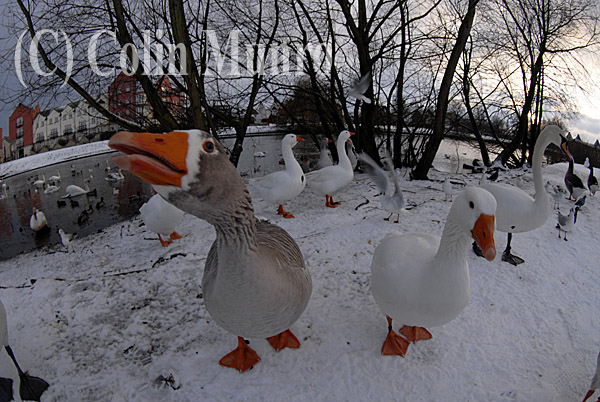
Hungry geese paddle across the snow-covered footpath on Exeter's Quayside
This image is for sale at Alamy, click here and search for geese, snow, Exeter.
Snow has finally arrived in Exeter, just in time for Christmas! Despite sub-zero conditions that have lasted for weeks we have escaped the heavy snowfalls that have paralysed much of the UK. This morning I woke to a couple of inches in light, fluffy snow covering my boat, and pretty much everything else. Just enough to look pretty without causing too much disruption.
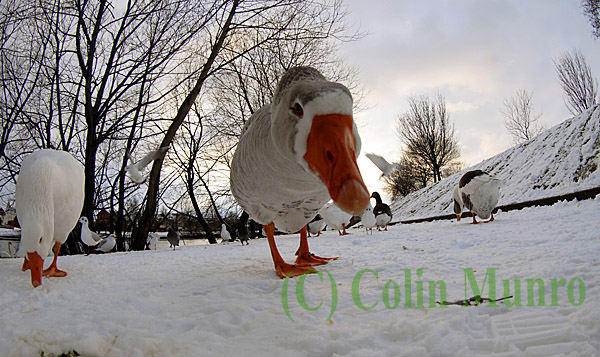
Close up of an inquisitive goose in snow, Exeter Quayside
This image is for sale at Alamy, click here and search for geese, snow, Exeter.
Close-up of inquisitive goose standing in snow, Exeter Quayside
This image is for sale at Alamy, click here and search for geese, snow, Exeter.