A visit from Islamic Revolutionary Guard Corps

A visit from Islamic Revolutionary Guard Corps

Rather different from my usual blogs. At the time of writing this it seems likely that the US is about to launch an attack on Iran. Hopefully that assumption is wrong as the potential to spill over into a major war is considerable. However current events have made me think about my only time in Iran, some 20 years ago. So I thought I’d share my experience of an encounter with the Iranian Islamic Revolutionary Guard Corp, many years ago.

Assalouyeh (also known as Assaluyeh, Asalouyeh or Bandar Assaluyeh) port and refineries, southern Iran.  Assalouyeh is the main port, refinery and other land-based facilities for the Pars Special Energy Economic Zone (PSEEZ).  It has been chosen due to its proximity to the South Pars gas field, the largest known gas field in the World, jointly shared between Iran and Qatar.  © Colin Munro Photography
Our vessel leaving the port of Assalouyeh (also known as Assaluyeh, Asalouyeh or Bandar Assaluyeh) southern Iran, in 2006. Assalouyeh is the main port, refinery and other land-based facilities for the Pars Special Energy Economic Zone (PSEEZ). In the background the Zagros mountains can be seen.


Back in around 2006 I was working on a survey vessel off Iran, more specifically in the South Pars Gas Field in the Persian Gulf. Oil and gas survey vessels are essentially platforms used to conduct a wide range of survey and sampling techniques that better inform on the physical environment. This one was a brand new 42 metre offshore support vessel, built earlier that year in the Wuxi shipyard in China. We were helping to map for new pipeline routes. The vessel charter itself is normally the most expensive part of such an operation, so teams work around the clock in shifts to maximise efficiency.

Colin Munro getting a hair cut on the back of an offshore suppport vessel, off Iran, 2006. © Colin Munro Photography
In between shifts there is time for mundane things like haircuts. I had more hair 20 years ago.

I was there to provide visual imaging of the seabed along the proposed pipeline corridor, and had brought along a towed underwater camera system for the project. But as a biologist I was also part of the grab sampling team, where a large, heavy grab is lowered to the seabed at pre-determined stations, and samples of the seabed sediment collected for physical and biological analysis.

Towed camera sled being deployed. South Pars Field, off Iran, 2006. © Marine Bio-images/Lin Baldock.
My towed camera system being deployed within the South Pars Gas Field. Photograph by Lin Baldock.

There is a lot of heavy equipment moving around, winch drums, cables and grab buckets, so safety is a priority. At night the entire back deck is floodlit to ensure everyone can be seen and all moving parts can be seen. One effect of this however, is that, outside of this pool of intense white light everything is dark, the surrounding sea is inky black. We were working two hour shifts through the night. It was around 2.30am, around 30 minutes into my shift, when the night took an unexpected turn.

A survey deplying a remote camera system, operating at night. © Colin Munro Photography
When working on the back of a survey vessel under lights at night, everything outside the beam of the floodlights appears pitch black (note: this image is from a different survey vessel, not off Iran, but in the Mediterranean and used used for illustrative purposes).

A grab bucket had just landed on the grab table, located near the stern, port side of the vessel, when we first heard it. A deep, powerful throbbing sound. My first thought was there must be a helicopter above us, but I could see no lights other than our own. As the sound grew louder we stopped working and looked at each other. I don’t recall anyone saying anything, but I’m sure we were all thinking ‘what the hell?’

The noise had reached a roaring crescendo when we finally saw it, the silhouette of a large launch emerging from the darkness on our starboard side. The vessel appeared uniformly dark coloured and displayed no lights. It only became partially visible when close enough to pick up the reflected light from our downward pointing spotlights, and from small hand-held torches carried by three or four men standing on its long foredeck. Once it came alongside I estimated its length to be between 15 and 20 metres. No insignia or other markings were visible, but from size and shape it appeared to be either a high-speed patrol boat (such as the Taregh) or an IPS torpedo boat (note: I knew nothing of these at the time, so this is comparing images from memory with information available online). Once alongside several armed men climbed onboard. They stated they were Islamic Revolutionary Guard Corps (IRGC). I could see no badges or insignia on their uniforms, but no-one was about to argue the point. As inconspicuously as possible, I took off my hard hat and placed it over my SLR camera. Events then took a rather surreal turn. The soldier in charge stated that they had a problem, and that they needed engine oil from us. An engineer was summoned. The Second Engineer was a tall, young Syrian guy, whose name I confess I have forgotten. He was a likeable guy and by far the most useful person in the engine room. He was also someone with little respect for ‘rules’. When we had berthed in one of Iran’s oil ports a few days earlier, we were informed in no uncertain terms that no-one except the few Iranians aboard were allowed off the ship. I was sitting on deck around midnight, it being far too hot in my cabin, when I saw the 2nd Engineer and one other crew heading towards the gangway. ‘Hey, you know we’re not supposed to….?’ I left my question hanging. ‘It’ll be interesting. Want to come?’ he replied. I hesitated….. what was the worst that could happen? I decided not to contemplate the answer. ‘Sure’ I said, and tagged along down the gangway behind them. To my amazement there was no obvious port security. Immediately back from the quay was a long truck stop, where numerous arctics hauling who knows what were stopped for the night. Along the roadside small camps were set up; Iranian truckers were sitting around eating and drinking tea. Several called us over to offer us tea. We sat with them drinking hot sweet tea. I spoke no Farsi and they spoke little English, so conversation was limited to ‘where are you from’ and other pleasantries. Having stared at the imposing Iranian coastline for many days, it felt good to finally set foot on it. We sneaked back on board a little after 1am with a mixture of elation and relief.

The 2nd Engineer emerged and spoke to the commanding soldier. Whether in Arabic or Farsi I couldn’t tell. It seemed that the soldier was repeating his request for oil. The 2nd Engineer turned and descended the ladder that lead to the engine room. After what seemed like a long time but was probably only a few minutes he emerged again, carrying a small plastic Coke bottle filled with oil. Without a word he presented the tiny bottle to the armed military man. No one said a word. In my head I was thinking ‘Shit, this is going to go very bad’. The soldier looked at the bottle, looked at the Syrian engineer, then took the small bottle. A few words were said to the other armed men, they climbed back on board their own vessel, the engine roared, and they left. Just like that.

To this day I’m still not exactly sure what happened that night. The next few days were very busy, and then our work was complete and I was off the ship. I never had a chance to talk to the 2nd engineer about about what was said between him and the men from the boat. Nor do I have a good explanation as to why they simply accepted a tiny amount of oil. Is it possible that this was not simply engine oil but specialist lubricant for some other piece of equipment, and only a small amount was required? Maybe. Was the oil simply a pretext for boarding to check exactly what we were doing and that we were indeed simply an oil survey vessel? Again, maybe; but none of those who boarded seemed to have much interest in checking what we were doing. It was one of those events where, once it is over, you ask yourself ‘did that really happen?’ Let’s hope the current tensions in the Persian Gulf are defused as quickly.

If you found this post interesting, you may also like my blog Lessons in stupidity ..Diving the trawl

Recent blogs include Thailand’s Chao Lay People.

Images and text copyright Colin Munro/Colin Munro Photography

For more stories, made to order framed wall-art canvas wrap prints, fine art prints, posters, stock images and more stories, visit my main site: www.colinmunrophotography.com

I write these posts primarily because I enjoy doing so. They’re free to read, and if you enjoyed reading this one I hope you’ll continue to read them (maybe even subscribe to my blog). I have no plans to paywall any of them. If you feel like you want to support my time input, well … I do like good coffee.

Buy Me A Coffee

P.S I am now also on Substack

Colin Munro Photography on Substack

Fine Art Prints and ready to hang Canvas Gallery Wrap prints

So Here’s the sales pitch. If you like my stories and images you might be interested in viewing my canvas wrap prints, fine art prints, posters, all available direct from the photographer (that would be me) stock images (and more stories) on my main site: www.colinmunrophotography.com

ColinMunroPhotography.com Colin Munro Photography fine art wildlife and landscape prints direct from the photographer
Fine Art wildlife and landscape prints colinmunrophotography.com
A baby stump-tailed macaque, Mcaca arctoides, closely guarded by its mother and another adult, feeding on grass blades. Thailand. © Colin Munro. Colin Munro Photography. https://colinmunrophotography.com

The Stump-tailed Macaque, Macaca arctoides, largest of Thailand’s macaques.

The Stump-tailed Macaque (Macaca arctoides) is the largest and heaviest of the six species of macaque found in Thailand. It is not one of the more commonly encountered species. The range of stump-tailed macaques has shrunk significantly in recent decades; once widespread across Thailand it is now largely confined to Peninsular Thailand, plus a few small populations close to the south-western and far south-eastern borders of Thailand. Across it’s entire range, from North-East India to Southern Malaysia and East as far as Southern China, stump-tailed’s are classed as ‘vulnerable’ by the ICUN. In Thailand they are considered ‘endangered’ largely due to the rate of decline.

A baby stump-tailed macaque, Mcaca arctoides, closely guarded by its mother and another adult, feeding on grass blades. Thailand. © Colin Munro. Colin Munro Photography. https://colinmunrophotography.com
A baby stump-tailed macaque, Macaca arctoides, closely guarded by its mother and another adult female (allmothering), feeding on grass blades. Thailand.

In other parts of Southeast Asia, hunting is thought to play a significant role. During the 1960s and 70s, large numbers were trapped in Thailand and sent overseas (primarily to the U.S.) for the biomedical trade. The export of primates was banned in Thailand in 1976. The biggest threat today, as with much wildlife in Southeast Asia, is urban development and large scale commercial crop farming, especially rubber and oil palm plantations. Stump-tailed macaques are creatures of upland primary or secondary forest. Rubber plantations, especially during the middle and latter part of last century and, since the 2000s, the expansion of oil palm plantations (in part driven by the promotion of bio-diesel, Srisunthon and Chawchai, 2020) have replaced much of Thailand’s original forests.

Stump-tailed macaques, Macaca arctoides, inhabiting caves within karst limestone rock outcrops, Thailand. © Colin Munro Photography https://colinmunrophotography.com
Stump-tailed macaques, Macaca arctoides, inhabiting caves within karst limestone rock outcrops, Thailand.

Stump-tailed macaques, like other macaques, are social animals. They live in troops of 10-60 or more individuals. Again, like other macaques, they are polygamous, living in multi-male, multi-female groups where both sexes will mate with multiple partners. There is a strong maternal bond with infant macaques, with weaning sometimes not completed until the young macaque is more than one year old. All adult females within the group share responsibility for caring for and protecting the youngsters, a process known as ‘allmothering‘. Due to the promiscuous nature of macaques, young stump-tails may never know exactly who their father is, but there is some intriguing evidence that macaques are able to recognise paternal siblings through similarities in facial features. This would make evolutionary sense in order to avoid inbreeding. Adult males tend to be heavier bult than females, they also have conspicuously large red testicles, which makes identification of the sexes relatively easy. Large testicles are an evolutionary adaptation common among species where both sexes are promiscuous. In promiscuois species sperm competition is important, so the more you produce, the better your chances of fathering offspring. In contrast, for haremic species (i.e. those where one male controls a harem of females and they exclusively mate with him) this is not so much an issue. Thus the promiscuous macaques have testicles that weigh over twice that of (haremic) gorillas, despite a large silverback weighing maybe 16 times more than a large macaque.

A Stump-tailed macaque, Macaca arctoides, mother breastfeeding a baby macaque. Thailand. © Colin Munro Photography. https://colinmunrophotography.com
A stump-tailed macaque, Macaca arctoides, mother breastfeeding a baby macaque. Thailand

Stump-tailed macaques are primarily frugivorous – fruit eaters – but will also consume insects, worms, frogs, birds eggs and dig for tubers. At one location I watched them move on to grassy areas to eat blades of grass.

Stump-tailed macaques, Macaca arctoides, have striking red faces that often  become more black as they age. © Colin Munro Photography https://colinmunrophotography.com
Stump-tailed macaques have striking red faces that often become more black as they age
A juvenile stump-tailed macaque sits in a tree chewing a fruit. Thailand. © Colin Munro Photography. https://colinmunrophotography.com
A juvenile stump-tailed macaque sits in a tree chewing a fruit. Thailand

If you found this post interesting, you may also like my blog on pig tailed macaques in Thailand.

Other blogs of mine on Thailand wildlife include Fiddler crabs of Phuket Shores

For more stories about Southeast Asia you might like Laos Stories

Images and text copyright Colin Munro/Colin Munro Photography

For more stories, made to order framed wall-art canvas wrap prints, fine art prints, posters, stock images and more stories, visit my main site: www.colinmunrophotography.com

I write these posts primarily because I enjoy doing so. They’re free to read, and if you enjoyed reading this one I hope you’ll continue to read them (maybe even subscribe to my blog). I have no plans to paywall any of them. If you feel like you want to support my time input, well … I do like good coffee.

Buy Me A Coffee

P.S I am now also on Substack

Fine Art Prints and ready to hang Canvas Gallery Wrap prints

So Here’s the sales pitch. If you like my stories and images you might be interested in viewing my canvas wrap prints, fine art prints, posters, all available direct from the photographer (that would be me) stock images (and more stories) on my main site: www.colinmunrophotography.com

ColinMunroPhotography.com Colin Munro Photography fine art prints direct from the photographer
colinmunrophotography.com

Stock Images

I license many of my images as stock images for use in journals, magazines, books, websites etc. A number of my images can be found and licensed on Alamy. You can also contact me directly to license images. I also have a great many images not currently online.

Colin Munro Photography stock images on Alamy
Colin Munro Photography on Alamy

Christmas gifts. Made to order wildlife and landscape canvas prints to buy

Christmas gifts. Made to order wildlife and landscape canvas prints to buy

Made to order fine art canvas prints, ready-to-hang, direct from the photographer

It is almost that time again, where we rack our brains to find novel gifts for our loved ones. So here’s a thought. How about a wall art, canvas, fine art paper, or acrylic print. One you cannot buy from any of the large online retail outlets or ship street stores.

Many of my photographs are available as ready-to-hang, stretched canvas prints. These are available to purchase directly from me. These are not mass produced: each print is produced to order, and sold only by me through my website. These prints are available in sizes up to 160cm (63 inch) width (individual images vary in maximum reproducible size). They can be shipped to most countries across the World. I work with different printers in different geographic regions to minimize shipping time and costs. You can check out some of these on my main website, to enquire about purchasing one of my prints, please email me.

Ready to hang, canvas prints of wildlife and landscapes, direct from the photographer. The perfect gift for Chistmas and birthdays. Each print made to order, using finest pigment inks for maximum longevity. Colin Munro photography
Wall art canvas prints of wildlife and landscapes. Each print made to order.

Canvas wrap prints, also known as ‘gallery wrap’ are where the canvas is stretched over a wooden frame (known as stretcher bars) and wraps around. Thus the image goes all the way to the edge. They arrive ready to hang, with no additional framing required. My canvas prints are archival quality (not to be confused with cheap, mass produced canvas prints) using state of the art pigment ink technology. Tests indicate such prints are fade free for 100+ years out of direct sunlight. You can see a couple of examples below.

'Sky on Fire'
Fine art canvas wrap wall art print for sale. Original photograph by Colin Munro Photography. To purchase a print please email me.
‘Sky on Fire’ Fine art canvas wrap wall art print for sale. Original photograph by Colin Munro Photography. To purchase a print please email me.
Selkies on the shore. Juvenile grey seals play on the rocks. Shiant Isles, Outer Hebrides, West Scotland. Colin Munro Photography. Art prints for sale
‘Selkies on the Shore’ Juvenile grey seals play on rocks at the waters edge. Selkies are creatures in Scottish mythology that shift between being seals in the water, and take human form on land. The word ‘selch’ is Old Scots language for a grey seal. I took this picture at a rocky ourcrop in the Shiant Islands. The Shiants lie between the Island of Skye and Lewis in the Outer Hebrides, West Scotland. This image is available as a fine art paper print, a stretched canvas print and an facemount acrylic print. Sizes from 25 x 16 cm up to 85 x 56 cm are available (media dependent). Email for details. https://colinmunrophotography.com

For more canvas prints please visit my main website colinmunrophotography.com

Thailand’s Chao Lay People.

In murky water, a Chao Lay diver comes out from inside a fish trap on the seabed, having netted all the trapped fish inside. he will now take the fish to the surface. © Colin Munro Photography

Changing lives for the remaining sea nomads of the Andaman coast

In Southeast Asia, as in so much of the World, traditional ways of life are disappearing fast. Ethnic groups and cultures are being absorbed into the modern world before our very eyes. In the past few decades nomadic groups that roamed across national borders have largely been settled in villages, and so their way of life rapidly evolves to accommodate these changes. The internet, mass tourism, and the accelerated rate at which ‘undeveloped’ land is disappearing have speeded up this process. But, even among the new tourist hotels and shopping malls some, like the Chao Lay, still cling on, for now.

Chao lay, in Thai language, literally translated means People of the Sea (Chao means citizens, folk or inhabitants; Thale translates as ‘the sea’). It’s something of a catch all term for a number of ethnically related groups that live on or by the sea along the coasts of Myanmar, Thailand and Malaysia. They are all linked by cultural similarities and speaking similar Austronesian languages (rather than the Thai, Burmese or Malay of the mainland). In Thailand three distinct groups are found, the Moken of the Surin Islands, the Moklen on Peninsular Thailand, and the Urak Lawoi in Phuket, Rawaii and islands of Phang Gna Bay. The Moken and Urak Lawoi are often lumped together as ‘sea gypsies’ or ‘sea nomads’ , reflecting their nomadic lifestyles, at least until very recent times (the Moklen having settled on the mainland longer and are no longer closely associated with the sea). Much has changed for the Moken and Urak Laoi in the past twenty years. They still have few land rights, though that has improved significantly. Their communities face growing pressure from developers, but also from marine conservation areas limiting their traditional fishing grounds.

The Urak Lawoi are thought to have come from Malaysia four or five hundred years ago. In Phuket, in particular, the demand for coastal land for development is huge. The lack of literacy among many Chao Lay, and unfamiliarity with Thai law, has allowed unscrupulous developers to exploit these limitations and grab land. The Urak Lawoi villagers in Rawaii have recently won a nine year long legal battle against developers who claimed ownership of their land and wished to expel them. A welcome victory but only one against relentless pressure. In other locations, such as Ko Lipe island, to the south, the Urak Lawoi have become illegal squatters on their own lands.

I don’t get in to the water as much as I used to. It can be hard to make the time between other projects. Monsoon winds and rain have not helped recently, turning the water into a green, turbid soup. But here’s a picture , taken yesterday, from a small, personal project.

A Chao Lay diver, Phuket, Thailand. In murky water, a Chao Lay diver comes out from inside a fish trap on the seabed, having netted all the trapped fish inside. he will now take the fish to the surface. © Colin Munro Photography
In murky, turbid water, a Chao Lay diver comes out from inside a fish trap on the seabed, having netted all the trapped fish inside. he will now take the fish to the surface.

Even among Thais, Chao Lay communities were largely unknown until 2004. They were officially stateless and landless people. The devastation wreaked by the 2004 tsunami hit the Chao Lay particularly hard. Few if any were killed, knowledge passed down through generations allowed them to recognise the danger approaching and move to higher ground, but their bamboo and wooden villages were devastated. Government agencies and Relief groups suddenly became aware of the Chao Lay and the problems they faced, in particular their statelessness and diminishing access to the resources needed for their traditional lifestyles. Somewhere around 12,000 Chao Lay are believed to live in communities scattered along the Andaman coast of Thailand.

A Chao Lay (Sea Nomads or Sea Gypsy) diver enters the water to collect fish from a seabed fish trap. Phuket, Thailand.
The Urak Lawoi are an ethnic group of Chao Lay that inhabit the Andaman coast of Southern Thailand.  ©Colin Munro Photography
A Chao Lay (Sea Nomad or Sea Gypsy) diver enters the water to collect fish from a seabed fish trap. Phuket, Thailand. The Urak Lawoi are an ethnic group of Chao Lay that inhabit the Andaman coast of Southern Thailand.

Below: A Chao Lay diver works inside a fish trap on the seabed, repairing a break in the net wall after having having transferred all fish to a smaller net, ready to take them to the surface.

A Chao Lay diver works inside a fish trap on the seabed, repairing a break in the net wall after having having transferred all fish to a smaller net, ready to take them to the surface. ©Colin Munro Photography
A Chao Lay diver works inside a fish trap on the seabed.

One, perhaps unexpected, problem appears to have arisen – in part at least – out the recent granting of Thai citizenship to the Chao Lay. Overall, this must be viewed as a good thing, granting them right and a level of security they previously did not have. The flip side is that many of the younger generation are branding themselves as ‘Thai Mai’, literally ‘new Thai’ rather than Chao Lay. Surrounded by development: flashy cars, brand new hotels and affluent tourists, the ‘old ways’ are seen by some as backward, looked down upon, and something they wish to distance themselves from. How much longer the Chao lay in Thailand will survive as a distinct cultural and ethnic group is an open question.

Images and text copyright Colin Munro/Colin Munro Photography

For more stories, made to order framed wall-art canvas wrap prints, fine art prints, posters, stock images and more stories, visit my main site: www.colinmunrophotography.com

I write these posts primarily because I enjoy doing so. They’re free to read, and if you enjoyed reading this one I hope you’ll continue to read them (maybe even subscribe to my blog). I have no plans to paywall any of them. If you feel like you want to support my time input, well … I do like good coffee.

Buy Me A Coffee

P.S I am now also on Substack

Fine Art Prints and ready to hang Canvas Gallery Wrap prints

So Here’s the sales pitch. If you like my stories and images you might be interested in viewing my canvas wrap prints, fine art prints, posters, all available direct from the photographer (that would be me) stock images (and more stories) on my main site: www.colinmunrophotography.com

ColinMunroPhotography.com Colin Munro Photography fine art wildlife and landscape prints direct from the photographer
Fine Art wildlife and landscape prints colinmunrophotography.com

Stock Images

I license many of my images as stock images for use in journals, magazines, books, websites etc. A number of my images can be found and licensed on Alamy. You can also contact me directly to license images. I also have a great many images not currently online.

Colin Munro Photography stock images on Alamy
Colin Munro Photography on Alamy

Now on Substack

Now on Substack

Photography, Natural History, Travel and Environment stories now on Substack

This is just a brief post to let people know I’ve fairly recently started a Substack account and began posting stories on there. This will cover topics including photography, wildlife, environment, diving, travel, in other words broadly the same topics I’ve been posting about in this blog. I will continue to post on this blog, and some I will crosspost. However, the current plan is to make my Substack account my prime blogging account.

Colin Munro Photography on Substack. https://colinmunrophoto.substack.com/
Colin Munro Photography on Substack

As I say, I will continue to post here on my website blog, but if you feel inclined to check out the new Substack account you can simply follow the link. Hope to see you there!

Uninvited lodgers

Uninvited lodgers

When a lesser short-nosed fruit bat decides to move in

I’ve just returned to Thailand after a couple of months working around the British Isles, and so it’s time to deal with all the pressing domestic issues that have piled up in my time away. Flat vehicle batteries had to be charged, and the brakes and suspension on our ancient Toyota pickup needed attention.

We are in the process of building a small wooden house on some land we own, and had ordered the delivery of concrete support pillars. Once vehicle issues were dealt with, my wife an I headed off to supervise their delivery, and to see just how overgrown the land was after three, rainy season, months with no attention.

I never fail to be amazed by just how fast growth occurs in the wet tropics. The grass was now thigh-high, while small trees nearly a metre high had miraculously sprouted. Morning glory vines had spiralled up the legs and across the verandah of the small bamboo house we were using as temporary accommodation while building our main house. Given time it would, no doubt, have completely devoured the small structure.

The delivery of the pillars was uneventful. We had planned to attack the rampantly growing vegetaion with a strimmer, but given the torrential downpours that were occurring every 30 minutes or so that plan was postponed for a later visit. This left the decision of what to do with the sacks of concrete that had been deposited in the back of our pickup. Carrying them back to Phuket, only to bring them back again, seemed pointless, with the added danger that we might end up with several sack-shaped concrete blocks given the amount of rain falling. So we decided to transfer them into the bamboo hut for safe keeping, covered with a tarp for good measure, until our return. Hefting 50kg sacks on to my shoulder was a powerful reminder that I am neither as young or strong as I once was. What I once would have accomplished with ease now involved a great deal of puffing, panting and groaning. Once the sacks were safely secured inside we took a little time to inspect our temporary abode. As nature began to reclaim its own, it was no real surprise to find that others had liked the shelter of our bamboo house just as much as we had. Two rather long shed snake skins were draped across the beam above the verandah, but as there was no sign of their former occupants we were not too concerned. The floor of the verandah, directly in front of the door, was stained a dark blue from what looked like the poo of some fruit-eating animal. Looking up revealed the culprit. A rather cute looking fruit bat was hanging from the nipa palm leaf thatch roof of the verandah, about two feet above my head.

lesser short-nosed fruit bat (Cynopterus brachyotis) hanging from the thatch of a small house. Colin Munro Photography
A lesser short-nosed fruit bat (Cynopterus brachyotis) hanging from the thatch of our bamboo house.

This guy was a lesser short-nosed fruit bat (Cynopterus brachyotis) to be precise. These are common fruit bats throughout much of Southeast Asia, across a wide range of habitats. If you are a farmer, you may not like these guys as they will eat your fruit crop – they’re especially fond of wild figs and wild peppers, but will also eat cultivated mangos and bananas – but the flip side is they are important pollinators and for seed dispersal. Normally they roost in groups but, according to the literature, young males may be solitary. So this might be a young male. Apart from their small size, a key identification feature of lesser short-nosed fruit bats are the whitish wing bones and edges of their ears. Our uninvited lodger, who I christened Hamo, was not all worried by our unexpected arrival, exhibiting a mix of mild curiosity and slight annoyance at being woken from his slumber.

Will he still be around when we return? We shall see.

For framed wall-art canvas wrap prints, fine art prints, posters, stock images and more stories, visit my main site: www.colinmunrophotography.com

I write these posts primarily because I enjoy doing so. They’re free to read, and if you enjoyed reading this one I hope you’ll continue to read them. I have no plans to paywall any of them. If you feel like you want to support my time input, well … I do like good coffee.

Old Man of the Forest, Bornean Orangutan

Old Man of the Forest, Bornean Orangutan

The name orangutan is believed to come from two Malay words, ‘ura? hutan‘ meaning ‘forest people’ or ‘forest men’ (Wayan Jarrah Satrawan) . Apart from humans, they are the only species of great ape (or Hominid, to use the scientific term) found outside of Africa. Three species of orangutan are currently recognised, the Bornean orangutan, the Sumatran orangutan, and the relatively recently described Tapanuli orangutan.

Bugang, a large male Bornean Orangutan, Pongo pygmaeus, Samboja Lodge, East Kalimantan, Borneo. This older orangutan cannot be released to the wild, so now lives in a natural environment on an artificial island within the lodge grounds. Image Colin Munro Photography.
Bugang, a large male Bornean Orangutan, Pongo pygmaeus, Samboja Lodge, East Kalimantan, Borneo. Samboja rehabilitates younger orangutans to the wild. At over 30 years old, Bugang is too old to learn to survive on his own. A fine art print of this image can be seen on my website.

Nowadays, orangutans are found only on the islands of Borneo and Sumatra. That was not always so; at the beginning of the Pleistocene (the geological epoch that started around around 2.6 million years ago) a number of orangutan species were found all the way from central China, through what is now Vietnam, Cambodia, Laos and Malaysia, across east to Sumatra, Java and Borneo. But by the end of the Pleistocene, around 12,000 years ago, some species had become extinct and range of those that remained had shrunk to the two islands. We don’t know for sure exactly why this happened; there are currently two popular theories. We know that during the Pleistocene (often called the Ice Age) the climate cooled, and large areas that had been tropical forest then became more open savannah that did not favour the slow moving, fruit-eating orangutans. Tropical forests survived on Borneo and Sumatra, providing orangutans with a refuge. Sea level fell perhaps 120 metres, thus the Sunda Shelf seabed between Southeast Asia and the islands of Borneo, Sumatra and Java became dry land. As the land warmed, and tropical forest returned to parts of their original range, so sea level once again rose. Borneo and Sumatra became islands, trapping the remaining orangutans. The second theory is that hunting by man, and in particular the development of bone tools such as bone spear and arrow tips. The sharp decline towards the end of the Pleistocene appears similar to the rapid extinction of other species following the arrival of modern man (e.g. the giant lemurs of Madagascar). Almost certainly, both factors played a role. The relative importance and timing of each is still a matter of debate.

The Bornean orangutan, Pongo pygmaeus, is the most abundant of the three species. Despite that it is still considered critically endangered, with only around 100,000 remaining in the wild. Habitat loss, through logging and burning forests, clearance for palm oil plantations and for agriculture, are major factors in this. Individuals being killed through conflict with humans, increasing as natural habitat is lost and orangutans may damage farmer’s crops, is also a major factor. The planned new capital city of Indonesia, Nusantara, currently being built in East Kalimantan, Borneo, is planned as an environmentally friendly city with major reforestation projects being part of the project. However, such a major urban development, with road and infrastructure and perhaps hundreds of thousands more people to feed, also has great risks for the orangutans in the region.

At over 33 years old Bugang (meaning ‘The Batchelor’) is old. Typically wild orangutans will life for 35-40 years. Mature males like Bugang weigh around 75kg and possess large, fleshy cheekpads (or flanges). In Bornean orangutans these have a distinctive forwards curve to them. Bugang lives on one of the artificial islands created at Samboja Lodge, within Samboja Lestari tropical Forest Restoration and Orangutan Rehabilitation Programe, East Kalimantan, Borneo. Bugang is considered too old to be successfully released to the wild, so lives on one of the specially created islands in a natural environment. The lodge and programes are run by the Borneo Orangutan Survival Fountation (BOS). BOS is a global organisation dedicated to the protection and restoration of tropical rainforest and the survival of orangutans. I visited Samboja in 2024, and was very impressed with the work they do there, both in restoration and education of the public. As this image of Bugang would not be possible without the work they do there, ten percent of profit from any sales of this print will be donated to BOS.

Further reading

Stephanie N. Spehar et al., Orangutans venture out of the rainforest and into the Anthropocene.Sci. Adv.4, e1701422(2018).DOI:10.1126/sciadv.1701422

Sastrawan, Wayan. (2020). The Word ‘Orangutan’: Old Malay Origin or European Concoction?. Bijdragen tot de taal-, land- en volkenkunde / Journal of the Humanities and Social Sciences of Southeast Asia. 176. 532-541. 10.1163/22134379-bja10016. Link

If you enjoyed this blog please consider subscribing. You can do this using the simple subscribe form

I write these posts primarily because I enjoy doing so. They’re free to read, and if you enjoyed reading this one I hope you’ll continue to read them. I have no plans to paywall any of them. If you feel like you want to support my time input, well … I do like good coffee.

Other blogs of mine

You may also enjoy: Laos Stories

For framed wall-art canvas wrap prints, fine art prints, posters, stock images and more stories, visit my main site: www.colinmunrophotography.com

Rantepao buffalo market, Tana Toraja, Sulawesi

Rantepao buffalo market, Tana Toraja, Sulawesi
A young Sulawesi lad shovels buffalo manure, Rantepao Buffalo Market (Bolu Market) Tana Toraja, Sulawesi. Indonesia. Buffalo. Photograph by Colin Munro. Copyright Colin Munro Photography
A young Sulawesi lad shovels buffalo manure, Rantepao Buffalo Market (Bolu Market) Tana Toraja, Sulawesi.

In preparation for an upcoming trip to Borneo and Sulawesi I’ve started going through some of my old images from previous visits. I took this photograph a little over ten years ago, in the Tana Toraja region on the island of Sulawesi, Indonesia. This is Rantepao buffalo market, known as Bolu market. In years gone by, Tana Toraja highlands were known for their trade in slaves, guns and coffee. Fortunately nowadays only the coffee trade remains. The Toraja people are known for their cave cemeteries high on cliff faces. Funerals of wealthy individuals involve the slaughter of numerous buffalo and pigs, buffalo considered essential to assist in the journey to the afterlife. A small buffalo may sell for around 5 million Indonesian Rupiah (~300USD). As in other parts of SE Asia the rarer white buffalo are much prized and will fetch many times this sum. This young lad will probably be in his late teens now. On that day he did not have the best of jobs, shoveling buffalo dung while wearing flipflops. So if you’re having a bad day today, think of him. It’s been ten years last in either Borneo or Sulawesi, it will be interesting to see how much life has changed in the intervening years.

If you enjoyed this blog please consider subscribing. You can do this using the simple subscribe form

Other blogs of mine

You may also enjoy: Laos Stories

Fine Art Prints and ready to hang Canvas Gallery Wrap prints

So Here’s the sales pitch. If you like my stories and images you might be interested in viewing my canvas wrap prints, fine art prints, posters, all available direct from the photographer (that would be me) stock images (and more stories) on my main site: www.colinmunrophotography.com

I’ve just added this photograph to my collection of canvas gallery wrap prints for sale. Canvas wrap prints, also known as ‘gallery wrap’ are where the canvas is stretched over a wooden frame (known as stretcher bars) and wraps around. Thus the image goes all the way to the edge. They arrive ready to hang, with no additional framing required. My canvas prints are archival quality (not to be confused with cheap, mass produced canvas prints) using state of the art pigment ink technology. Tests indicate such prints are fade free for 100+ years out of direct sunlight.

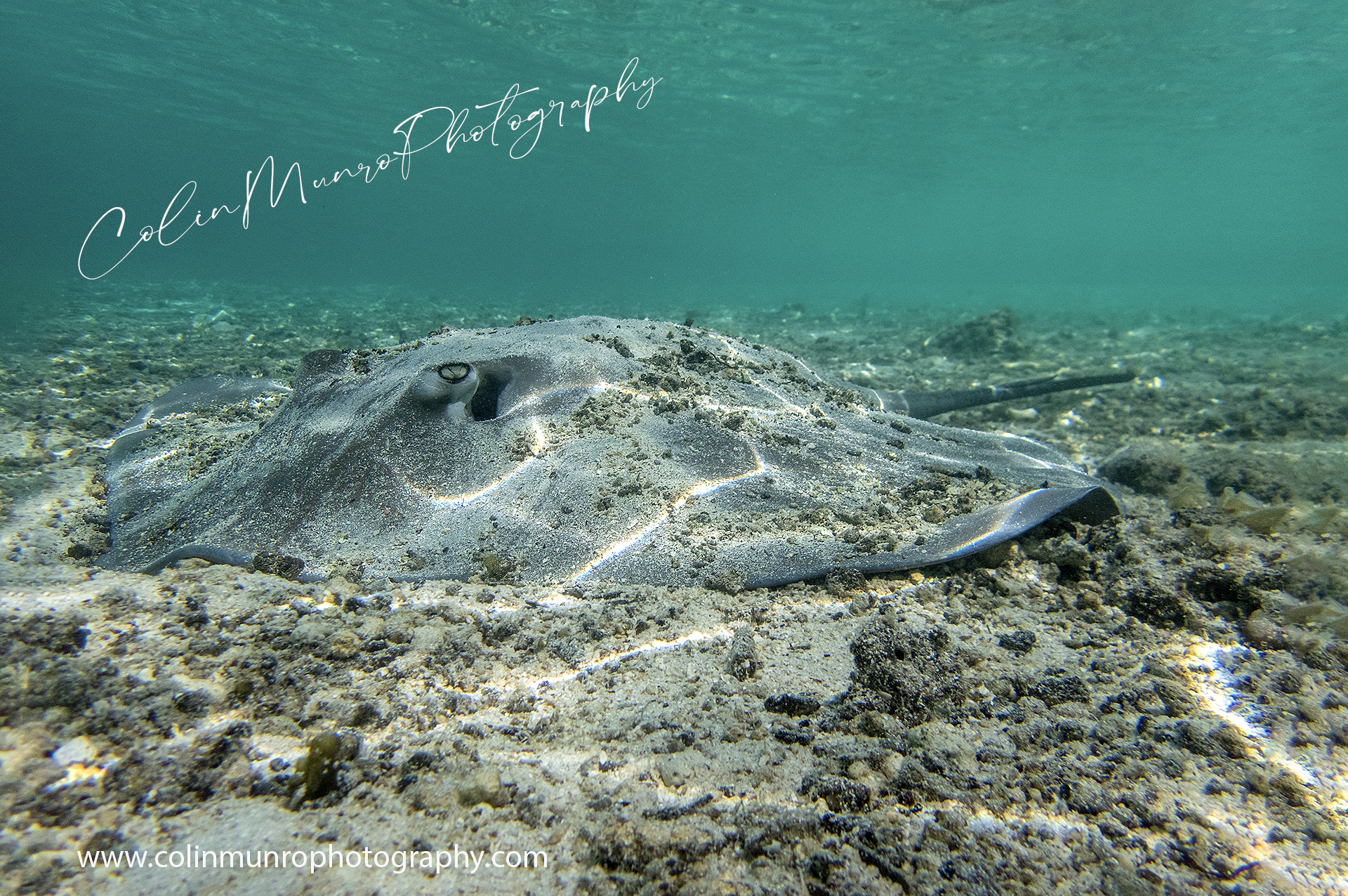
The Pink Whipray Pateobatis fai

The Pink Whipray Pateobatis fai

The Pink Whipray aka Tahitian Stingray Pateobatis fai (formerly Himantura fai).

A pink whipray (Pateobatis fai) lies quietly in shallow water, having previously thrown sediment up into the water column, allowing it to settle on its back to provide camouflage.

The pink whipray, aka Tahitian Stingray, is a large stingray, around a metre wing-tip to wing-tip, often found in shallow bays and lagoons. It’s preferred habitat appears to be sandy or sand and coral rubble seabeds. It occurs widely across the Indian Ocean and Western Pacific, from West Africa to Western Polynesia. Like all stingrays they do have a venomous barb near the end of their tail. The venom is not generally considered dangerous to humans, but it can be painful. Equally the barb is long and sharp, so is capable of inflicting a nasty wound. Pink whiprays are generally not at all aggressive, and so the risk is mostly if the animal feels threatened, thus chasing or cornering it is not a good idea. Sometimes they can be seen swimming with the tail raised almost vertical, possibly as a warning.

Pink whiprays feed mostly on crustaceans; crabs, prawns and shrimps; but will also take molluscs. In some locations they will gather in feeding groups in very shallow water (less than one metre). This has created a tourist attraction, especially in parts of French Polynesia.

This continues on my main website, where more information about pink whiprays, and more images, can be found. https://www.colinmunrophotography.com/pink-whipray-pateobatis-fai/

In you enjoyed this blog please consider subscribing. You can do this using the simple subscribe form

.

Fine Art Landscape and Wildlife Prints

Some of the framed canvas wrap prints on my website. You can also check out my fine art prints and posters.

Laos Stories

Laos Stories

I’ve recently returned from ten days in Laos, a truly fascinating and stunningly beautiful country. This is the first of what I hope will be a short series of blogs about Laos. One of the poorest in Southeast Asia, it is leapfrogging into the 21st Century in fits and starts. Laos has many things holding back its development. It has no coastline, so all trade must pass through its surrounding neighbours. The majority of the country is mountainous, still clad in dripping tropical forest, and much of the land has still to be cleared of cluster bombs and other unexploded ordinance (UXO), a deadly legacy of the USA’s ‘secret war’ between 1963 and 1974, when they dropped over 260 million bombs on Laos, making it the most bombed, per capita, country on the planet. Still, six decades later, people are killed or lose limbs every year through old UXO. Laos has some of the worst roads on the planet, but more modern high speed rail than the United States. Most transactions, from hotel booking to hiring an electric motorbike are still done in cash. With the low value of the Laos kip, the smallest banknote you can you can usefully carry is the 1000 kip note, which is worth about 5 cents (US) at the time of writing. Laos is the only country I know where I can become a multimillionaire after visiting an ATM in the morning, and have blown it all by mid-afternoon.

A farmer and her buffalo, near Luang Prabang, Central Laos.
Kam la and her buffalo

The lady pictured above is Kam la. She and her husband, Boon Tham, are farmers in Central Laos, a little outside the former capital of Luang Prabang. I passed them on my small hired motorbike as they were walking along the new highway that connects Central Laos to Northern Thailand, so I stopped to have a quick chat. Their buffalo had a sudden urge to go for a stroll early that morning. They had finally caught up with her almost at the shores of the Mekong and now faced an eight kilometre plod back home.

A small herd of domestic buffalo, Luang Parabang district, Laos.

Domestic water buffalo (Bubalis bubalis), aka domestic asian buffalo, are descendents of the wild water buffalo (Bubalus arnee) native to Indian and Southeast Asia. The domestic variety are still commonly used for meat, milk and ploughing rice fields. The wild variety is now pretty rare; the few remaining populations are small, widely scattered and most are in decline. habitat fragmentation is a significant cause of decline. Like so many other wild species with domesticated relatives, the junglefowl and domestic chickens, and Scottish wildcats and domestic cats being obvious examples, they are also suffering from inbreeding with their domestic counterparts. Domestic water buffalo are generally smaller than their wild counterparts, with proportionally shorter horns. Wild water buffalo have the largest horns of any known bovid. Unfortunately, despite the large areas of wilderness, no known populations of wild water buffalo exist in Laos.

In you enjoyed this blog please consider subscribing. You can do this using the simple subscribe form

I write these posts primarily because I enjoy doing so. They’re free to read, and if you enjoyed reading this one I hope you’ll continue to read them. I have no plans to paywall any of them. If you feel like you want to support my time input, well … I do like good coffee.

Fine Art Landscape and Wildlife Prints

Some of the framed canvas wrap prints on my website. You can also check out my fine art prints and posters.