Shutter speed control on digital cameras, what exactly does it do?

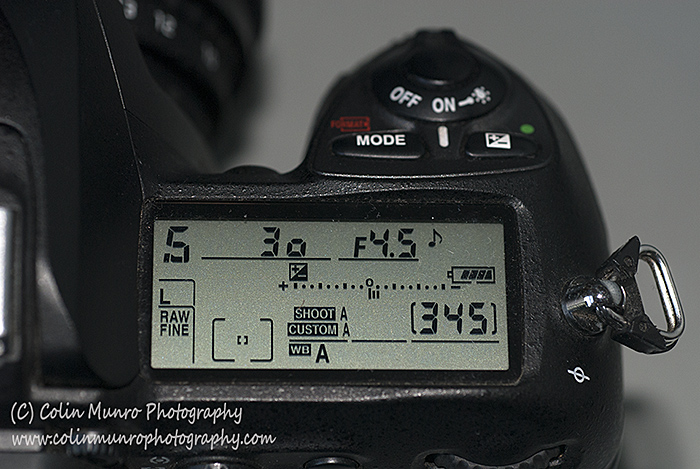
The LCD Display on a Digital SLR camera showing the shutter speed (here set to 1/30th of a second). This diplay may be on the top or back of the camera, depending on model. Colin Munro Photography

About a week ago I put up an article looking at looking at what the ISO control on a camera does, so it seems logical to cover the other camera controls that determine image exposure. So logically the place to start is with the first, most basic control, the shutter.  The shutter is basically light-proof barrier placed between the camera’s sensor (or film frame, if you’re old school) and the aperture through which light passes in to the camera.  But, and this is the key aspect, it is a barrier that can be opened for precise durations of time.  Now image exposure is determined by the amount of light hitting the sensor: too much light and the image is overexposed, too little and the image is underexposed, the correct amount and the image is just right (think of Goldilocks and the three bears).  So one way we can control the amount of light hitting the camera’s sensor is by controlling how long the shutter is open and light is allowed to pass through and reach the sensor, rather like controlling the flow of water in to a glass with a tap.

So what does a shutter look like?  various designs have been used over the years with different camera types and as cameras have evolved.  Digital SLR cameras (and film SLRs for that matter) use what is known as a focal plane shutter, that is a shutter placed directly in front of the flat area where the camera sensor (or film) is located.  These consist of a series of overlapping blades that lift and fall as the shutter opens and closes.  Compact, point and shoot, cameras generally do not have a mechanical shutter (as the focal plane shutter is) rather they have an electronic shutter.  Electronic shutters are an integral part of the camera sensor and primarily work by ‘turning off’  reading of the light hitting the sensor.

Focal plane shutter in a film SLR, showing mechanism.  Shutter CLOSED
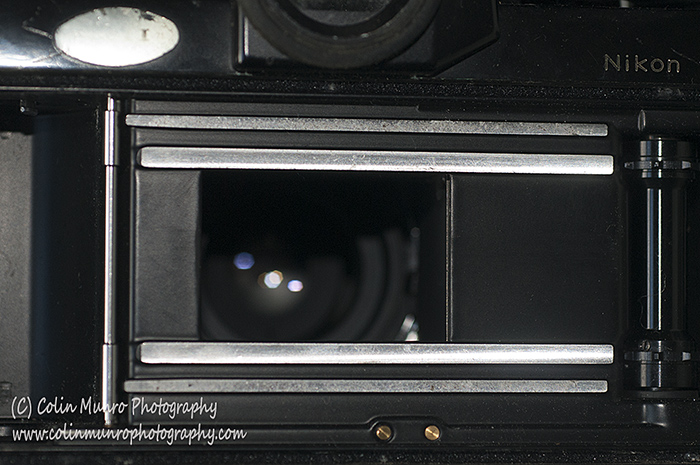
Focal plane shutter in a film SLR, showing mechanism. Shutter CLOSED

Focal Plane shutter mechanism in a film SLR. Shutter OPEN.

Focal Plane shutter mechanism in a film SLR. Shutter OPEN.

Shutter speed. When we talk about shutter speed that we are actually referring to is the duration the shutter is open and the sensor exposed to light.  In most general photography these durations are only fractions of a second and, despite the spread of decimalisation, we still tend to use common fraction rather than decimal fraction notation (e.g. 1/2, 1/4, 1/8, 1/15th of a second).   Setting the shutter speed on a camera serves two purposes: firstly it determines how much light hits the sensor, and secondly it freezes or blurs movement across the image.

Shutter speed control on a film SLR, showing standard shutter duration increments. Colin Munro Photography
Shutter speed control on a film SLR, showing standard shutter duration increments.

The LCD Display on a Digital SLR camera showing the shutter speed (here set to 1/30th of a second).  This diplay may be on the top or back of the camera, depending on model. Colin Munro Photography

The LCD Display on a Digital SLR camera showing the shutter speed (here set to 1/30th of a second). This diplay may be on the top or back of the camera, depending on model.

Motion blur. Not everything we photograph remains perfectly still. So, the duration the shutter is open will also influence how sharp a moving object is, or whether it is blurred due to it moving across the field of view whilst the shutter is open.  This can be a person, an animal, cars, flowing water etcetera.   Mostly we want our images nice and sharp, with objects frozen in time, but sometimes we will deliberately allow (our induce) motion blur for artistic reasons or to give the impression of movement.  A further consideration here is that motion blur comes not just from objects in front of the camera moving.  If we hand-hold a camera (as opposed to mounting on a tripod) there will always be a slight amount of ‘hand shake’.  At faster shutter speeds this is not noticeably in the captured image but with very slow shutter speeds the camera will wobble slightly in our hands whilst the shutter is open. This results in everything in the image being slightly burred.  A general rule of thumb is to shoot at 1/60th or faster when hand holding your camera, for non-moving objects when using a standard lens (i.e. not a telephoto lens).  When shooting using a telephoto lens, or shooting fast moving objects (maybe motor sports) you will need a significantly faster shutter speed to freeze motion, maybe 1/250th of a second or possibly up to 1/1000th of a second depending on factors such as the focal length of the lens, the speed the subject is moving at and how close you are to the moving subject.

Find me on Google+ Colin Munro

Like my page on Facebook
My main website Colin Munro Photography
Follow me on twitter @colinmunrophoto

ISO setting on digital cameras, what exactly does it do?

ISO setting on digital cameras, what exactly does it do?

This is part of an occasional series looking at the basic controls on a camera. It’s here primarily to supplement, and as a taster for, my beginners photography classes and one-to-one sessions. Some of the controls on a camera are fairly intuitive. Zoom, for example, controls the focal length of the lens and so the degree of magnification of the image (we zoom in, or we zoom out). Shutter speed controls the…er…speed of the shutter; well accurately it controls the duration the shutter is open, and so the amount of light allowed to pass through the shutter and impinge on the sensor, which in turn directly influences how bright or dark the image is. But ISO? Knowling that the acronym stands for International Organisation for Standardation doesn’t help that much either, and yes, I know it should be IOS not ISO (there are reasons but truthfully that would simply be too much of a digression to go there now, ask me after class :)). So if we simply accept that the name, ISO, tells us nothing about what the control actually does – then what does the ISO control on a camera do? Essentially the ISO setting works rather like the amplifier on a radio or CD player; it varies the signal gain to produce a brighter (for higher iSO values) or darker (for lower ISO values) without any changes in the amount of light hitting the sensor. Typically ISO values range from 100 (low) to 3,200 or 6,400 (high) on some cameras. These numbers are derived from film; with film cameras the film had a set sensitivity to light. Film that responeded quickly was termed fast film; film that responded slowly …. you’ve guessed already ..slow film. The film’s sensitivity could not be changed, so once it was loaded into the camera the ISO value of that film was then dialled in using the camera ISO control, allowing the film’s sensitivity to be taken in to account when exposure was evaluated by the camera’s light meter (or it would be dialled in to the meter if a hand held light meter was used). The ISO sensitivity in a digital camera is created very differently to in a film camera, but the same numerical values are used and they approximate closely to the changes in sensitivity to light that occurred in film. Essentially, the steps between each ‘standard’ ISO value represents a doubling or a halving in senstivity, depending on whether one goes up or down. So ISO 200 is twice as sensitive as ISO 100; ISO 400 is twice as senstive as ISO 200, and so on. What does this mean in practical terms? Well, if a particular scene was correctly exposed at a shutter speed of 15th of a second at ISO 100, then (all other settings remaining unchanged) the same scene would still be correctly exposed at 30th of a second at ISO 200 (a shorter time the sensor is exposed to light, but a more sensitive ISO value) it would also be correctly exposed at 60th of a second at ISO 400. Okay, so what would the correct ISO setting be if the shutter speed was changed to 500th of a second?
Hopefully this explains how the ISO values influence image exposure, but why do we want this control? Well there are a few situations where it is useful but the fundamental one is that a higher ISO allows us to use faster shutter speeds. If we go back to my first example, a shutter speed of 15th of a second at ISO 100. A 15th of a second is very slow and likely to produce a blurred image, a) due to the slight shakiness in everyone’s hands and b) as people (or animals, cars etc.) move. By selecting a higher ISO value we can then change to a faster shutter speed where these problems will be greatly reduced (for the sake of simplicity I have not considered aperture values and have assumed they remain unchanged).


Find me on Google+ Colin Munro
Like my page on Facebook
My main website Colin Munro Photography
Follow me on twitter @colinmunrophoto

Hallowe’en in Glen Nevis

River Nevis in spate, Glen Nevis, Scottish Highlands. Colin Munro Photography

Christmas is coming, and with this thought in mind I’ve produced a new range of fine art prints on canvas.

I spent this Hallowe’en in a small, backpacking two-man tent with my ten year old son, near the base of Ben Nevis.  It had been a wet and chilly day, with gale force winds howling across Rannoch Moor and through Glen Coe when we passed though earlier in the day.  As we sat in a pub restuarant in Fort William, thawing and drying out over large plates of chips, I gave him the choice of bailing.  We could stay in a hotel tonight if you like?  But no, we had planned to camp and camping was what he wanted to do.  I was pleased by his gumption (though part of me was thinking a warm, dry hotel wasn’t such a bad idea). So, by 8pm that evening we were tucked up in sleeping bags listening to the steady patter of rain on the tent walls whilst eating tinned curry by the weak candlelight emanating from a pumpkin lantern.

Tinned curry by candlelight. Hallowe'en in a two-man tent, on a very wet night in Glen Nevis. Colin Munro Photography

Tinned curry by candlelight. Hallowe’en in a two-man tent, on a very wet night in Glen Nevis.

Crawling out of our tent to face a sea of mud the following morning was a fairly grim affair.  However we managed to pack up with extraordinary speed and after a hot breakfast the World seemed a much better place.  The incessant rain had turned the River Nevis, impressive in ordinarly conditions, in to seething cauldron; much of the river was simply a thundering wall of white foam cascading down between the steep side of the Glen.  It would have been the perfect location for great photographs were it not for the incessant rain.  Each photo-opportunity had to be grabbed during the briefest intermission between downpours.  Even so, with everything thoroughly drenched it, lenses becoming fogged or coated with droplets, I was left with only a few useable images at the end of a long and chilly day.  Calum, on son, on the other hand stood up to the rigours admirably provided he was continually fed with chocolate.  We will certainly be back in 2014, and hopefully climbing Ben Nevis together – in the summer months!

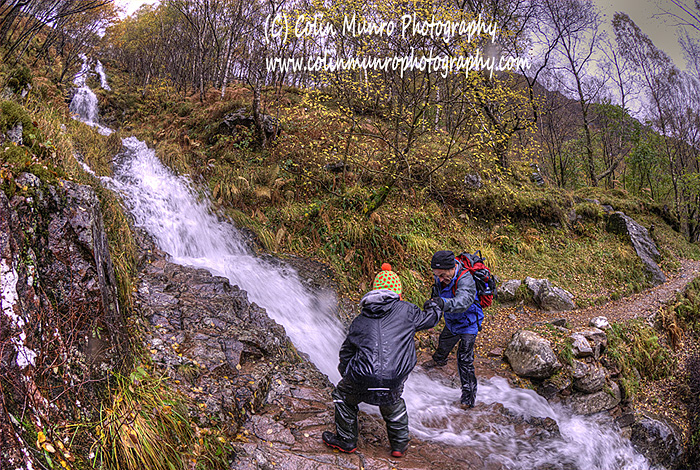
Helping Calum (or Calum helping me?) ford a mountain stream in Glen Nevis. Colin Munro Photography

Helping Calum (or Calum helping me?) ford a mountain stream in Glen Nevis

A self timer pic as we headed up the glen.

River Nevis in spate, Glen Nevis, Scottish Highlands. Colin Munro Photography

River Nevis in spate, Glen Nevis, Scottish Highlands. Image MBI001493.

Signed canvas prints

You can buy signed, made to order, canvas wrap framed prints of this image directly from me here by selecting the print size you want using the Paypal drop down menu below and clicking the Buy it Now button.  Please note that sizes are approximate; postage costs apply to mainland UK only.  If you live further afield please email me directly to get costs, or you can buy through my Esty store (below).

Canvas Print Sizes


Buy signed canvas prints, signed photographs ready to frame and gift tokens for my photography and Photoshop sessions through my Etsy Store.

Find me on Google+ Colin Munro
Like my page on Facebook
My main website Colin Munro Photography

The Three Sisters, Bidean nam Bian mountain range, Glen Coe.

The Three Sisters of Glen Coe, Glen Coe, Highlands, Scotland. Colin Munro Photography
The Three Sisters of Glen Coe, Glen Coe, Highlands, Scotland.  Colin Munro Photography

The Three Sisters of Glen Coe, Glen Coe, Highlands, Scotland.

The Three Sisters, Glencoe, Scotland.

The Three sisters are three steep-sided ridges forming part of the mountain complex Bidean nam Bian along southern side of Glen Coe.  These ridges are Gearr Aonach (Short Ridge), Aonach Dubh (Black Ridge) and Beinn Fhada (Long Hill).  The summit of Bidean nam Bian lies at 1150m (3773ft) making it the highest mountain in the former county of Argyll (regional boundary changes in recent years means Argyll no lnger exists as a county).  Bidean nam Bian is popular with walkers and Munro-baggers (Munros are Scottish mountains over 3000ft) summer and winter. The most popular route passes down through the col (low gap between two peaks) between Bidean nam Bian and Stob Coire Sgreamhach, more commonly known as the hidden valley or lost valley.  The name derives from it’s reputation as a hiding place for rustled cattle taken by the Clan Macdonald in earlier times and the fact that the valley is all but hidden from view until one is in it.

Glen Coe is an awe inspiring landscape of looming mountains, the soul of which is most clearly seen on darky and stormy days.  It is sometimes known as the ‘Glen of Weeping’ in reference to the Massacre of Glen Coe in  February 1692 when Thirty-eight men of the Clan MacDonald were killed in the night by soldiers from the Earl of Argyll’s Regiment of Foot who they had accepted in as guests.  Many more died of exposure on the hills as their homes had been burnt down.  The soldier in command of the Foot Regiment was Captain Robert Campbell of GlenLyon; this fact, allied to an existing history of feuding between the Campells and MacDonalds and attempts by the Government of the time to deflect blame and have this seen as no more than inter-clan feuding.  The orders for the massarce were in fact signed by King William II (King Willaim III or England).

The dramatic scenery of Glen Coe has formed the backdrop for many big budget films; these include Highlander, Rob Roy, Braveheart and, more recently, Harry Potter and the Prisoner of Azkaban. In the summer of 2003 vistors to the glen occasionally stumbled across Hadrig’s hut nestly behind the Clachaig Inn.

The picture.  I took this image at 16:45 on the 31st of October 2013 (Hallowe’en).  I was on a brief walking and camping trip with my ten year old son during school half term.  It was a wild day; storm force winds were battering the west coast.  The wind was literally howling down through the glen driving needles of rain before it and forcing me to keep one hand on my camera tripod at all times lest it was blown over.  At 15 minutes to 5pm the sun had just set, though this was not obvious through the thick black cloud overhead, but an already gloomy day was darkening rapidly.  As light was disappearing I dispensed with the polarising filter I had been using earlier but kept the gradient nuetral density filter.  The image is a composite of three seperate exposures, ranging from a 1/60th to a 1/15th of a second duration, to capture detail in both the dark mountain shadows and the clouds overhead.  Between each exposure rain droplets had to be carefully dried off the filter in front of the camera lens and the entire camera covered by my jacket (taking care not to accidentally jostle the camera or tripod) until the next brief gap between squalls allowed another image to be taken.

Find me on Google+ Colin Munro

Like my page on Facebook
My main website Colin Munro Photography

The rules of landscape photography: The Golden Hour

Sunset creating a dramatic sky of pinks, purples and orange hues. Colin Munro Photography

The rules of landscape photography.  That’s a fairly ambitious title huh?  Maybe I’ll backtrack a little. As with all photography there are no absolute rules.  There are only guiding principles; and like all guiding principles they are there to be broken  – once you understand them and have a clear understanding of the effect you are trying to acheive by breaking them.  But I’m getting ahead of myself here…. let’s get but to the rules ..er.. guiding principles.

The Golden Hour.

Just to make life that little bit more confusing, the Golden Hour is actually two hours each day.  It’s generally considered to be the first hour after dawn and the last hour before sunset.  At these times, when the sun is near the horizon, the light we see travels almost parallel to the land. This creates longer shadows, adding a more pronounced three-dimensional look to our images.  It also mean that the light passes through more air before it reaches us, scattering more blue light and creating a warmer more reddish hue.  i confess I am addicted to working during the Golden Hour(s).  In summer this means getting up at stupid times in the morning to be on location as the sun rises; in winter you get to stay in bed later but often have to brave sub-zero temperates.  But if conditions are right, the images are well worth it.

Low winter sun and breaking waves on Dawlish Warren beach, Exe Estuary, South Devon, UK. Colin Munro Photography www.colinmunrophotography.com

The Golden Hour can be very golden indeed. Late afternnon in early December.


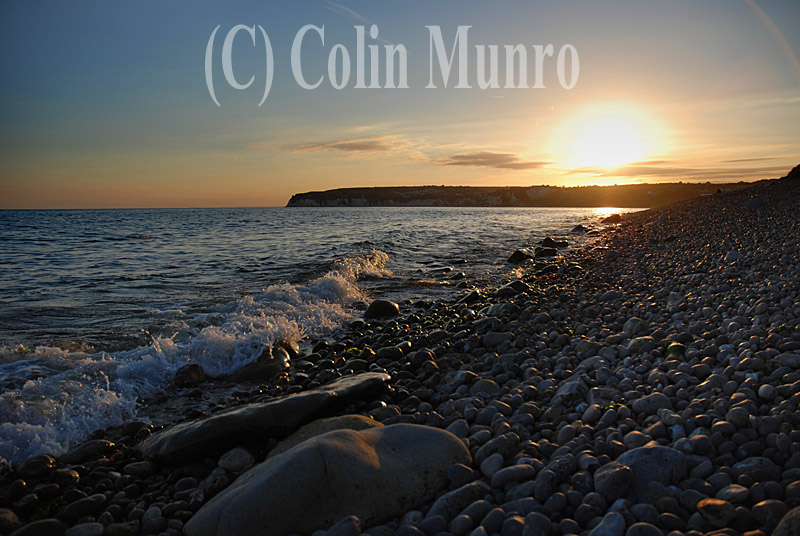
By creating shadows and so releif, the low lighting that occurs during the Golden Hour enhances the three dimensional appearance of features such as pebble beaches.  Sunset, Axmouth pebble beach, beneath Haven Cliff.

By creating shadows and so releif, the low lighting that occurs during the Golden Hour enhances the three dimensional appearance of features such as pebble beaches. Sunset, Axmouth pebble beach, beneath Haven Cliff.

generally we want the sun coming in from the front-side of the image, creating shadows on the photographer side of the image.  If we place the sun closer to the centre of the image we create silhouettes, which can be interesting, but run the danger of large amounts of flare in the image.  One pleasing effect that can be created by shooting towards the sun is backlighting peaple or objects, creating a rim light around their edges.  Often with people this in the sun catching the hair of the person (in the similar way to the way a ‘hair light’ works in studio photography).  The image below, with the silhouette of a young boy (my son actually) juggling on the beach near sunset helps illustrate these effects.  The silhouetted girl below that shows how backlighting can be used to light features such as long hair.

A backlit image with the sun almost directly central in the image, creating silhouettes.  The low lighting picks out the texture of the sand clearly. Colin Munro Photography

A backlit image with the sun almost directly central in the image, creating silhouettes. The low lighting picks out the texture of the sand clearly.

Of course it doesn’t have to be people that are backlit.  A nice effect can equally be creating with animals as the subject, such as this highland cow I photographed in Perthshire on a summer evening.

A highland cow in semi-silhouette, backlit by the setting sun. Colin Munro Photography

A highland cow in semi-silhouette, backlit by the setting sun.


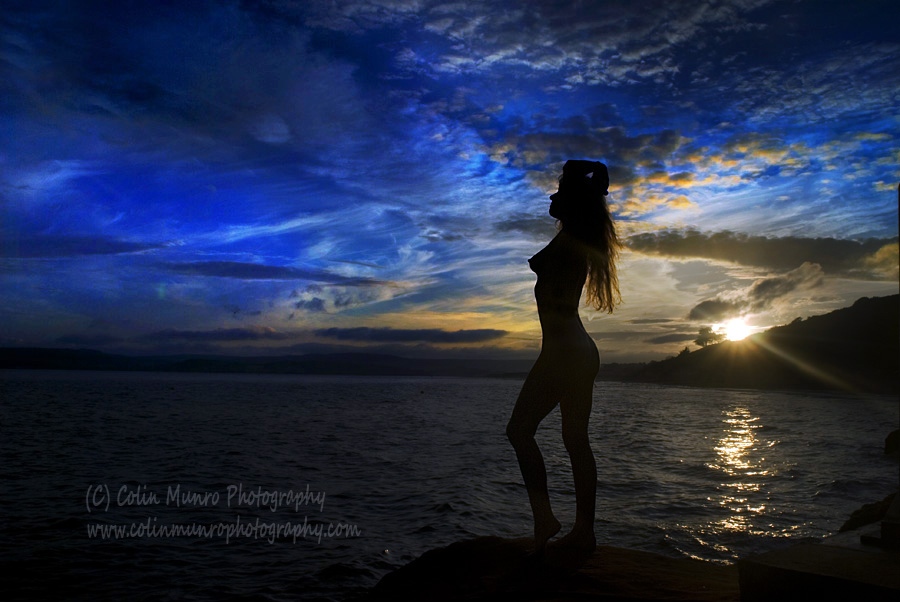
A girl silhouetted by the setting sun.  The backlighting from the sun catches on the edges of her hair, creating a pleasing backlighting. Colin Munro Photography

A girl silhouetted by the setting sun. The backlighting from the sun catches on the edges of her hair, creating a pleasing backlighting.

The other thing worth noting is that just after sunrise, or just before sunset, often produces the most dramatic skies.  Clouds are etched in stark relief due to the low light, and are often painted in varying shades from delicate pinks to blood reds.


Sunset creating a dramatic sky of pinks, purples and orange hues. Colin Munro Photography

Sunset creating a dramatic sky of pinks, purples and orange hues.

Find me on Google+ Colin Munro

Like my page on Facebook
My main website Colin Munro Photography
Follow me on twitter @colinmunrophoto
Light and shadow

tara in light and shadow Colin Munro Photography www.colinmunrophotography.com

As a rule I don’t do standard portraits.  It’s not that I have strong feelings against them, they have there place of course.  It’s simply that they don’t interest me greatly.  I have always preferred working with light and shadow.  It’s about creating shapes and outlines, creating a certain atmosphere.  This applies also to many of my landscape images but is particularly true of images of people.  Simply put, images where the eye cannot see everything, and one must deduce what is there from a certain shape or pattern of light, are much more interesting to me.

with landscapes I am particularly drawn to combining colour and shadow; or maybe I am drawn to sunrises and sunsets, which naturally means colour and shadow.  We often think the quality of light is the same whether it is dawn of sunset.  It is not. At dawn the air is much cooler and generally less dust laden.

Sunrise over the Navua River, Viti Levu, Fiji. Colin Munro Photography www.colinmunrophotography.com

Sunrise over the Navua River, Viti Levu, Fiji

This tends to produce more subtle colours, such as the pastel shades of sky and cloud in the above images from dawn in Fiji. The intense blood reds skies are more likely to occur at sunset, as blue light is scattered when the low sun’s rays pass through hot dusty air.


Pirogue fishermen at senset, Senegal, West Africa. Colin Munro Photography. www.colinmunrophotography.com

Pirogue fishermen at senset, Senegal, West Africa.

But it is the human face, and the human figure, where light and shadow are most compelling.  The curves, angles and textures that we all recognise so well are most strikingly captured in stark black and white, like pen and ink drawings.

The grace and elegance of a dancer, the beauty of youth, the lined and weathered face of experience are all best painted by selective shafts of light.  Photography is often considered to be painting with light; this is only half true for it is also the selective absence of light that differentiates an artistic portrayal from a passport photograph.

Find my stock images on my ColinMunroImages website

Find me and more of my images on Facebook

Colin Munro

Split image (above and below the surface) shots of swimmers

Over under shot of a girl in a blue patterned bikini swimming front crawl in an outdoor pool. The shot is half above and half below the waterline and uses a combination of monochrome, reduced colour saturation and selective colour. Image copyright Colin Munro Photography

I’ve been taking a few split image shots recently, where the image recorded is partly above and partly below the waters’ surface.  These are sometimes termed over under shots, sometimes half anfd half shots.

Over under shot of a girl in a blue patterned bikini swimming front crawl in an outdoor pool.  The shot is half above and half below the waterline and uses a combination of monochrome, reduced colour saturation and selective colour. Image copyright Colin Munro Photography

Over under shot of a girl in a blue patterned bikini swimming front crawl in an outdoor pool. The shot is half above and half below the waterline.

The technique can be quite challenging when working with fast moving subjects. To ensure crisp images the subject must be very close to the camera, in the above case the girl’s hand was around 10-20cm in front of the camera dome port at the time of the shot.

Over under shot of a girl in a blue patterned bikini swimming front crawl in an outdoor pool. Colin Munro Photography

Over under shot of a girl in a blue patterned bikini swimming front crawl in an outdoor pool.

Keeping the port clear of large water droplets often involves dipping the entire camera housing below the surface, then raising it at the last moment thus ensuring the image is recorded before droplets can form. Needless to say this normally involves a lot of luck and a LOT of takes to get the right image. However, when it works well the effect can be quite dramatic. I will be making this image, and some others, available as fine art prints.  They can be printed on a range of art media, canvas or 300gsm art paper, up to 24 inches across.  So if you are interested in a print for your studio, office, fitness centre or lounge, please get in touch with your requirements and I’ll get back to you with a quote.

You can contact me directly email me

More women and water images on my http://colinmunro.photoshelter.com site.
More split images (above and below) on my photoshelter site here.
find me on Google+ Colin Munro

Photographing Blue sharks off Cornwall

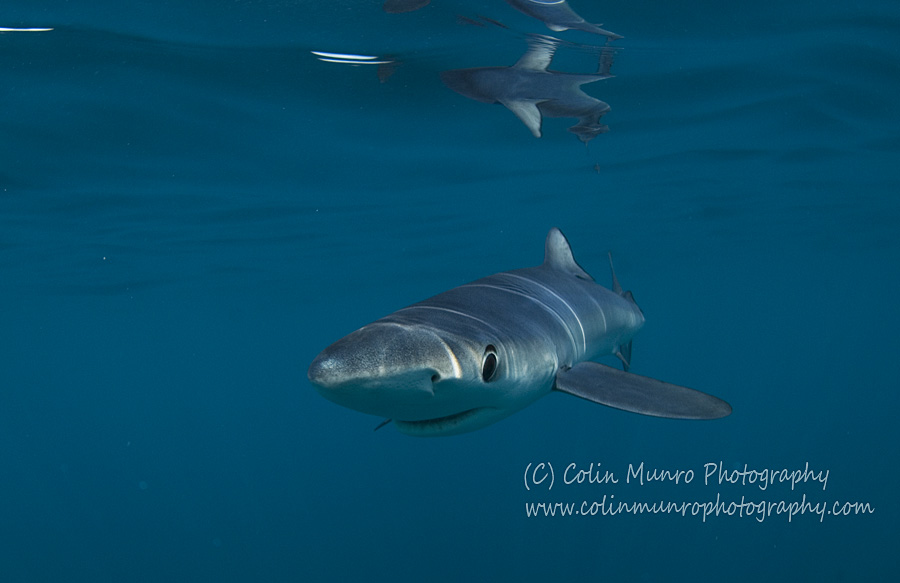
Blue shark, Prionace glauca. A female blue shark swimming close to the surface off Southwest Cornwall, UK.

A few days ago I was fortunate enough to get in to the water off Cornwall with a couple of blue sharks (Prionace glauca).  Getting some good images of blues had been high on my ‘to do’ list for several years, but for one reason or another it had not happened. In part this was a result of the dreadful summers we have had in the UK for the past few years; wet and windy and severely limiting the number of days when it was possible to spend all day offshore in a small boat (and limiting even more the number of days one would want to). This summer has so far been perfect, high temperates and light winds.

Blue shark, Prionace glauca.  A female blue shark swimming close to the surface off Southwest Cornwall, UK.

Blue sharks are highly migratory, with strong evidence for there being a single well-mixed population within the Atlantic Ocean and seasonal trans-Atlantic migration.  Some studies indicate a crosswise annual migration across the temperate zone of the Atlantic but evidence for this is inconclusive.  What we do know is that blue sharks start to appear off the tip of Cornwall in early July and remain around Southwest England until late September.

Blue shark, Prionace glauca.  A female blue shark swimming close to the surface off Southwest Cornwall, UK.

Off the tip of Cornwall is one of the best areas to see blues; it also has the advantage of exceptionally clear water.  Most are found at least five miles offshore, so with the longish drive an early start was required.  By 10a.m. we were drifting with the current, a nice fish oil slick trailing from our chum bag, cameras ready and waiting.  The sky was blue, the sun hot, the sea ruffled by a light breeze and our spirits were high.  And we waited.  Mid-afternoon a brief flurry of excitement: two sharks arrived within the space of an hour, grabbed our mackerel bait….. and disappeared.  By 4.30pm our hopes were fading and our thoughts turning to when we could schedule the next trip.  Suddenly at 4.45pm a third shark arrived.  A smallish female, probably around 5ft, but most importantly she showed none of the skittishness of the previous two. She was interested in the fishy smell from our chum bag and she was hanging around.  It took a real effort of will to stay calm, remain on the boat and allow her time to settle – what if she also suddenly disappeared?  However, after a few minutes Charles, the boat skipper, gave us the nod and Richie and I slipped gently and quietly in to the water.  As we swum towards her she showed no fear at all, appearing quite curious about us, to the extent that she temporarily lost interest in the chum bag and began cicling us as we drifted slowly from the boat.  Time and again we would swing around to make close passes, to the extent that she occasionally had to be gently pushed away as she came nose to nose.  A more obliging photographic model I could not have wished for.  Around 20 minutes passed in a flash, at which point she became bored with us and disappeared.  Yet no sooner had we climbed back in to the boat than a larger female arrived.  She definately wasn’t timid; before anyone could react she had grabbed the chum bag and was tearing it to pieces.  Within seconds the water around the boat was a murky brown from the contents of the chum bag and the bag itself shredded.

This was too good an opportunity to miss, all four of us hit the water.  She was a real beauty.  Between 6 and 7 ft long, the most dazzling vivid blue on her dorsal surface with deep indigo patches near her dorsal fin, pure white on her underside.  As she passed close the mating scars left by the males teeth could be clearly seen on her head neck and back.  For more than 30 minutes she hung around. circling us.  It was almost 6pm when we finally climbed out of the water.  Tired but very happy.

passing under a snorkeller

Our trip was on board the RIB of Charles Hood (charleshoodphotography.com).  Charles regularly runs basking shark and blue shark trips from Penzance, Cornwall.  I would heartily recommend him.

All my blue shark photographs are available for licence and some as fine art prints along with all my other stock images at http://colinmunro.photoshelter.com. Or you can contact me directly email me

Signed canvas prints and photographs of my work can be bought through my Etsy Store

find me on Google+ Colin Munro

Tony Garnett, Cathy Come Home and British Film Institute talk

Tony Garnett, Cathy Come Home and British Film Institute talk

Should anyone be in London tomorrow with time on their hands tomorrow evening, I’d recommend a trip to the British Film Institute Southbank.   Film and Television producer Tony Garnett will be discussing his work.  For those unfamiliar, this includes such ground-breaking dramas as Cathy come home, the Play for Today television production that lead to debates in Parliament and the setting up of Crisis, Kes, Cardiac Arrest and This life.

I was nine when Cathy come home was first broadcast.  A quarter of the UK’s population watched it (a play; a social commentary, one cannot imagine such a thing happening now) including our household.  Despite my youth it was simply electrifying.  Shot on hand held 16mm cameras, mostly on location and often using members of the public, a naturalistic style that typifies director Ken Loach’s films.  I year or so back I bought the DVD of Cathy come home.  At first I was reluctant to watch it, fearing that the passage of time and the antiquated technology used to shoot and record it would deaden the impact.  I was wrong.  It is still electrifying 46 years on.  Not only that, it would be surprising for such an overtly political play to be allowed on a mainstream tv channel today; one only has to look at the way political documentary makers such as John Pilger, long broadcast on British television, are now independently producing documentaries for cinema and web broadcast instead.  Up the junction is another of Tony Garnett and Ken Loach’s controversial collaborations likely to be discussed, this one dealing with back street abortions.  Later made in to a film, it was Garnett and Loach’s television play that was the inspiration behind Chris Difford’s lyrics for the Squeeze song of the same name.  If you haven’t yet seen Cathy come home, check it out at Ken Loach’s YouTube channel.  

http://www.youtube.com/user/KenLoachFilms

We live in an age where the technology rather than the content is given pre-eminence.  One only has to spend a short time online looking at blogs or Facebook to see the myriad images and comments posted praising or decrying the latest iPhone/Nikon/Canon quadzillion pixel camera/smartphone with apps for everything from when you should take a picture of your cat to how many images of your cat you should force others to look at.  Like the images of Salgado, Nick Ut and Thessiger, these dramas clearly demonstrate the converse is true; it is the content not the camera.

 Footnote:  It is said that the final scene in Cathy come home was shot on location, London Underground, as her baby was forcibly taken from the arms of a screening Cathy by the authorities, unsuspecting members of the public  formed the background.  No-one intervened.  I guess little has changed.

Sunset corals

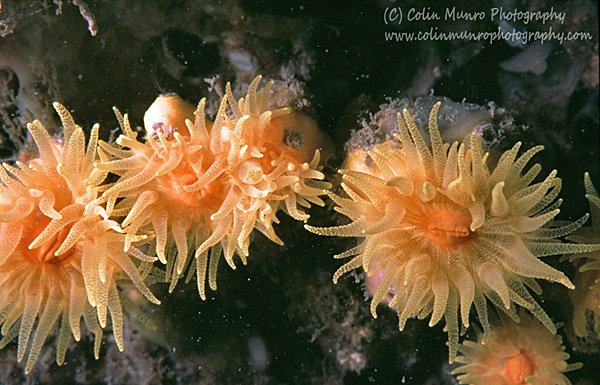
Leptopsammia prouviti, growing on undercut limestone ledges, Lyme Bay, Southwest England. colin munro photography

Sunset corals (Leptopsammia pruvoti), a little natural history.

Leptopsammia prouviti, growing on undercut limestone ledges, Lyme Bay, Southwest England. colin munro photography

Leptopsammia prouviti, growing on undercut limestone ledges, Lyme Bay, Southwest England.

For most, the word coral conjures up images of living reefs surrounded by shoals of colourful fish, in clear, brightly lit tropical waters.  Whilst this is the type of environment where the vast majority of coral species are found, it is not the exclusive habitat.  That corals are found in the chilly and turbid seas around Britain would probably surprise most of theBritish public.  In fact there are five known species of coral found in shallow waters around the UK.  The two best known species are the Devonshire cup coral, Caryophyllia smithii, and the sunset coral, Leptopsammia pruvoti.  Like all our shallow water corals they are solitary corals (apart from the Weymouth carpet coral, Hoplangia durotrix, which forms small clusters of polyps growing from a basal plate).  They don’t form large, colonial skeletons and hence don’t form reefs.The Devonshire cup coral is familiar to many divers and may even be found intertidally in shady overhangs at the very bottom of the tide.

Leptopsammia pruvoti is rather more enigmatic.  It is known to occur in only a handful of locations around Southwest Britain (The Scilly Isles, Lundy Island, Plymouth Sound, Lyme Bay and Portland Bill) though it is more widely distributed along the Atlantic coast of southern Europe and in the Mediterranean.  Leptopsammia pruvoti belongs to the taxonmic family Dendrophylliidae, a sub-group of corals.  An interesting feature of nearly all (around 91%) Dendrophylliidae corals is that they lack symbiotic zooxanthellae (technically speaking they are azooxanthellate).  At this point you may be asking ‘so why is that a big deal … and what exactly are symbiotic zooxanthellae anyway?’.  A common feature of most reef building corals (hermatypic corals) is the presence of tiny unicellular algae, termed zooxanthellae, living  within their tissues.  This is a symbiotic relationship; Zooxanthellae gain protection and some nuitrients from the coral whilst the coral gets glucose, glycerol and amino acids from the unicellular algae.  One of the key benefits for the coral is that this facilitates the production of large amounts of calcium carbonate, the material from which coral skeletons are formed.  Thus the calcuim carbonate based, skeleton-forming process in corals containing zoozanthellae is ‘turbo-charged’; they are able to produce skeletal material at a greater rate and so can grow to form large, colonial skeletons that meld together and form reefs.  Azooxanthellate corals do not have this advantage, but their lack of dependence on photosynthesising algae frees them to expand beyond the brightly-lit surface waters. Azooxanthellate corals in the family Dendrophylliidae can be found from a few metres depth down to over two thousand metres.  This takes them deep into the aphotic zone, the parts of the ocean completely devoid of light (roughly, below 1000 metres).  It also allows them to colonies niches that are out of direct sunlight, such as caves (e.g. the recently discovered coral Leptoseris troglodyta, troglodyte= ‘cave dweller’, found around Indonesia and the Philippines) or the rock overhangs of Lyme Bay.

You can contact me directly email me
Find me on Google+ Colin Munro