
This blog has now moved to my marine biology site. It can be read at


This post follows on from Lyme Bay Closed Area, a Marine Protected Area success? Part 1, which described the damage first noted on rocky reefs in Lyme bay, Southwest England, from scallop dredging during the 1990s. This post describes the voluntary agreements set up and the ongoing problems.
As described in Part 1, the condition of the reefs in Lyme Bay had begun to deteriorate markedly by the early 1990s, and this deterioration continued more or less unchecked over the next 12 or 13 years. It would however, be wrong to suggest that all reefs were suffering equally or that nothing was happening to change this situation. Some reefs were simply too rugged for any sort of mobile fishing gear to ever be towed across them, however even they suffered from degradation around the edges. Others that were more easily worked were devastated.
The Devon Wildlife Trust had been working hard with local fishermen since the early 1990s, and voluntary agreements had been set up voluntary agreements whereby trawlers and scallop dredgers would not work in the most fragile reef habitats. The first such agreement extended voluntary protection to two reefs (known locally as Lane’s Ground, a boulder reef rich in sponges, and The Saw-Tooth Ledges, a series of limestone ledges supporting abundant seafans, soft corals and sponges). Two additional reefs were added to this agreement in 2006, The East Tennants Reef, a boulder reef supporting high densities of large seafans, and Beer Home Ground, a reef of ledges and rocky promentories composed of softer mudtstone and sandstone amongst harder limestone that had suffered quite badly from reef erosion through the action of scallop dredges. However problems remained. The first was that however sincere most local fishermen were, there was always the problem that some from further afield would see no need to abide by this agreement and, it has to be said, not all local fishermen agreed with the closure. It only took one vessel operating within the voluntary closures, maybe late at night or early morning when they were unlikley to be spotted, to cause damage that would last for years. The second problem was that the four voluntary areas were small and in no way enclosed all of even the most vulnerable reefs. An example of this is the West Tennants Reef. This is an very extensive reef in Lyme Bay terms. It is a low limestone ledge, or series of ledges, that runs parallel to the shore, about 4 miles offshore and roughly 29 metres below sea level. Although only around 10-30 metres wide over much of its length, it runs east-west for over two miles. The ledge is fairly level and free of rocky protrusions, and drops less than a metre to the surrounding seabed, thus it was very easily worked from the top of the ledge, dredges running along, parallel to the edge before eventually dropping of the edge. Strong currents sweep along this ledge, and in the early 1990s a dense band of very large seafans grew along this ledge, along with significant numbers of large axinellid sponges.

Large Axinellid sponge (Axinella dissimilis) and seafans. Most of the West Tennants Reef used to look like this.
The band was not wide, perhaps no more than 8-10 metres across, but extended for nearly two miles East-West. Although the East Tennants Reef nearby had higher densities of seafans but, simply due to its size, the west Tennants Reef supported more large seafans than any other reef in Lyme Bay. Indeed it was one of the most extensive continuous beds of large seafans in UK waters. Unfortunately, by 2007 most of these large seafans (and large sponges) had gone. As part of a wider study, I conducted a remote video survey along the reef in the summer of 2007. Instead of a dense continuous bed of seafans we found isolated patches and extensive areas of bare reef. We also saw many recently detached large seafans lying flat on the seabed and scallop dredgers working nearby. We returned a couple of days later to dive the reef and capture some better video. This can be seen here: West Tennants Reef, 2007.
It was clear that the situation in Lyme bay was continuing to deteriorate. Fortunately major changes to rectify this were also happening. Following a lengthy consultation process, with proposals submitted by the Natural England, Conservation NGOs (in particular the Wildlife Trusts) and the fishing industry, DEFRA announced that an area of some 60 square nautical miles in the central part of Lyme Bay was to be closed to mobile fishing gear by Statutory Order. There have undoubtedly been a few vessels that continued to work inside the closed area at night, especially during the first couple of years. However it’s fair to say that by and large this has been a success, in terms of maintaining an area free from the impacts of mobile bottom fishing gear. So how has that been reflected in changes, or recovery, of the fauna of the reefs within the closed area. In order to assess this two parallel studies were set up, one by Plymouth University using remote video, and one conducted by ourselves (that is my consultancy Marine Bio-images) with divers recording life at fixed stations. Data was collected over three summers; 2008, 2009 and 2010, and the findings of these studies have now been analysed and are about to be published. The next part of this blog will look in more detail at what we found and what seems to have changed since the closed area was established.
Update 10th July 2012, New blog: Lyme Bay, what makes it special?
All images and text (C) Colin Munro Photography.
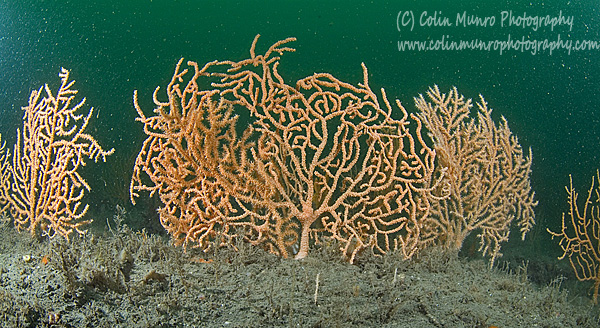
Dense beds of mature pink seafans (Eunicella verrucosa), some almost a metre across, growing on pristine reef in Lyme Bay.
In 2008, the UK Government Department for Environment, Food and Rural Affairs (DEFRA) closed an area of Lyme Bay, some 60 square miles in extent, roughly 10 per cent of the bay, to mobile benthic fishing gear. By mobile benthic fishing gear I mean gear that is towed across the seabed, i.e. bottom fishing trawl nets and scallop dredges. This closure was brought in to protect fragile seabed habitats and the associated marine life, in particular the subtidal rocky reefs and boulder and cobble reefs, known to occur in the central and eastern part of the bay. We’ve known for a long time, at least the late 1980s, that such heavy gear could be highly destructive to some reef species, especially fragile or soft tissued attached species such as sponges and soft corals. Of greatest concern was the increase in scallop dredging. Changes in the quota system, markets and fish prices had lead to the number of boats working with scallop dredges increasing dramatically in the late 1980s. The number of boats operating solely as scallop dredgers had also increased (vessels will often switch gear thoughout the year as fish species migrate and quotas change); thus the overall intensity of scalloping had rocketed. As far back as 1991, I conducted dive surveys for the Devon Wildlife Trust; we had heard reports from recreational divers of swathes of destruction on previously pristine reef areas. What we found was even more disturbing, not only were areas of reef being scraped clean of attached life, the very stucture of the reef was changing.
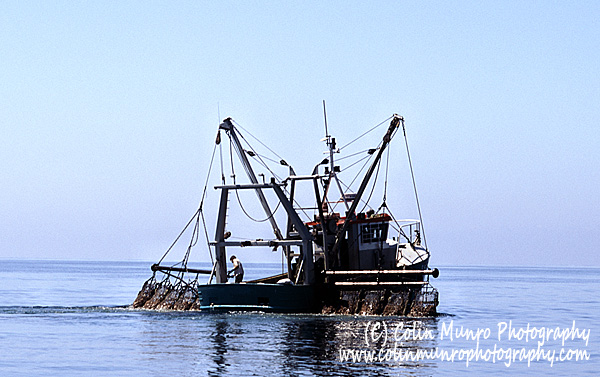
Scallop dredger in Lyme Bay. A scallop dredger hauling dredges (4 each side) to emtpy catch.
Amongst the more interesting reef areas in Lyme Bay are the boulder and cobble reefs and the mudstone ledge reefs. Boulder and cobble reefs are basically level boulder fields, most of the boulders are small, roughly football-sized and so the heavy scallop dredges can bounce and rattle across these boulders without getting damaged themselves, picking up the occasional scallop as they go. What also happens though is that the boulders are lifted out of the sediment, rolled along and banged together. As this happens the sponges and soft corals growing on the boulders are ripped off or ground to shreds. The steel teeth of the dredges rake into the sediment as the dredge travels, stirring up clouds of sediment which then subsequently settles on top of the boulders. The attached species that managed to survive intact are then smothered in a layer of sediment, blocking their delicate filter-feeding organs.
Mudstone reefs are composed of blue lias clay. This is the same hard, slate-like clay that can be seen in the fossil-rich cliffs that line much of the coast of Lyme Bay. As this clay can easily be shattered by a fossil hunters hammer, the effects of half a ton of toothed dredges being hauled across such ledges by a powerful fishing boat are quite devastating. The ledges simply crumble. Now as any good marine biologist knows, most of the larger attached fauna on reefs are filter feeding organisms – sponges, hydroids, soft corals, bryozoans etc., and as every hydrographer (and diver) knows, currents accelerate around the edges of ledges and promentories due to entrainment. So of course all the life clusters around the edges of ledges where the rich feeding currents are. Grind away the edges and you remove maybe 80% of the attached fauna and – most importantly – virtually all the large colonies. The large colonies are the structure-forming ones that provide new niches for other species, they are often the slow-growing species that can take years to re-establish (where possible), and they are also the ones with the largest reproductive potential: for example, a big seafan colony that’s maybe 15 or 20 years old is going to release many time more eggs or larvae than a little one about 5 years old thats only just reached reporductive maturity. So when the big colonies are removed this alone may drastically affect the ability of a species to maintain or re-establish its population in an area.
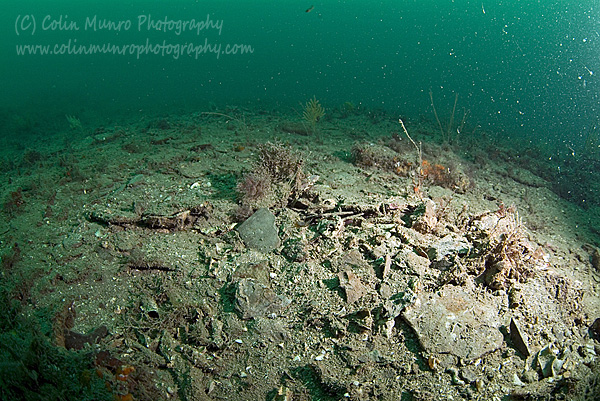
Reef badly damaged by scallop dredgers
So to put it mildly, the situation was not good, and was rapidly deteriorating. It only took one boat working across a reef to remove so much life that it would take years for recovery to occur. Six months of boats intensively working an area could (and did) irreversably change the structure of some reefs. As scallop stocks declined on the so-called ‘clean ground’ (areas of sandy seabed) boast began to work closer to the edges of reefs, nibbling away at the edges. Fish finders and echo sounders improved in quality, so skippers could see exactly which way ledges rose up, enabling them to work close around the most rugged ledges and pinnacles. DECCA became standard for position fixing, then was replaced by GPS, allowing every more accurate positioning of where the roughest points to be avoided were, so boats could work into reefs where previously they dare not enter. The power of vessels also increased, so when dredges did become stuck fast on a rocky ledge or large boulder the solution was often to turn on the power and pull free, often with devastating consequences for the reef. I personally witnessed this many times over the years. Boats would dredge right up the the edge of a reef, gradually extending further and further in to it through the day as the edges were ground down or boulders rolled away. Occasionally a dredger would come fast. You could see it stop dead in the water and list over to one side where the dredges on that side were caught. Watching from a couple of hundred metres away you would hear the engine rev, see the vessel sink deeper on the caught side, then suddenly lurch free to carry on around again.

Scallop dredger heeling over as the dredges on one side catch fast on the seabed.
On one occasion (whilst conducting dive surveys on a reef composed of large limestone boulders) we watched twelve dredgers work around in tight circles clipping in to the reef again and again for over six hours. We took position fixes and returned at dusk with stills and video cameras. It was about forty minutes steaming time to reach this offshore reef and the sun was disappearing as we descended to the reef and swum on a bearing towards where we had seen the boats working. It was quite black without lights when we hit the bottom at around 28 metres, visibility was very poor as the water was still full of suspended sediment from the dredgers working earlier. Even so the transition from pristine to ‘worked’ reef was clear cut and the devastating effects of that one day’s dredging were unmistakable. The entire seabed was carpeted in a layer of fine sediment, detached soft corals drifted loosely across the reef, detached seafans lay flat partially buried in sediment, fragments of the plates of ross coral (a bryozoan) littered the reef. Large boulders lay overturned with still attached seafans protruding from underneath. Only isolated patched of undisturbed reef remained where the dredgers had been working. Video footage taken during this dive, showing pristine reef from the start of the dive and damaged reef encountered later in the dive, can be downloaded from the link below (48Mb, plays in Windows Media Player or Quicktime Player).
East Tennants Reef following scallop dredging 2002
Thus began a long road to the establishment of protection for the reefs. An 18 year long campaign driven by the Devon Wildlife Trust finally lead to stautory protection for the reefs in 2008. So what has this acheived? I’ll address this in Part 2 of this blog.
Update 10th July 2012, New blog: Lyme Bay, what makes it special?
All images and text (C) Colin Munro Photography.
A couple of years ago I wrote a piece called lessons is stupidity: diving the trawl , describing the first time I dived on a commercial fishing trawling net. I’ve done this a few times over the years, most recently a couple of days ago. We re-did this because cameras improve and the quality of images improves, so we need to re-shoot. We also wanted to get some slightly different images this time; in particular we wanted to get images as the trawl net underwater, as it was being hauled, just below the surface.

As events transpired the weather conditions were against us. Strong winds prevailed through most of August and much of September. It was not until the last week of September, with equinoxal gales just around the corner, that we finally found a brief window of opportunity. Due to vessel availability and other logistical constraints we had only one day available that week in which everything came together. The weather was marginal but we were now well into autumn with precious few opportunities remaining this year, so we decided to take a chance and go for it.

Trawl net close up as it is hauled to the surface, Lyme Bay, Southwest England,
We began to load the trawl net on to our vessel on a bright but chilly morning. A stiff breeze was whipping whitecaps on the sea beyond the shelter of the harbour, but the latest forecast indicated this should die away during the morning. By the time the net had been hauled aboard and rigged and all our gear on deck it was midday; Lynsey, John and I were hot, dirty and sweaty but pretty satisfied everything was as ready as it could be. The wind had not abated. But we were now committed, so warps were unhitched and we nosed out into the bay. A 60 square mile exclusion area for bottom towed fishing gear (trawls and scallop dredges) has been established within the centre of Lyme Bay to protect the fragile reefs found there (this came about in part due to our earlier work looking at the impacts of bottom-fishing gear). We therefore had a two hour steam to get to a suitable location beyond this closed area in which to set the trawl. That gave us two hours for the wind to die down and the sea state to drop away. If we were lucky the wind would not yet have stirred up the seabed enough to destroy the visibility. The longer the wind continued the more our chances of success diminished.

John does all the hard work while I film the trawl net being deployed
We reach a shallow bay outside the closed area, about 20 metres depth, shortly after 2.30p.m. The wind was still fresh and we knew it was not looking good for getting workable conditions on the seabed. We decided to have a test dip to check out visibility before deploying the trawl.
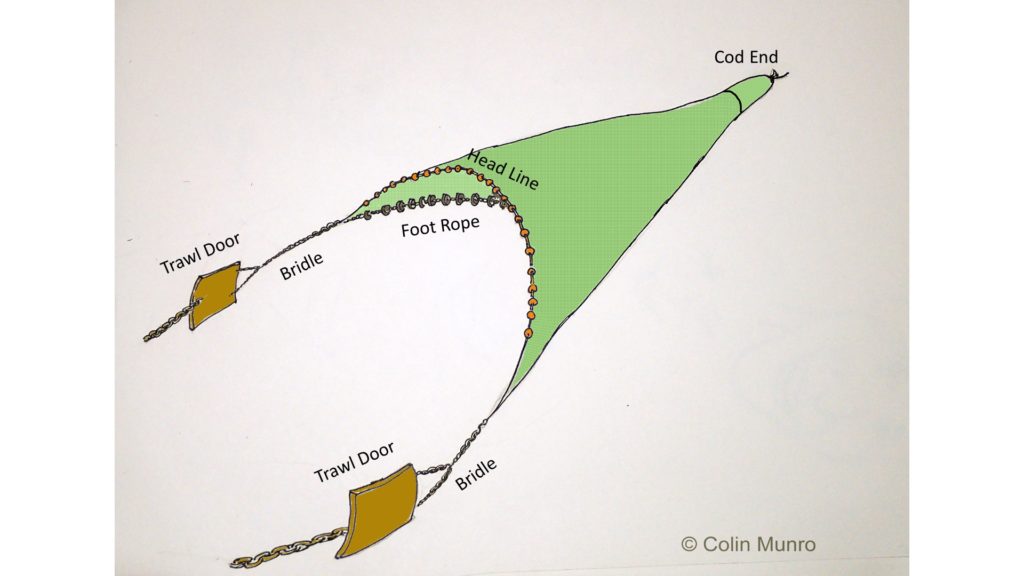
Diagram of the bottm trawl used (not to scale)
I wanted to stay dry in order to do some surface filming of the trawl being deployed, so this task fell to my dive buddy Lynsey. A quick dip was enough to convince her it was no-go. Seabed visibility was no more than one metre. Quite apart from it being impossible to film the trawl operating in such conditions it would also have been too dangerous to be around heavy moving fishing gear. Reluctantly I called the dive off and we reverted to plan B.

Setting up the Gates camera housing in the trawler’s tiny wheelhouse is always a bit of a challenge.
I also wanted to get footage of the trawl as it was being hauled, a little below the surface. This we could do as the near-surface visibility, although far from perfect, was much better than that close to the seabed. However, there were the added logistical problems that the trawl net had to be hauled with the boat steaming forward at a speed of several knots, way too fast to swim or hang on holding a large camera. We had worked a method where I would be dropped off close to the net as it reached the surface, and drift back alongside it, filming as I went. It sounded plausible – I mean what could possibly go wrong? Before this we set up some surface and just below shots at speed, working from a small inflatable.

John and Lynsey in deep discussion as we trawl for a couple of hours.
Poor Lyndsey had the unenviable task of heaving cameras across the tubes to me and hanging on to my legs as I dangled head-down in the water trying desperately to: a) get the vaguest impression of what I was filming through the spray and turbulence, and b) stop my camera from being ripped from my fingers. From the surface I must have presented a highly comical sight, legs waving and coughing and spluttering to the surface every few seconds. From a personal perspective it felt rather like what I imagine being waterboarded by a firehose while suspended upsidedown might feel like. Having had my sinuses thoroughly irrigated at high pressure, it was now time to get into the water, before I had time to ponder the stupidity of my actions and change my mind. At any rate, the sun was racing toward the horizon and light was fading rapidly, so it was either now or call it off and wait ’til next year. In the event the plan worked almost like clockwork; we were even able to repeat the operation so that I could run one haul taking stills and a second taking video footage. Given the relatively poor visibility (~ 4 metres near the surface) I was quite pleased with the results.
You can view video footage from these dives here.

The stupid grin you wear when it all works out.
Nothing got broken (apart from a torn shoulder muscle – my stupidity when the trying to work parallel to the waterflow) and everything worked pretty much as it should. October gales have now set in so there will be no more dives on fishing gear this year.
Note: As with my previous blog on this topic, this is NOT in any way designed to be a ‘how to’ guide to diving on trawl nets. I have deliberately ommitted key elements to try to avoid giving this impression. Diving around nets and heavy moving fishing gear obviously involves a significant element of risk if not approached with great care and planning. I have presented this in a fairly light-hearted manner and should be taken as such rather than a technical guide.

A common or European cuttlefish, Sepia officinalis, trapped in monofilament bottom set nets, Brixham Harbour. Each year nets are set around seagrass beds (Zostera marina) where cuttlefish come in to breed. Image No. MBI000305.
Intelligent life. Few divers who have ever encountered an octopus or cuttlefish underwater cannot have been struck by a sense of an alien intelligence staring hard at them, assessing whether you are friend or foe and what you are likely to do next. That cephalopods (octopi, cuttlefish, squid and their kin) are bright has now become common knowledge; yet this is still something that sits uneasily with their molluscan nature. Great apes, whales and dolphins are easier to accept; they are mammals and so not that distantly related to us. But cephalopods? They are not even vertebrates; first cousins to slugs, snails and slipper limpets. Their blood is greeny-blue not red as the oxygen carrying molecule is copper-based rather than the iron-based haemoglobin in all mammals. They really are shape-shifting aliens from inner space. And yet, when a cuttlefish rises out of the sand or seagrass to hover in front of you, you get a real sense of cogs turning and a logical decision-making process taking place. That may, of course simply be down their binocular vision; we tend to almost intuitively associate this with intelligence (it is designed, after all, to assess distance, form mental 3D images of the World and judge when and how to strike at prey). That there is real intelligence behind those eyes is most elegantly demonstrated by the octopus, which has joined the elite group of animals that have demonstrated the use of tools to manipulate their environment in the wild. The veined octopus has recently been filmed collecting and stacking discarded coconut shells halves to use as a shelter. So far it is the only invertebrate to do so.
Cuttlefish breeding. The seagrass beds of South Devon have long been a favourite dive habitat of mine. They provide gentle, sunlit dives where one can float along in the hope of encountering a pipefish, mating sea hares and, at the right time of year, cuttlefish arriving to lay eggs. Watching a female cuttlefish lay eggs is a fascinating experience. Each pointed black egg is attached to a tuft of seagrass or weed one at a time. The female will hover before it, then after a few minutes contemplation will move forward to firmly grasp the stem with her tentacles and pull it towards her. After a minute she draws back again, to reveal a new shiny, pointed black eggs bound to the stem by a band extending out of the egg case. This process with continue for over an hour, until the stem is wrapped in what resembles a bunch of black, pointed grapes.

A female common or European cuttlefish, Sepia officinalis, trapped in monofilament bottom set nets, Brixham Harbour. A male hovers nearby and will eventually also be entangled. Other males hover in the background. Image No. MBI000270.
While the eggs are laid a gang of males hover in attendance. When cuttlefish mate the male transfers the spermatophores (sperm packages) to within the females buccal cavity, using his modified fourth arm (the hectcotylus). The hectocotylus is then used to break open the spermatophores, releasing the sperm which is then temporarily stored within the female’s buccal cavity. If she subsequently mates with another male it will direct jets of water into her buccal cavity to attempt to flush out earlier sperm deposits. Consequently the most recent mate will hover above her, warding off other males that will hang around, to ensure that it is his genetic material that is passed on rather than that of his upstart rivals.
Cuttlefish in nets. Cuttlefish are, of course, a valuable catch for fishermen. They are caught in trawls out at sea and also in set nets deployed around their inshore breeding grounds. Cuttlefish grow quickly and most die shortly after breeding, so those caught after they have laid their eggs will not have any real effect on future populations. Unfortunately however, nets are often laid around the edges of breeding grounds such as seagrass nets, thus cuttlefish are caught not only when leaving the breeding ground but also when arriving, before they breed. The nets do not kill them, but they are often quite badly damaged as they twist and the fine line cuts into their flesh. Indeed I often wonder how they can be sold after their flesh is so ripped up. If a female is caught then inevitably a number of males arriving will hang around her until they too are caught. A trapped female may remain their for up to twelve hours before the nets are hauled, so the potential for catching large numbers of breeding cuttlefish is quite high. So far, this practice does not seem to have noticeably affected local cuttlefish populations. It is nonetheless rather disconcerting to watch such lovely animals twisting and turning for hours on end.
Update. In the past couple of years I, and other local divers, have seen notably fewer cuttefish hanging around in the shallow bays of South Devon during the breeding season. This may simply be due to factors like the lousy weather we’ve had during the past couple of summers; it may also be due to the almost impenetrable ring of nets set on the edge of these bays.
Images. All the images in this blog are available to license. You can search all my online stock images at my www.colinmunroimages.com Cuttlefish images, Sepia officinalis images, fishing images, stock images.

Egyptian fishing boat at sunset, Eastern Mediterranean Sea. Image MBI000912.
Fishing boat at sunset, Eastern Mediterranean, off Egypt. Please email me, quoting this number if you’d like to license use of this image or purchase a fine art print.
I spend a couple of weeks working off in the eastern Mediterranean Sea, a few miles off the Nile delta, a while back. It was mid-winter, and we spent much of the time dodging gales. Although we were in a fairly substantial boat, waves piled up high in the shallow waters off the delta, so work was completed in brief sorties, then running back to port with four or five metres waves chasing us. When the sea was calm however, it was absolutely beautiful, with the most stunning sunsets. Calm weather also brought out large numbers of fishing trawlers. At one time I counted twelve trawlers all within sight of us; it seems highly unlikely that such fishing is sustainable and indeed I saw precious little catch when nets were hauled. As the sun set all nest were hauled and the boats headed back to port leaving us with the sea to ourselves until the sun rose again. I watched this boat inch past the dipping sun, with an almost blood red sky as a backdrop. There has been vistually no editing to this image – the sky really did look like that. Sometimes you have to really work to get great pics, and sometime you just need to be there.

Yachts silhouetted just before dawn, San Diego harbour. Image MBI000899.
Those of you with way too much time on their hands may have noticed that reflections on water is a recurring theme in my images. I know its a cliche, but hey! Cliche images only become so because they work. The images I’ve uploaded span a good few years; although most were taken in the past four, the Loch Ness image pre-dates that by quite some time. Consequently the pictures include both digital and film originated images. I’ve also chosen pictures from around the World: from San Diego’s bay-side to rural Devon,Southwest England, through to the Navua River creek at the southern tip of Fiji’s largest island Viti Levu, and back to the northern hemisphere to the shores of Loch Ness, northern Scotland during a particularly hard winter. You won’t find a great many bright summer days amongst my pictures. Not that I don’t enjoy the sun as much as anyone else, but it’s rarely dramatic. I much prefer the low light of dusk and dawn or winter days when the sun bobbles along the horizon, creating light and shadow that I can play with. Although I cut my teeth working underwater with a purely mechanical camera devoid of even a light meter, I’m not really a purist and will use Photoshop or whatever tools are at my disposal to enhance an image. To me it is not that different from dodging and burning photographic paper. However, you don’t great create a good image from a mediocre one straight out of the camera. For me at least, what I see through the lens in 95% of the final image and getting that image on to the camera’s sensor is 95% of the work. Everything after that is dressing. Two of the photographs were taken in the 30 minutes or so before dawn. For me that’s a magical time; very still, the World haven not fully woken. A not-so-magical time is when my alarm goes off at 4:30a.m., but if I do force myself out of bed it is often well worth the effort. The final image of Exeter historic quay was actually an evening shot, around 9p.m. on a warm evening in early June. The sun had just set, leaving a dramatic sky but with most of the quayside in deep shadow. To bring out this detail I created an HDR (High Dynamic Range) image as a composite from four seperate images covering (if memory serves me correctly) six full stops. The images were then processed using Photomatix and Photoshop. The hardest part of compilations like these are what to leave out. Thus reflections is a theme I will no doubt return to, with a ‘Reflections’ gallery up soon. All feedback, including reports of any gliches, most welcome.
Colin

The Turf Locks Pub, Turf Lock, Exeter Canal, Devon, England. Image No MBI000900
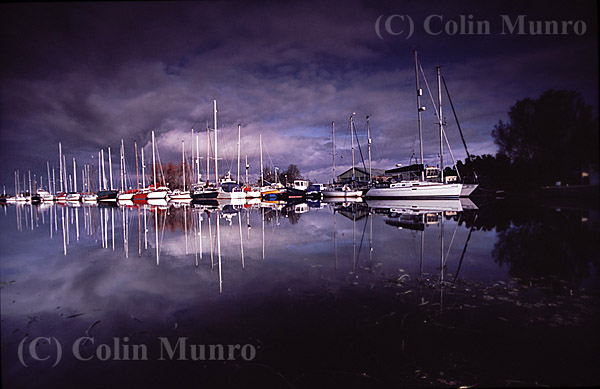
Yachts reflected on the calm waters of Exeter Canal on a winter's day. Image MBI000775.

Sunrise over the Navua river near the mouth at Beqa Lagoon, Viti Levu, Fiji. Image MBI000583.

Frozen birch trees and snow-capped mountains reflected on the waters of Loch Ness, Scotland,. Image MBI000124
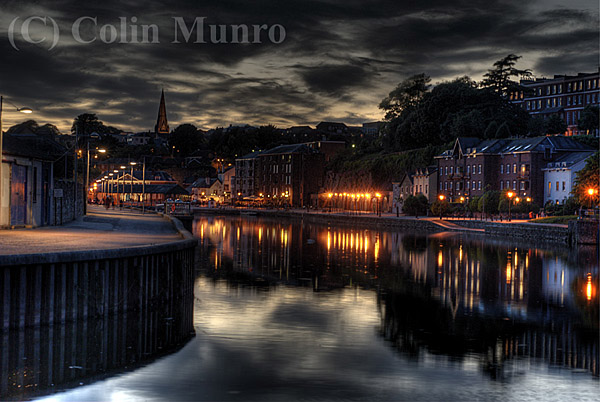
Exeter quayside at night. Exeter's historic quayside. Devon, England.

Humpback whale swimming under a fishing vessel, Lyme Bay, Southwest England
I have just uploaded what is probably the worst whale picture you’ve ever seen, or are likely to. For a start it was taken with an old Nikonos III camera, without use of an additional hand held light meter. Those old Nik IIIs were purely mechanical, so no built in light meter; thus exposure was based on the ‘guesstimate then bracket like hell’ maxim. Secondly, it was taken with the only wide angle lens I owned back in those days, a cheap plastic supplementary lens of rather dubious sharpness. To be honest the lack of sharpness was not really an issue. I was shooting in turbid coastal waters, where horizontal visibility near the surface was between 8-10 metres (26-33 feet); pretty good for the area as it happens but lousy for shooting whales. On top of this strong winds had been blowing so the shallow coastal water was nicely loaded with suspended sediment lifted off the seabed. This made for a rather hazy 8-10 metres visibility. As if that weren’t enough, conditions were further complicated by this occurring around 7.30pm, so the sun was getting low and light levels below the surface were dropping like a stone. To cap it all I had no fast colour film with me (yes this was waaaay back in the pre-digital days). I had not gone diving to photograph whales. I knew the visibility was likely to be lousy so I had arrived armed with a set of extension tubes for macro-photography and several rolls of Fuji Velvia 50 slide film. This produces wonderful, detail and rich, saturated colours, But it is slow! Certainly useless for photographing something the size of a bus in turbid, low light conditions. Throwing everything out of my camera bag over the deck of our dive boat I fished out an old roll of 400 asa film. Now that was more like it; still going to struggle but at least there was a chance of a recognisable image now. Only problem was it was black and white negative film (so long ago I forget exactly what). Still, it was that or nothing. So I loaded it with shaking hands are rolled over the boats gunnel into the water. The slowest shutter speed available on Nik IIIs is a 30th sec, so I wound it right down and hoped for the best. Black and white negative film is more forgiving of poor exposure than slide, which was just as well really.
So I guess I was quite fortunate (and there was a lot of luck) to get any recognisable images at all. But apart from nostalgia, why hang on to them, and why publish them online? The pictures are nearly two decades old now and after all, I have lots of lousy quality pictures from years gone by. The main reason, apart from being able to waffle on about the difficulties of photographing large marine mammals in lousy conditions, is that, eighteen years on, as far as I am aware these remain the only underwater pictures taken of a humpback whale in British coastal waters. I can still remember my utter amazement as I peered over the boat’s rail into the water below, watching a dark shape slowly rise up. As it approached the surface not more than two metres from the boat I could clearly make out a long, white object. When it was around a metre below I suddenly realised I was staring at a massive white pectoral fin. ‘Bloody hell! It’s a humpback!’ I remember shouting (okay, it may have been slightly stronger than ‘bloody’). By the time it broke the surface I was already throwing dive gear together. I loaded my camera, threw my cylinder on and rolled over the gunnel faster than any time before or since, oblivious to what anyone else was doing. I settled on the bottom at around 10 metres. I peered around but he (or she) was nowhere in sight. What now? Fortunately I didn’t have to wait long. The humpback was intensely interested in the boats echo sounder transducer and kept returning to make passes under the hull. I floated up to mid-water and simply hung there, waiting for him to return then clicked away frantically changing aperture sizes as I did so.
A small population of humpbacks inhabits the Eastern Atlantic, migrating each year between their arctic feeding grounds and breeding grounds off Cape Verde. They are frequently spotted off the West coast of Ireland as they head North or south. This guy somehow made a wrong turn off Cornwall and headed East along the English Channel. After our memorable dive he was not seen again, as far as I know. Let’s hope he made back on track.
I continue to muddle away at underwater photography, so if anyone is tempted I shall be running a series of workshops from March 2010 onwards. More info at Colin Munro photography Main Index under Courses and Workshops
If anyone knows of other humpbacks photographed underwater around the UK I’d be most interested to learn about it.
Colin Munro 3rd February 2010.
Colinmunrophotography.com