The extraordinary life cycle of the lion’s mane jellyfish

Lion's mane jellyfish, Cyanea capillata, underwater clearly showing tentacles trailing in many directions. Colin Munro Photography

Jellyfish, or sea jellies as they are now often called (clearly they are not fish) are amongst the most ancient of multi-organ animals.  Fossils of jellyfish (or scyphozoans, to give them their scientific name) are found only rarely as they contain no hard structures within their bodies, which are 95% water.  However, under the right conditions fossils of soft bodied creatures will form; current fossil evidence suggests they first evolved at least 500 million years ago.

Lion's mane jellyfish, Cyanea capillata, underwater clearly showing tentacles trailing in many directions. Colin Munro Photography

The lion’s mane jellyfish, Cyanea capillata, is the largest known species. The bell of individuals in colder northern waters can reach two metres across.

The lion’s mane jellyfish (Cyanea capillata) common throughout the North Atlantic, epitomises this image of a large, slowly pulsing, gelatinous bell (or medusa) and long trailing tentacles that pack a powerful sting, but this is in fact only one stage of a complex life cycle.  Lion’s mane medusae begin to appear in April or May in the Northern Atlantic, but are quite tiny at that stage.  These jellies are voracious predators and grow rapidly through the summer.  By August the medusae are commonly one third to half a metre across, with trailing tentacles many metres long.  However there is considerable variability;  large specimens have been reported at over two metres across with tentacles up to 37 metres long, though these generally occur within the more northern parts  of their range.  As they grow large in late summer they will often drift, under the influence of wind and tides, in to sheltered bays where they may aggregate in large numbers. This is when sperm is release and egg fertilisation takes place.  In common with most scyphozoans (the taxonomic group to which jellyfish belong) the sexes are separate; lion’s mane jellies are either male or female.  Sperm is released from the mouth of male jellies and drifts in the current, some reaching female jellies, where the eggs are fertilised. Fertilised eggs are stored in the oral tentacles of the female, where thy develop in to tiny planulae larvae. Once fully developed the planulae larvae detach and, after drifting for a short time, settle on the seabed.  Here they metamorphose into a polyp, not dissimilar to tiny sea anemones or coral polyps (both of which are relatives of jellyfish).  These polyps then grow, taking on a layered appearance until they resemble a stack of wavy-edged pancakes.  Each one of these ‘pancake layers’ will then separate from the parent polyp, once again becoming free living and drifting with the currents.  The ‘pancakes’, more properly ephyra larvae, will grow throughout the summer into the giant lion’s mane jellies and the cycle is complete.  With a lifespan on only one year, during which they can grow to be as long (possibly even longer) than blue whale, lion’s mane jellies need to catch and consume considerable amount of prey.  Each trailing tentacle is packed full of vast numbers of stinging cells, known as nematocysts.  When touched these cells fire out a harpoon-like structure which pumps toxins in to the hapless victim (this is what causes the painful sting from jellyfish).  These toxins incapacitate the prey, which is then drawn up towards the mouth of the jellyfish.  A large lion’s mane may have over 1,000 tentacles trailing far behind them.  Many SCUBA divers in Scotland and Scandinavia have experienced the situation where, having completed their dive on a sunken wreck and returned to the buoy line they planned to ascent to the surface, only to look up and see numerous lion’s mane jellies strung out along the line.  As the current sweeps the jellies along so their tentacles catch on the buoy line, leaving the divers with the unpleasant prospect of ascending through thousands of jellyfish tentacles.

A diver warily watches a large lion's mane jellyfish (Cyanea capillata) drift past. Isle of Arran, West Scotland.

A diver warily watches a large lion’s mane jellyfish (Cyanea capillata) drift past. Isle of Arran, West Scotland.

Not every creature lives in fear of lion’s mane jellies however.  Leatherback turtles, the only species of marine turtle that can tolerate the cold waters these jellies inhabit, consume them with relish, apparently oblivious to the stinging tentacles.  Lion’s mane jellies can make up 80-100% of a leatherback’s diet.  When you consider that a full grown leatherback weighs up to 800kg and may consume up to its own weight in jellyfish daily (bear in mind jellyfish are 95% water) then that equates to pretty large numbers of jellyfish being eaten.

As summer wanes and autumn approaches the lion’s mane jellies begin to die.  This provides a feeding bonanza for many scavengers.  On the surface seabirds will peck away at the gelatinous bell, whilst those that sink are often torn to shreds by shore crabs (Carcinus meanus) and velvet swimming crabs (Necora puber).

Dying lion's mane jellyfish (Cyanea capillata) that has sunk to the seabed being eaten by a velvet swimming crab (Necora puber).

Dying lion’s mane jellyfish (Cyanea capillata) that has sunk to the seabed being eaten by a velvet swimming crab (Necora puber).

At the other end of the scale these deadly tentacles can provide refuge to some unlikely creatures.  Juvenile whiting (Gadus melangus) have long been known to swim underneath the bell of lion’s mane jellies, apparently unconcerned by the curtain of tentacles they weave between. In fact they have been observed to rush into the mane of tentacles when startled by predators.  A series of fascinating experiments by the Swedish zoologist Erik Dahl in the late 1950s showed that, compared to other fish species, juvenile whiting were able to adapt their movements such that even when surrounded by tentacles they rarely came in to contact with them.  Also, unlike other fish species, when they did brush against them it seemed to cause them little concern. Biopsies of the tissue of whiting where they had contacted tentacles showed that very few if any stinging nematocysts had fired into the fish’s body; this compared to hundreds per square millimetre for other fish species.  We still don’t understand the mechanism behind this protection. So does the lion’s mane get anything in return for the refuge afforded the young whiting?  Well another creature found on lion’s mane jellies is the tiny planktonic amphipod (a type of crustacean) Hyperia galba. Hyperia is, for the jellies, a rather irritating ectoparasite. It lives on the outside of the jellies’ bell, nibbling away at it.  Now whiting don’t appear to like the taste of lion’s mane jellies, instead they are rather partial to planktonic crustaceans; in particular (you’ve guessed this already) Hyperia galba.   It is these elegant little symbiotic collaborations that make nature so beautiful.

These, and many more of my images, can be found at colinmunroimages.com

Sign up to my newsletter

Fine art prints and canvas wraps printed in the USA

Fulmars and gannets over stormy seas, St Kilda, West Scotland. Colin Munro. www.colinmunroimages.com

I’ve recently decided to make some of my photographs available as fine art prints and canvas prints through a print vendor based in the US.

Fulmars and gannets over stormy seas, St Kilda, West Scotland. Colin Munro. www.colinmunroimages.com

Fulmars and gannets over stormy seas, St Kilda, West Scotland.

These can now be in a wide range of fine art print sizes, rolled canvas prints and stretched canvas wraps (canvas on wooden frames).  These can be browsed and purchased direct from my website www.colinmunroimages.com.  Printing and delivery is handled by EZ Prints. EZ prints are a large-scale printing facility based out of Norcross, Georgia, USA, whose innovative technology and personalization expertise combine to deliver affordable and easily accessible prints and products.

Hound Tor, Dartmoor, Devon, fine art print

Hound Tor, Dartmoor

All EZ Prints orders are processed in a state-of-the-art manufacturing plant using the latest digital printing components.  This process is fully integrated within my website.

Sunrise over the Navua River, Viti Levu, Fiji. Colin Munro Photography www.colinmunroimages.com

Sunrise over the Navua River, Viti Levu, Fiji


Printing within the US allows far cheaper shipping costs within the US and Canada. Print sizes from 10″ x 15″ to 24″ x 36″ are available.  www.colinmunroimages.com


Not quite Phileas Fogg

The katuali or flat-tail sea snake (Laticauda schistorhynchus) is a type of sea snake, or more precisely a krait, found only around Nuie Island in the South Pacific. There is some debate as to whether it is a seperate species or a sub-species of the black-banded sea krait (Laticauda semifasciata) also known as the Chinese sea snake. Colin Munro Photography www.colinmunroimages.com

I have been very lucky recently.  In the past 12 months alone my work has taken me to around 23 countries. Whilst not quite in the slipstream of Phileas Fogg it has nonetheless been something of a wild roller-coaster ride.  This has enabled me to greatly increase the range of my stock images, from orang utans to komodo dragons and Pitcairn Island to St Kilda.  The down side (I know, I know…. I’m not complaining) is that time to sort, edit, key-word and upload this exponentially growing back catalogue has been in short supply.

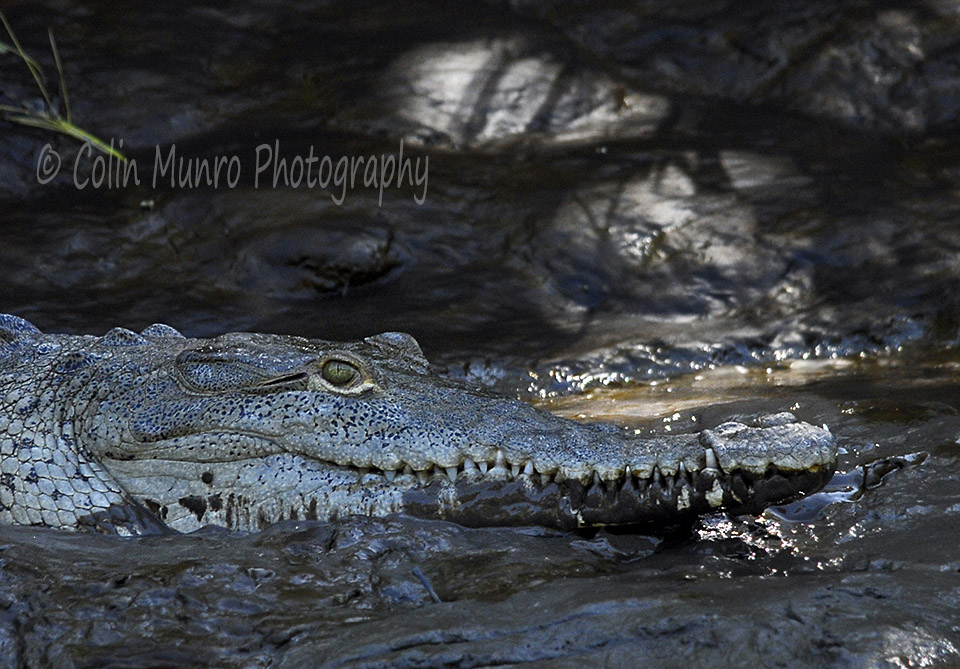
American crocodile (Crocodylus acutus) lying on a muddy river bank, Tempisque River, Costa Rica. www.colinmunroimages.com

American crocodile (Crocodylus acutus) lying on a muddy river bank, Tempisque River, Costa Rica.

Often this has been limited to brief spells in cafes or airport departure lounges with sluggish WiFi.  However, the up side of a recent accident and a few weeks enforced recuperation in one country has been  time to sit down and tackle the rather daunting task of sorting through almost a terabyte or raw images.

The katuali or flat-tail sea snake (Laticauda schistorhynchus) is a type of sea snake, or more precisely a krait, found only around Nuie Island in the South Pacific.  There is some debate as to whether it is a seperate species or a sub-species of the black-banded sea krait (Laticauda semifasciata) also known as the Chinese sea snake. Colin Munro Photography www.colinmunroimages.com

The katuali or flat-tail sea snake (Laticauda schistorhynchus) is a type of sea snake, or more precisely a krait, found only around Nuie Island in the South Pacific.

I am now doggedly sifting through these and uploading to my stoc images website www.colinmunroimages.com.  This is a seachable site, where named galleries can be browsed (e.g. Norway, Cape Verde islands, Fish, Seabirds) or images can be searched by keyword, geographical area and other parameters.  The opening page links to a small number of showcase galleries which I will rotate as I update galleries.

Grey-headed kingfisher(Halcyon leucocephala) Cape Verde Islands, West Africa. Colin Munro Photography www.colinmunroimages.com

Grey-headed kingfisher(Halcyon leucocephala) Cape Verde Islands, West Africa

So if you haven’t checked out www.colinmunroimages.com yet why not give it a few minutes during your next coffee break.  If you have, then come back again next week and hopefully there will be updates since last time.  Either way, if you have any comments or requests then please get in touch colin@colinmunrophotography.com.

[avatar user=”colinmu” size=”thumbnail” align=”right”]

Tony Garnett, Cathy Come Home and British Film Institute talk

Tony Garnett, Cathy Come Home and British Film Institute talk

Should anyone be in London tomorrow with time on their hands tomorrow evening, I’d recommend a trip to the British Film Institute Southbank.   Film and Television producer Tony Garnett will be discussing his work.  For those unfamiliar, this includes such ground-breaking dramas as Cathy come home, the Play for Today television production that lead to debates in Parliament and the setting up of Crisis, Kes, Cardiac Arrest and This life.

I was nine when Cathy come home was first broadcast.  A quarter of the UK’s population watched it (a play; a social commentary, one cannot imagine such a thing happening now) including our household.  Despite my youth it was simply electrifying.  Shot on hand held 16mm cameras, mostly on location and often using members of the public, a naturalistic style that typifies director Ken Loach’s films.  I year or so back I bought the DVD of Cathy come home.  At first I was reluctant to watch it, fearing that the passage of time and the antiquated technology used to shoot and record it would deaden the impact.  I was wrong.  It is still electrifying 46 years on.  Not only that, it would be surprising for such an overtly political play to be allowed on a mainstream tv channel today; one only has to look at the way political documentary makers such as John Pilger, long broadcast on British television, are now independently producing documentaries for cinema and web broadcast instead.  Up the junction is another of Tony Garnett and Ken Loach’s controversial collaborations likely to be discussed, this one dealing with back street abortions.  Later made in to a film, it was Garnett and Loach’s television play that was the inspiration behind Chris Difford’s lyrics for the Squeeze song of the same name.  If you haven’t yet seen Cathy come home, check it out at Ken Loach’s YouTube channel.  

http://www.youtube.com/user/KenLoachFilms

We live in an age where the technology rather than the content is given pre-eminence.  One only has to spend a short time online looking at blogs or Facebook to see the myriad images and comments posted praising or decrying the latest iPhone/Nikon/Canon quadzillion pixel camera/smartphone with apps for everything from when you should take a picture of your cat to how many images of your cat you should force others to look at.  Like the images of Salgado, Nick Ut and Thessiger, these dramas clearly demonstrate the converse is true; it is the content not the camera.

 Footnote:  It is said that the final scene in Cathy come home was shot on location, London Underground, as her baby was forcibly taken from the arms of a screening Cathy by the authorities, unsuspecting members of the public  formed the background.  No-one intervened.  I guess little has changed.

Porbeagle populations in the N.E. Atlantic critically endangered.

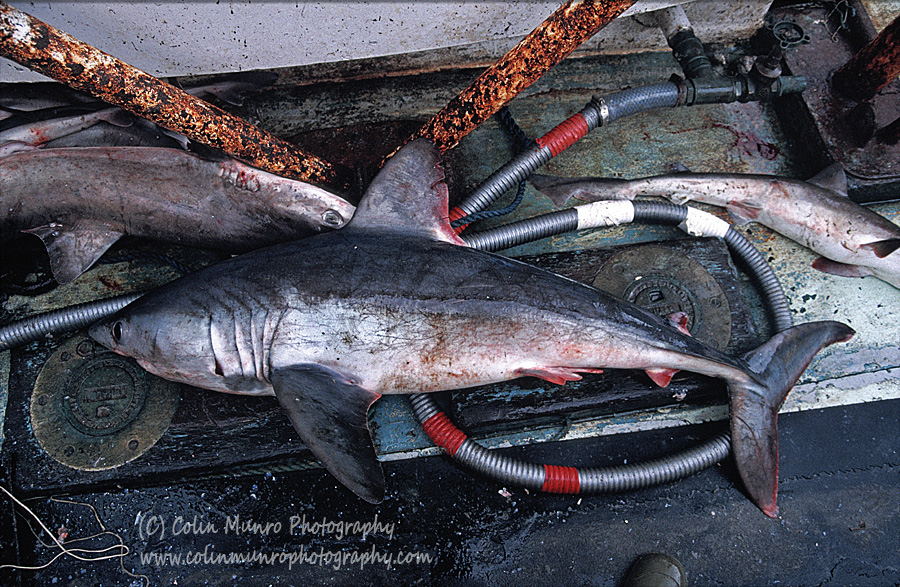
Porbeagle shark, Lamna nasus, caught as bycatch, on the deck of a fishing vessel, Irish Sea, UK. Colin Munro Photography

Porbeagle shark, Lamna nasus, caught as bycatch, on the deck of a fishing vessel, Irish Sea, UK. Colin Munro Photography

Porbeagle shark, Lamna nasus, caught as bycatch, on the deck of a fishing vessel, Irish Sea, UK.


Porbeagle sharks (Lamna nasus) are a temperate water species of shark belong to the mackerel shark family (Lamnidae), the same family as salmon sharks, makos and great whites. Adults are around 2.5 metres long and and weigh about 140kg. They are considered vulnerable throughout their range. The population around UK shores (NE Atlantic) is considered critically endangered (IUCN). The International Committee for Exploration of the Seas (ICES) advises that the NE Atlantic stocks may be close to collapse. A quota system for porbeagles was introduced in 2008. The Total Allowable Catch (TAC) was reduced to 436 tonnes in 2009. In UK waters a total ban on targetted fishing by commercial fishermen has been in place since 2010, with release of accidental bycatch whenever possible. ICES has called for a zero TAC since 2006; there are now proposals to bring this in to effect throughout the EU.

There is a still a problem in that porbeagles, are fast swimming predators that feed on squid and fish. Freuqently the species that fishermen are also targetting. Porbeagles may end up as accidental bycatch in trawls or in set nets. Like other mackerel sharks, porbeagles’ gills work by obligate ram ventilation. This means they need a constant flow of water past their gills in order to oxygenate their blood. Trapped in nets they quickly drown. As set nets are often deployed on the seabed then hauled 12 or 24 hours later, even if the fishermen would like to release them alive it will be too late. The Centre for Environment, Fisheries and Aquaculture Science (CEFAS) is currently conducting a DEFRA commissioned study in to the threats posed by accidental bycatch to porbeagle in UK waters. Hopefully this will result in guidance for fishermen as to the best ways to minimise the risk of accidentally catching porbeagles.

Save our Seas is working with the Marine Institute in Ireland to satellite tag porbeagles. This should help us understand portbeagle migration and possibly identify nursey areas. This has so far shown that porbeagles tagged off northern coast of Ireland have resurfaced off Lisbon, Portugal. Details of the study can be seen here.

Interesting fact: All fish are cold blooded right? Not quite. Recent studies have found that most mackerel sharks (salmon sharks, great whites, shortfin mako and porbeagles) are able to maintain their body temperature above that of the surrounding water, as marine mammals do. They acheive this by passing deoxygenated blood, heated by muscle activity and biochemical reactions, past a network of cold, oxygenated blood travelling through a network of fine arteries (the rete mirable, literally ‘wonderful net’) thus transferring heat to the arterial blood rather than simly losing it to the external environment. Salmon sharks (Lamna ditropis) sharks have been found to maintain their core temperature up to 21 degrees C above that of the surrounding water (Goldman et al, 2004)

Update
Porbeagles are endangered throughout the Atlantic. The EU has now voted to ban commercial porbeagle fishing. Currently only Canada allows a commercial fishery, although the Canadian Government are coming under considerable pressure from conservationists within and outside Canada. More more information on this read the Friends of Hector article here.

References
Goldman, K.J., Anderson, S.D., Latour, R.J. and Musick, j.A., 2004. Homeothermy in adult salmon sharks, Lamna ditropis. Environmental Biology of Fishes 71 (4): 403–411.

Filming over-under shots at sea: the pros and cons of high-end video versus DSLR

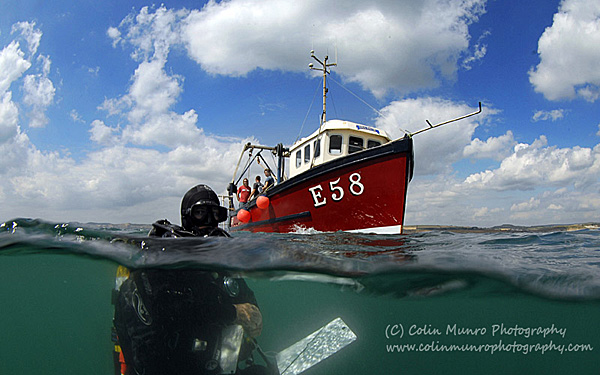
An over-under shot of a diver waiting to be picked up at the end of a dive. Colin Munro Photography
An over-under shot of a diver waiting to be picked up at the end of a dive.

I recently completed a short shoot requiring over-under shots at sea; shots of a boat passing by and of a girl who had ‘fallen’ in to the sea. This was UK waters in late September, so conditions were – shall we say – not mirror smooth and crystal clear. If fact we ended up shooting about an hour and a half before sunset with the water darkening and a noticeable sou’westerly breeze creating a bit of a swell; so on the positive side the look was realistic. The shots had been planned for a Sony Alexa, but housing availability and cost considerations pushed the shoot to a DSLR; a Canon 5D MkII to be precise. At first consideration shooting video on a DSLR may seem a big step down from the 2K Alexa, but that’s not necessarily so. The shoot brought a number of these points to mind, so I thought I’d write a short blog on the pros and cons of dedicated high-end video cameras versus DSLRs for shooting over-under or surface shots in open sea. I’m not going to consider or compare camera image quality here; there are plenty of websites reviewing and out there doing just that. Instead I’m going to look purely at usability in this rather problematic situation. Producing good images is not simply a question of image resolution; factors such camera steadiness, ability to focus and frame accurately and freedom from water splash droplets need to be taken in to account also. I’ve randomly selected some well known manufacturers to as examples. This is not to imply the are particularly better or worse than others, simply that they are brands many will be familiar with and the data for them is readily available (and sometimes because I have used them and so have experience and images). Equally, any implied criticism is merely to point out that in this very specific type of shot certain types of equipment have inherent problems. In general, for underwater shoots (which is what they are designed for) they perform excellently.

Weight

A key consideration is the overall weight of the rig. Now of course well designed housing-camera combinations are near neutral buoyancy below the surface as the air spaces inside the housing providing positive buoyancy and so compensating for the weight of the metal, glass and perspex of the housing and the camera itself. Close to the surface a large housing with plenty of mass is also a distinct advantage. Swell and surface chop will buffet both cameraman and camera, tending to make the image jump about. A large system with plenty of mass will resist such buffeting and moves more slowly than a little lightweight system, in much the same way as a small rowing boat is tossed about by wave action that has no effect at all on a naval destroyer.

Colin Munro setting up a Sony EX1 in a Gates Underwater housing on the surface prior to a dive. (C) Holly Latham.ll size video housing above the surface
Holding a full size video system partially out of the water requires the strength of Arnie Swarzenegger, even with a trailing line to hang on to. Picture by Holly Latham.

On the surface however, other factors come in to play. That positive buoyancy that balances the weight of the system disappears, and the downward force of the weight of the proportion of the camera and housing above the surface is counteracted only by the upward force applied on the grip handles by the cameraman’s arms. That is damn hard work! As an example, a Gates housing for the Red Epic or Scarlet, in air, weighs in at about 43lbs (19.5kg) including camera. That’s roughly the weigh of a six year old child. It is true that not all of that weight will be felt as not all of the housing will be above the surface; but even if it is only 20lbs for those half and half shots you are going to need pretty impressive biceps and shoulder muscles to hold it up and hold it steady whilst getting that 3rd take of that key shot. You are also going to be finning like hell to counteract the toppling forward effect of the unbalanced weight of the housing held in front of you. Comparing this with a suitable DSLR for video, a 5D MkII in an Aquatica housing (again, given as a representative example) weighs in at around 9lbs (4kg). This is still not much fun in a choppy sea but you don’t have to be built like Arnie to be capable of doing it.

Leverage

Essentially the weight distribution combined with the overall length of the rig. Again, a DSLR wins hands down in the category. A Gates housing for the Sony EX1 is around 17 inches (44cm) long; an Amphibico housing for the Sony EX3 squeezes in at a tad over 20 inches (52cm). For over-under shots one will almost certainly need to be working with a wide angle lens and a big dome port (if you don’t understand why, read the last paragraph). This can mean having something like the exceedingly beautiful and optically wonderful, but extraordinarily heavy Fathom superwide port fitted to the far end of your housing. This will produce stunning images but cause vein-popping strain on your upper body as you attempt to lever this half out of the water. Big glass ports on DSLRs are also heavy (e.g. the fantastic Zen DP-230 9 inch superdome, weighs in at 3.9lbs, 1.8kg) but due to the much shorter length of DSLR housings they are mounted only a couple of inches in front of the grip handles. There is still a forward tilting effect, but it is much less pronounced.

Colin Munro leak testing a Hugyfot housing for a Canon 5D MkII DSLR, during setup prior to filming.
As can be seen in this pic of leak testing a Hugyfot, the dome port is only fractionally in front of the grips handles.

A final consideration is focussing and viewing. Most housings for professional video systems do allow viewing of the camera’s viewfinder, but this is generally small and tricky to use through a housing even in easy conditions. So instead most come equipped with a larger external monitor that can be mounted on top of the housing. This is perfect for underwater, but at the air-water interface simply adds additional weight above the water’s surface, pushing the camera further down. External monitors are also available for DSLR housings, and again they are extremely useful beneath the surface but not at the surface. DSLRs do have the advantage of having a large LCD screen that is much easier to view at the surface of a choppy sea; many housings will also take a 45 degree enlarged viewfinder that can make focussing and framing through the viewfinder a much more practical proposition when floating on the surface.

Why do we need to use wide-angle lenses and large dome ports?

This is a brief summary of quite a complicated subject. We need to use large dome ports when taking over-under shots for two reasons. The main reason is because light travels at a different speed through air than water. If flat ports are used with wide angle lenses then considerable bending occurs to light rays passing through the port other than those passing through perdicular, significantly distorting all except the central part of the image. However, this change in wave velocity of light passing through the dome (effectively a curved water-air interface) causes the dome to act as a powerful diverging lens below the water surface making objects at infinity appear to be at a distance of slightly less than 4 x dome radius. This is known as the virtual image. Thus using a small dome port, with a small radius, will bring the virtual image very close to the lens entrance pupil. For example, a 4 inch dome port will result in a virtual image approximately 5.5 inches in front of the port. Above the surface, with air on either side of the dome, this effect does not happen and the lens must focus on the actual image to produce sharp images. Consequently a lens with a large depth of field (DoF), i.e. a wide-angle lens, is required. However 5.5 inches to infinity is too great a DoF for almost any lens, thus a larger dome is required, moving the virtual image further away from the front of the dome and so decreasing the required DoF for both underwater and above surface images to be in focus simultaneously. An 8 inch diameter dome is generally considered the minimum necessary to allow simultaneous focussing above and below the surface (a more detailed technical explanation, with calculations and downloadable formulae has been produced by Dave Knight of Cameras Underwater. This can be read here. The example figures I give here also came from Dave’s page). The second consideration is that, if working in a pool with a mirror calm surface, then we can precisely line up the water surface with the middle of the lens even on a tiny dome or flat port. It’s not like that in the sea though; if you are lucky you’ll be working with just a few ripples or maybe a lazy swell passing through, if not you may have 18inch waves slopping through (if you have more than this, give up and go home). A bigger dome gives you more surface area to play with when lining up the camera. It also means that small waves or splashes are less likely to cover the upper half of the dome, leaving droplets visible on the surface. Whilst on the point of droplets and splashes, the biggest curse of trying to shoot half in-half out, although heavier and more expensive, glass domes do have the advantage of shedding water more easily that their acrylic counterparts.

For more stories, made to order framed wall-art canvas wrap prints, fine art prints, posters, stock images and more stories, visit my main site: www.colinmunrophotography.com

ColinMunroPhotography.com Colin Munro Photography fine art prints direct from the photographer
colinmunrophotography.com

Lyme Bay, Lane’s Ground Reef: sponge species recovery and opportunities lost

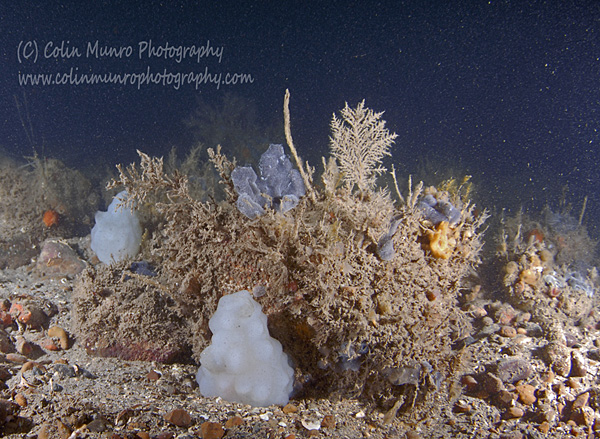
Lane's Ground Reef, a circalittoral boulder reef rich in sponges and ascidians, within Lyme Bay Closed Area, Lyme Bay, southwest England. Colin Munro Photography

This blog post has now moved to my Marine Biology website, Marine-bio-images.com. It can be read at:

Lyme Bay, Lane’s Ground Reef: sponge species recovery and opportunities lost

https://www.marine-bio-images.com/blog/lyme-bay-marine-ecology/lyme-bay-lanes-ground-reef-sponge-species-recovery-and-opportunities-lost/

New gallery: Lyme Bay Reefs and Lyme Bay Seabed stock images

Along the tide-swept crest of a low limestone ledge larger filter-feeding organisms flourish. Lyme Bay Reefs, Southwest England. (C) Colin Munro Photography.

New gallery uploaded – Lyme Bay Seabed Images and Lyme Bay Reefs

A rich epifaunal turf forms on the tide-swept edge of a rocky reef, Saw-tooth ledges Reef, Lyme bay, Southwest England. Colin Munro Photography

A rich epifaunal turf forms on the tide-swept edge of a rocky reef, Saw-tooth ledges Reef, Lyme bay, Southwest England. Image No. MBI001163

I’ve started creating a dedicated gallery of stock images documenting the seabed habitats and species of Lyme Bay. This gallery will include Lyme bay Reefs, for which the Lyme Bay Closed Area was set up to protect, and will catalogue the diversity of these reefs, but will also document some of the interesting sedimentary habitats which usually fail to receive the attention they merit.  These and more Lyme Bay images can be seen here.

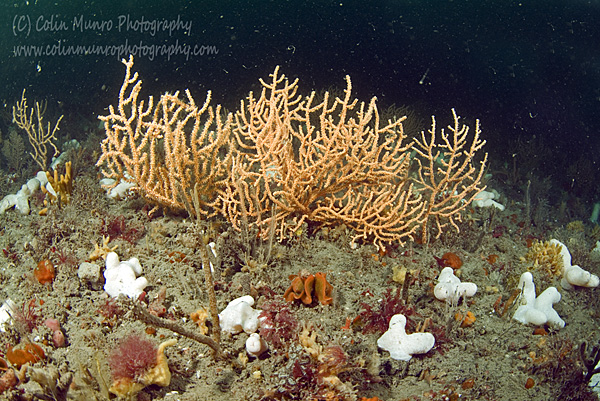
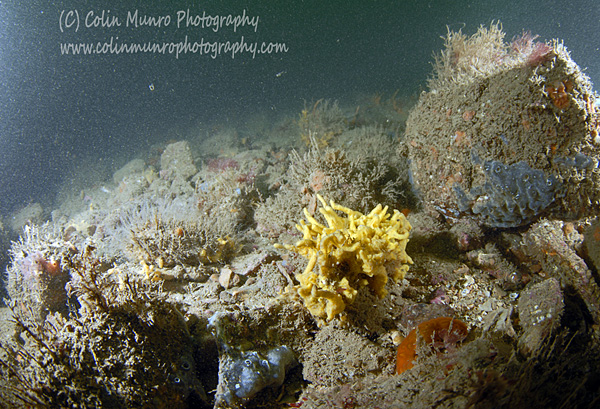
A sediment covered limestone boulder reef in Lyme Bay, Southwest England. The bright yellow tassled sponge Iophon hyndmani or Iophonopsis nigricans (the two species  cannot be positively differentiated underwater) can be seen in the centre of the image; (C) Colin Munro Photography

A sediment covered limestone boulder reef in Lyme Bay, Southwest England. The bright yellow tassled sponge Iophon hyndmani or Iophonopsis nigricans (the two species cannot be positively differentiated underwater) can be seen in the centre of the image. Image No. MBI001162

Along the tide-swept crest of a low limestone ledge larger filter-feeding organisms flourish.  Lyme Bay Reefs, Southwest England. (C) Colin Munro Photography.

Along the tide-swept crest of a low limestone ledge larger filter-feeding organisms flourish. Lyme Bay Reefs, Southwest England. Image No. MBI001156

A scallop, Pecten maximus, swim away from a perceived threat. Gravel waves, Lyme Bay, Southwest England. (C) Colin Munro Photography

A scallop, Pecten maximus, swim away from a perceived threat. Gravel waves, Lyme Bay, Southwest England. Image No. MBI001173

All the images in this blog are available to license. To view a gallery (license images or purchase prints of) these, and more of my Lyme Bay seabed images go here. Alternatively you can search all my online stock images at my www.colinmunro.photoshelter.com site through the search box (top right) here or on my main website here. Lyme Bay Reefs images, Lyme Bay seabed images, stock images.


Lyme Bay, what makes it special?

Lyme Bay, what makes it special?

I’ve published about Lyme Bay marine biological monitoring on my marine-bio-images blog   here and earlier on this blog here, looking at the monitoring of Lyme Bay Closed Area, a Marine protected Area success? Parts 1 and 2 describe the impacts mobile fishing gear, in particular scallop dredging, had been having on the reefs since at least the late 1980s. I describe the impacts of scallop dredging in detail here. I will look soon at the actual monitoring that has taken place since the closed area came in to being in 2008, but before doing so it is probably worth devoting a couple of blogs to describe why Lyme Bay is important and worth protecting; just what makes it special.

What Lyme Bay is not

In seeking to justify protection for the reefs and ‘sell’ the area to the wider public, the concepts of ‘coral gardens’ and ‘charismatic species’ has often been pushed.  Such poetic language may well raise the area’s profile and engender support in the short term, but it has lead to some fairly profound misunderstandings – including within NGOs and Government Agencies – about the bay and the reasons the reefs within are important.

A sediment covered limestone reef in Lyme Bay, Southwest England showing the profusion of sediment tolerant species that grow on such reefs. Colin Munro Photography.

A sediment covered limestone reef in Lyme Bay, Southwest England showing the profusion of sediment tolerant species that grow on such reefs. Image No. MBI001261.

Most of Lyme bay is not visually spectacular, there are few dramatic underwater rock cliffs painted with a riot of colour; nor is it beautiful clear water offering panoramic vistas across the seabed.  The reefs in Lyme bay are mostly low lying and the waters tend to be fairly gloomy and turbid.  As this is essentially a large, open, sandy bay exposed to the prevailing winds, then significant amounts of suspended sediment (at least near-shore, close to the seabed) are the norm.  Whilst winds may ease in summer, it is also prone to strong plankton blooms during May and June, with a second less pronounced bloom in late summer.  Thus underwater visibility rarely exceeds 10 metres (30ft) and frequently may be less than 3 metres (10ft).  The reefs in the bay, though numerous in the centre and east, are mostly discontinuous, forming a patchwork of low rocky outcrops surrounded by sediment.  This means that they tend to be covered by thin veneers of sediment as tide and wave action lifts and sweeps saltating sand across them.  The amount of sand will vary, depending on the size of the reef area, how high the reef rises above the surrounding sediment plain, the strength of tidal streams in that part of the bay and how strong the wind has been recently (and thus how big the waves).  This makes it a rather challenging environment both the underwater photographer and scientist attempting to record visual data.  Low light levels and high levels of suspended sediment producing lots of backscatter from lights making for tricky problems in producing good images.

An area of sediment covered boulder reef, Lyme Bay. The large white sea squirt Phallusia mammillata, and the blue-grey colonial sea squirt Diplosoma spongiforme, both characteristic of Lyme Bay, can be seen in this image. Image No. MBI001264. Colin Munro Photography

An area of sediment covered boulder reef, Lyme Bay. The large white sea squirt Phallusia mammillata, and the blue-grey colonial sea squirt Diplosoma spongiforme, both characteristic of Lyme Bay, can be seen in this image. Image No. MBI001264.

The species that make Lyme Bay different and the effects of the Closed Area

The flip side of this is that the communities on these reefs tend to be rather different from those inhabiting areas with perhaps more visually spectacular ‘clean’ reefs further west.  Species that tolerate a degree of sand and silt cover do well here.  A good example of this is the sponge Adreus fascicularis, a species found almost exclusively on silt-covered horizontal bedrock  Considered rare in UK waters, it is relatively common  on the reefs of Lyme Bay.  Similarly the large solitary sea squirt Phallusia mamillata.  A very distinctive species, the largest sea squirt found around British coasts its striking white colour stands out against the dull sediment.  More associated with silty, sheltered harbours and estuaries it is uncommon or rare on open coasts along the rest of its UK range, but quite abundant within Lyme Bay.  So the factors that make this a difficult environment in which to capture appealing images or gather data on the marine life in quite a significant contribute to Lyme Bay being an interesting and unusual environment. There are other species common here that we simply do not known enough about their ecology to say why they are more abundant in Lyme bay than elsewhere; a good example of this is the colonial sea squirt Diplosoma spongiforme. Though not rare elsewhere, it is abundant in Lyme Bay, forming mats, growing over rocks, seafans and other sponges. Similarly the tassled yellow sponge Iophon hyndmani/Iophonopsis nigricans (the two species are grouped together as very difficult to tell apart underwater) is particularly abundant in Lyme Bay. Indeed the sponge assemblages are frequently very rich and diverse on Lyme Bay reefs; for some reefs such as the boulder reefs (for example Lane’s Ground Reef in the central part of Lyme Bay) they are probably the most obvious characteristic of the reef and may well be the most diverse groups within the reef community there. Unfortunately they are still very poorly described (in part because sponge taxonomy is a difficult subject with field characteristics often not being sufficient for positive identification) and so are certainly under-reported and thus frequently undervalued in terms of the Bay’s conservation value. Yet sponges, being soft tissued and quite often slow-growing species, are amongst the most vulnerable to damage and eradication from areas of reef by mobile fishing gear. Indeed the sharp decline in sponge species occurring on Lane’s Ground Reef between 1995 and 2008 (clearly visible for video footage and still images taken by myself during this time period) was one of the most obvious and disturbing changes in the years before statutory protection from bottom-towed mobile fishing was established for central Lyme Bay.

Boulder reef, Lyme Bay.  The amount of suspended sediment in the water can be clearly seen.  The yellow tassled sponge Iophon hyndmani or Iophonopsis nigricans can be seen in the centre of the image, however the lack of sponges (and other attached life) compared to previous years is clear. Image No. MBI001267

Boulder reef, Lyme Bay. The amount of suspended sediment in the water can be clearly seen. The yellow tassled sponge Iophon hyndmani or Iophonopsis nigricans can be seen in the centre of the image, however it can be seen that many of the boulders are now (2010) bare of sponges and other attached life. Image No. MBI001267

Has there been a recovery of sponge species since the Closed Area was established in 2008? Our study (running from 2008-2010, when funding from Natural England ended) suggested that sponge recovery was beginning. Three years is too short a time in which to expect marked changes in such communities. It would also be foolish to read much in this data, three annual surveys (i.e. data being collected once a year for three years) represent only three data points. There will obviously be good years and bad years, plus a degree of error in any data collected, so a line drawn from three data points must come with huge caveats. Nevertheless, this slight improvement was noticeable. We are hopeful that we will be able to re-start our monitoring programme, albeit in a slightly reduced form, on a voluntary basis in 2013. It will be exciting to see what effects the Closed Area has had on the reef communities after five years.

More information about Lyme Bay, in particular the impacts of scallop dredging and the protected Closed Area, can be found on my marine biology blog www.marine-bio-images.com/blog, and on the marine-bio-images website where numerous reports on the research we have conducted here can be found.

All text and images in this blog copyright Colin Munro 2012.  All images are available to license.    Alternatively you can search all my online stock images at my www.colinmunroimages.com  site through the search box (top right) or on my main website here.

About Me

About Me

Colin Munro Dartmoor Devon in tent before dawn mid-winter

Feeling very motivated. Making coffee still in my sleeping bag, about and hour before dawn, Dartmoor, mid-winter.

I thought it about time I put a bit about me on my website, who I am, what I do, what I’ve done that’s fit to print and what motivates me…why I do it. So here goes.

My twin passions are the marine environment and photography. I’ve been a diver for a long time. I started out a thousand years or so back as an army diver in the British army, however after far too long grovelling around in freezing cold black water in the middle of the night I finally accepted that this wasn’t going to bring me the lifestyle that watching every episode of The Undersea World of Jacques Cousteau had led me to expect. So at 19 I ended up in Africa, Mombasa to be precise, more by accident than design. I spent a couple of seasons there working on the wreck of the Santo Antonio de Tanna a 17th Century Portuguese shipwreck, then a short spell as a ship’s diver on an ocean going salvage tug, but what Kenya did mostly was rekindle my passion for wildlife and wild places.

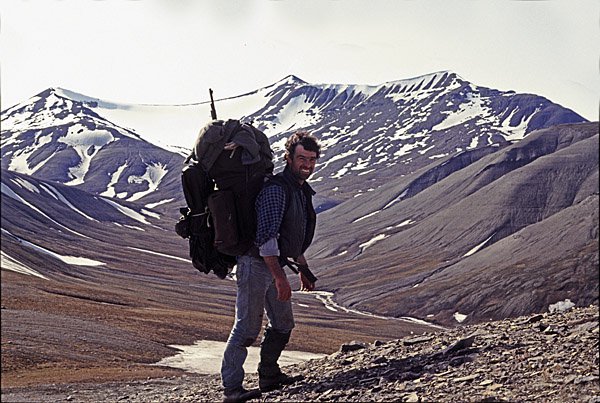
Colin Munro Svalbard expedition

I’ve always loved wild places. Spitzbergen, Svalbard. Wonder why I’ve a bad back now?

Returning to the UK and to university I eventually ended up with a masters degree – they were obviously keen to get rid of me – and so began a 20-odd year career participating in and running biological diving surveys. My photography career has grown in parallel to my marine biological work. Initially because pictures were required to illustrate reports and well…someone had to take them. My first camera was not a land camera but an underwater one, an ancient Nikonos III. Almost completely mechanical and fully manual, I spent many hours lost in concentration under an old wooden pier, gradually improving my skills through trial and error. Mostly error actually. The skills learned there did serve me well though. With no automation, no light meter and no automatic flash control you were forced to learn the fundamental laws of light and optics and the interaction with water. The turbid waters of the Clyde Estuary were not very forgiving, so one had to pay attention to these laws if you wanted to get any usable images at all out of a 36 exposure film roll.

Currently I am based in Exeter, south Devon, England, living on a rather old wooden trawler converted to sail (a ‘work in progress’). I split my time between photography, running workshops and lecturing and marine environmental survey. That is when not head down in the bilges of my boat cursing, effecting some repair, or escaping on to Dartmoor.

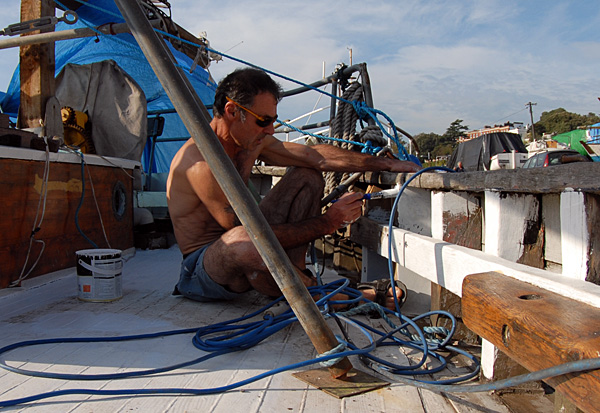
Colin Munro painting Maria

An old wooden boat is rather like the Forth Road Bridge. Painting and repairs never end.

Nowadays, where Photoshop is not just a software package but a verb, ‘he/she’s been Photoshopped‘, the concept that ‘the camera never lies‘ is one few of us still believe. But images are still powerful, and they still have the ability to change things. In a World now flooded with images it is unlikely a single image will ever have the same power to change the course of events as Nick Ut’s picture of Phan Thi Kim Phuc. Nevertheless we live in a image-based World and images can still change public perception and attitude to social and environmental issues in a way that dry, dusty reports never will. So for me taking pictures is, of course, about creating beautiful images, and it’s about the satisfaction of creating technically difficult or hard to get images; but the greatest satisfaction comes from creating images that inform or change peoples attitudes however slightly.

You can find me on Google+ , Facebook and LinkedIn.  Most of my stock photography images are available at http://colinmunro.photoshelter.com.  This can also be searched directly from my main website www.colinmunrophotography.com where you will also be able to buy fine art prints of my work and find information on photography training courses I run.
Back to my main website