A race against the rising water

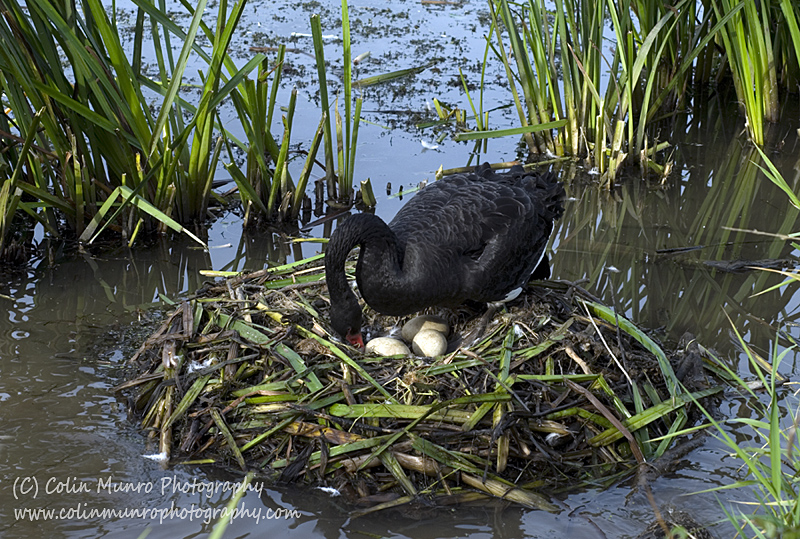
A black swan frantically tries to save her nest and eggs as the river water rises following torrential rains. Colin Munro Photography

A black swan tends her eggs in the nest she has constructed along the banks of the River Exe. Colin Munro Photography

A black swan tends her eggs in the nest she has constructed along the banks of the River Exe.


A black swan frantically tries to save her nest and eggs as the river water rises following torrential  rains. Colin Munro Photography

A black swan frantically tries to save her nest and eggs as the river water rises following torrential rains.

The human cost of the wettest summer in 100 years, lost income and damaged property, has been highin the Southwest.  The cost to wildlife has also been high.  The mute swans that gather on the River Exe in the centre of Exeter have failed to raise a single clutch this year.  At the end of September, an Austalian Black Swan (Cygnus atratus) attracted considerable interest as she tried to brood a small clutch of eggs along the riverbank.  The weather was warm, and drier than it had been for most of the summer.  perhaps she might be lucky.  However Sunday and Monday the 23rd and 24th were to test her to the limit.  Around 2am on the morning of the 23rd the rain becan to fall and the wind started to howl.  For more than 30 hours it rained, and as it rained the river rose.  By the early hours of the 24th she was already frantic, trying desperately to shore up her nest.  By 10am the nest was still there, but floating.  Although probably exhausted she moved incessantly, plucking reed blades of the bottom, trying vainly to build up her nest.  The eggs were still same, but became submerged when she sat on the nest.  She was engaged in a desperate race to raise the nest before the eggs lost too much heat. A black swan frantically tries to save her nest and eggs as the river water rises following torrential  rains. Colin Munro Photography

The black swan tries to move her eggs out of the water pooling in the centre of her nest as the river rises.

Although the rains had now stopped, at least temporarily, millions of gallons were still flowing down the river from high ground and so the river was continuing to rise. Passerby stopped to watch, and throw her bread, which is probably all she had time to eat since she had laid her eggs. No-one knew whether the eggs were fertile. She was the only black swan on the river all summer; tagging along at a safe distance with the larger mute swans that congregated along the quayside. But hybrids between mute and black swans were believed to have occurred in captivity. So it was just possible. And although the odds seemed against her, it was still possible her eggs main survive the flood.
This story will me expanded soon – and the whole story of the black swan and her nest will be told.
All images can be licenses from my Photoshelter website here Search black+swan

Lyme Bay, Lane’s Ground Reef: sponge species recovery and opportunities lost

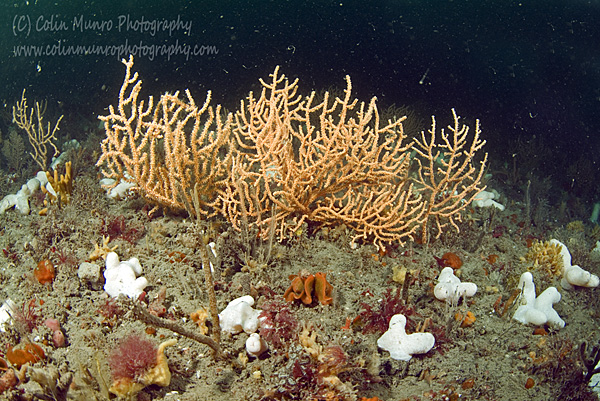
Lane's Ground Reef, a circalittoral boulder reef rich in sponges and ascidians, within Lyme Bay Closed Area, Lyme Bay, southwest England. Colin Munro Photography

This blog post has now moved to my Marine Biology website, Marine-bio-images.com. It can be read at:

Lyme Bay, Lane’s Ground Reef: sponge species recovery and opportunities lost

https://www.marine-bio-images.com/blog/lyme-bay-marine-ecology/lyme-bay-lanes-ground-reef-sponge-species-recovery-and-opportunities-lost/

New gallery: Lyme Bay Reefs and Lyme Bay Seabed stock images

Along the tide-swept crest of a low limestone ledge larger filter-feeding organisms flourish. Lyme Bay Reefs, Southwest England. (C) Colin Munro Photography.

New gallery uploaded – Lyme Bay Seabed Images and Lyme Bay Reefs

A rich epifaunal turf forms on the tide-swept edge of a rocky reef, Saw-tooth ledges Reef, Lyme bay, Southwest England. Colin Munro Photography

A rich epifaunal turf forms on the tide-swept edge of a rocky reef, Saw-tooth ledges Reef, Lyme bay, Southwest England. Image No. MBI001163

I’ve started creating a dedicated gallery of stock images documenting the seabed habitats and species of Lyme Bay. This gallery will include Lyme bay Reefs, for which the Lyme Bay Closed Area was set up to protect, and will catalogue the diversity of these reefs, but will also document some of the interesting sedimentary habitats which usually fail to receive the attention they merit.  These and more Lyme Bay images can be seen here.

A sediment covered limestone boulder reef in Lyme Bay, Southwest England. The bright yellow tassled sponge Iophon hyndmani or Iophonopsis nigricans (the two species  cannot be positively differentiated underwater) can be seen in the centre of the image; (C) Colin Munro Photography

A sediment covered limestone boulder reef in Lyme Bay, Southwest England. The bright yellow tassled sponge Iophon hyndmani or Iophonopsis nigricans (the two species cannot be positively differentiated underwater) can be seen in the centre of the image. Image No. MBI001162

Along the tide-swept crest of a low limestone ledge larger filter-feeding organisms flourish.  Lyme Bay Reefs, Southwest England. (C) Colin Munro Photography.

Along the tide-swept crest of a low limestone ledge larger filter-feeding organisms flourish. Lyme Bay Reefs, Southwest England. Image No. MBI001156

A scallop, Pecten maximus, swim away from a perceived threat. Gravel waves, Lyme Bay, Southwest England. (C) Colin Munro Photography

A scallop, Pecten maximus, swim away from a perceived threat. Gravel waves, Lyme Bay, Southwest England. Image No. MBI001173

All the images in this blog are available to license. To view a gallery (license images or purchase prints of) these, and more of my Lyme Bay seabed images go here. Alternatively you can search all my online stock images at my www.colinmunro.photoshelter.com site through the search box (top right) here or on my main website here. Lyme Bay Reefs images, Lyme Bay seabed images, stock images.


Lyme Bay, what makes it special?

Lyme Bay, what makes it special?

I’ve published about Lyme Bay marine biological monitoring on my marine-bio-images blog   here and earlier on this blog here, looking at the monitoring of Lyme Bay Closed Area, a Marine protected Area success? Parts 1 and 2 describe the impacts mobile fishing gear, in particular scallop dredging, had been having on the reefs since at least the late 1980s. I describe the impacts of scallop dredging in detail here. I will look soon at the actual monitoring that has taken place since the closed area came in to being in 2008, but before doing so it is probably worth devoting a couple of blogs to describe why Lyme Bay is important and worth protecting; just what makes it special.

What Lyme Bay is not

In seeking to justify protection for the reefs and ‘sell’ the area to the wider public, the concepts of ‘coral gardens’ and ‘charismatic species’ has often been pushed.  Such poetic language may well raise the area’s profile and engender support in the short term, but it has lead to some fairly profound misunderstandings – including within NGOs and Government Agencies – about the bay and the reasons the reefs within are important.

A sediment covered limestone reef in Lyme Bay, Southwest England showing the profusion of sediment tolerant species that grow on such reefs. Colin Munro Photography.

A sediment covered limestone reef in Lyme Bay, Southwest England showing the profusion of sediment tolerant species that grow on such reefs. Image No. MBI001261.

Most of Lyme bay is not visually spectacular, there are few dramatic underwater rock cliffs painted with a riot of colour; nor is it beautiful clear water offering panoramic vistas across the seabed.  The reefs in Lyme bay are mostly low lying and the waters tend to be fairly gloomy and turbid.  As this is essentially a large, open, sandy bay exposed to the prevailing winds, then significant amounts of suspended sediment (at least near-shore, close to the seabed) are the norm.  Whilst winds may ease in summer, it is also prone to strong plankton blooms during May and June, with a second less pronounced bloom in late summer.  Thus underwater visibility rarely exceeds 10 metres (30ft) and frequently may be less than 3 metres (10ft).  The reefs in the bay, though numerous in the centre and east, are mostly discontinuous, forming a patchwork of low rocky outcrops surrounded by sediment.  This means that they tend to be covered by thin veneers of sediment as tide and wave action lifts and sweeps saltating sand across them.  The amount of sand will vary, depending on the size of the reef area, how high the reef rises above the surrounding sediment plain, the strength of tidal streams in that part of the bay and how strong the wind has been recently (and thus how big the waves).  This makes it a rather challenging environment both the underwater photographer and scientist attempting to record visual data.  Low light levels and high levels of suspended sediment producing lots of backscatter from lights making for tricky problems in producing good images.
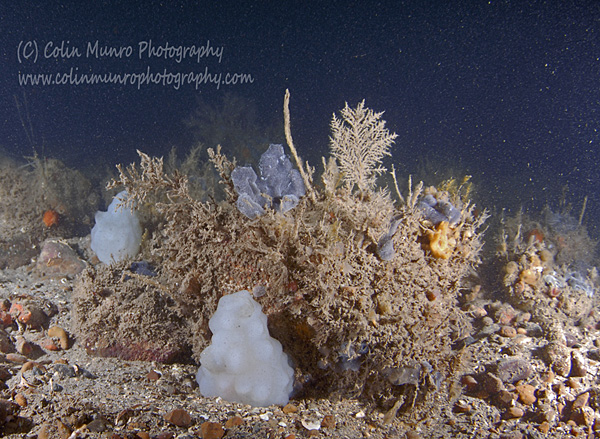
An area of sediment covered boulder reef, Lyme Bay. The large white sea squirt Phallusia mammillata, and the blue-grey colonial sea squirt Diplosoma spongiforme, both characteristic of Lyme Bay, can be seen in this image. Image No. MBI001264. Colin Munro Photography

An area of sediment covered boulder reef, Lyme Bay. The large white sea squirt Phallusia mammillata, and the blue-grey colonial sea squirt Diplosoma spongiforme, both characteristic of Lyme Bay, can be seen in this image. Image No. MBI001264.

The species that make Lyme Bay different and the effects of the Closed Area

The flip side of this is that the communities on these reefs tend to be rather different from those inhabiting areas with perhaps more visually spectacular ‘clean’ reefs further west.  Species that tolerate a degree of sand and silt cover do well here.  A good example of this is the sponge Adreus fascicularis, a species found almost exclusively on silt-covered horizontal bedrock  Considered rare in UK waters, it is relatively common  on the reefs of Lyme Bay.  Similarly the large solitary sea squirt Phallusia mamillata.  A very distinctive species, the largest sea squirt found around British coasts its striking white colour stands out against the dull sediment.  More associated with silty, sheltered harbours and estuaries it is uncommon or rare on open coasts along the rest of its UK range, but quite abundant within Lyme Bay.  So the factors that make this a difficult environment in which to capture appealing images or gather data on the marine life in quite a significant contribute to Lyme Bay being an interesting and unusual environment. There are other species common here that we simply do not known enough about their ecology to say why they are more abundant in Lyme bay than elsewhere; a good example of this is the colonial sea squirt Diplosoma spongiforme. Though not rare elsewhere, it is abundant in Lyme Bay, forming mats, growing over rocks, seafans and other sponges. Similarly the tassled yellow sponge Iophon hyndmani/Iophonopsis nigricans (the two species are grouped together as very difficult to tell apart underwater) is particularly abundant in Lyme Bay. Indeed the sponge assemblages are frequently very rich and diverse on Lyme Bay reefs; for some reefs such as the boulder reefs (for example Lane’s Ground Reef in the central part of Lyme Bay) they are probably the most obvious characteristic of the reef and may well be the most diverse groups within the reef community there. Unfortunately they are still very poorly described (in part because sponge taxonomy is a difficult subject with field characteristics often not being sufficient for positive identification) and so are certainly under-reported and thus frequently undervalued in terms of the Bay’s conservation value. Yet sponges, being soft tissued and quite often slow-growing species, are amongst the most vulnerable to damage and eradication from areas of reef by mobile fishing gear. Indeed the sharp decline in sponge species occurring on Lane’s Ground Reef between 1995 and 2008 (clearly visible for video footage and still images taken by myself during this time period) was one of the most obvious and disturbing changes in the years before statutory protection from bottom-towed mobile fishing was established for central Lyme Bay.
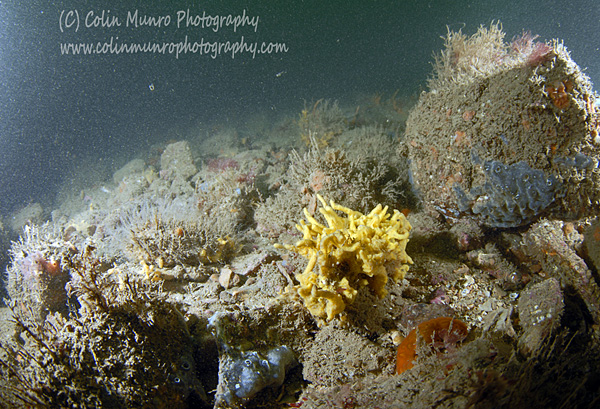
Boulder reef, Lyme Bay.  The amount of suspended sediment in the water can be clearly seen.  The yellow tassled sponge Iophon hyndmani or Iophonopsis nigricans can be seen in the centre of the image, however the lack of sponges (and other attached life) compared to previous years is clear. Image No. MBI001267

Boulder reef, Lyme Bay. The amount of suspended sediment in the water can be clearly seen. The yellow tassled sponge Iophon hyndmani or Iophonopsis nigricans can be seen in the centre of the image, however it can be seen that many of the boulders are now (2010) bare of sponges and other attached life. Image No. MBI001267

Has there been a recovery of sponge species since the Closed Area was established in 2008? Our study (running from 2008-2010, when funding from Natural England ended) suggested that sponge recovery was beginning. Three years is too short a time in which to expect marked changes in such communities. It would also be foolish to read much in this data, three annual surveys (i.e. data being collected once a year for three years) represent only three data points. There will obviously be good years and bad years, plus a degree of error in any data collected, so a line drawn from three data points must come with huge caveats. Nevertheless, this slight improvement was noticeable. We are hopeful that we will be able to re-start our monitoring programme, albeit in a slightly reduced form, on a voluntary basis in 2013. It will be exciting to see what effects the Closed Area has had on the reef communities after five years.

More information about Lyme Bay, in particular the impacts of scallop dredging and the protected Closed Area, can be found on my marine biology blog www.marine-bio-images.com/blog, and on the marine-bio-images website where numerous reports on the research we have conducted here can be found.

All text and images in this blog copyright Colin Munro 2012.  All images are available to license.    Alternatively you can search all my online stock images at my www.colinmunroimages.com  site through the search box (top right) or on my main website here.

Flying crabs and flailing birdmen

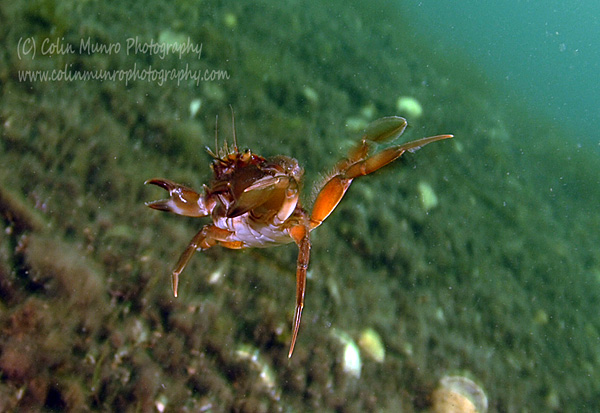
Swimming crab, Liocarcinus depurator, swimming in mid-water. This crab is also known as the harbour crab, blue-legged swimming crab and sandy swimming crab. Colin Munro Photography.

All the images in this blog are available to license.  To view a gallery (license images or purchase prints of) these, and more of my North east Atlantic marine invertebrate images go here.  Alternatively you can search all my online stock images at my www.colinmunro.photoshelter.com  site through the search box (top right) here or on my main website here.  swimming crab images, Liocarcinus depurator images, necora puber images, stock images.
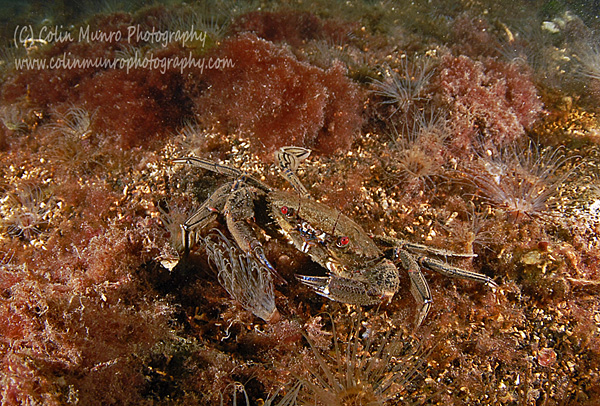
Flying crabs
A crab is neither the most graceful nor aerodynamic creature in the sea.  Okay you probably knew that already.  At first glance it does not appear to be designed for flight, its squat, angular body, entirely encased in a thick, heavy shell.  A crab attempting to fly would seem as sensible as attempting to run a marathon wearing a suit of armour.  But then, as anyone who has watched the London marathon will know, people do attempt – and succeeded  – in running marathons in suits of armour.  So why shouldn’t crabs fly?

I have been a little loose with the term ‘fly’; okay, they fly underwater.  They are collectively known as swimming crabs.  This group includes such species as the blue crab (Callinnectes sapidus) which is found around the coasts of North and South America, the red-eyed and fearless velvet swimming crab (Necora puber) that is common on shallow rocky reefs around the coast of UK and much of Europe, and the blue-legged swimming crab (Liocarcinus depurator) also common in shallow waters around UK and Europe but preferring sandier areas.

A velvet swimming crab, Necora puber (previously known as Liocarcinus puber) adopts a defensive posture as it moves across a maerl gravel seabed. Colin Munro Photography.

the distinctive wild red eyes and aggressive posture of a velver swimming crab (Necora puber). Note the broad swimmerets. Image No. MBI001256

A common feature of all these crabs is the adaptation of the fifth walking leg for propulsion through the water.  Crab legs are mostly fairly spindly affairs, ending in points on which they tippy-toe across the sea bed.  The final articulated segment of swimming crab legs is flattened and splayed into a paddle shape.  Additionally they are edged with long thick hairs, effectively widening the paddle blade.  These swimming legs are known as pleopods (from the Greek plein, to sail or to swim, and pods – legs) or swimmerets.

Swimming crab, Liocarcinus depurator, swimming in mid-water.  This crab is also known as the harbour crab, blue-legged swimming crab and sandy swimming crab. Colin Munro Photography.

Swimming crab, Liocarcinus depurator, swimming in mid-water. Image No. MBI001254.

I started this by stating that crabs were not really designed to fly (or swim for that matter).  This is true.  Swimming marine creatures conjures up images of graceful fluid movements.  That is not swimming crabs.  Generally swimming crabs swim when disturbed, as a means of escaping real or perceived danger.  They launch themselves off the seabed, flailing wildly as if convulsing through being wired up to high voltage electricity.  For seconds, or at most a few minutes, the crab will move erratically through the water.  As it tires its legs will slow; the crab will drift back down to the seabed, to scuttle away hopefully haven shaken off its pursuer.

Swimming crab, Liocarcinus depurator, swimming in mid-water.  This crab is also known as the harbour crab, blue-legged swimming crab and sandy swimming crab. Colin Munro Photography.

Close up of a swimming crab, Liocarcinus depurator, swimming in mid-water. Image No. MBI001254CP2

Watching a crab frantically waving its legs in an attempt to defy gravity, as it descends inexorably back to solid seabed I am always struck by the uncanny resemblance to another quirky British tradition (apart from wearing ridiculous costumes for marathons) that of the birdman competition.  This is an annual event held in several seaside towns, most notably Bognor Regis, where the great British eccentric emerges to don one-piece stripey swimsuits, circa 1900, batman masks, vinyl capes and wings that appear to be constructed from broom handles and ostrich feathers.  Suitably attired they launch themselves off the end of the town jetty.  Arms flaying wildly in an attempt to defy gravity (now you see where I’m coming from) they perform a graceless parabola and they too, descend inexorably to the sea below.

The first birdman competition (according to Wikipedia) occurred in Selsey, West Sussex, in 1971.  How long have crabs been launching themselves off the seabed, attempting to escape the limitations imposed by a million years of evolution, no-one knows.  Perhaps they have been sitting, half-buried, on the seabed, watching and pondering on ill-designed creatures in strange garb plunge in to the sea as they attempt to escape their own limitations.  Perhaps flying crabs are a recent phenomenon, the dreamers inspired by eccentrics in sleepy seaside towns.

Lyme Bay Marine Protected Area: How effective is it? update

Lyme Bay Marine Protected Area: How effective is it? update

Five days ago the skipper/owner of a Brixham based trawler/scallop dredger, the Kelly Marina II (BM454) was convicted and fined for using towed bottom-fishing gear (apparently scallop dredges) within Lyme Bay Closed Area, a 60 nautical mile exclusion zone for such gear.  This Closed Area was established for conservation reasons (the first and so far only one established for such reasons in U.K. waters), specifically the rocky reefs that occur in the Bay and their associated fauna.  So, given the high profile of this recently established protected area, (widely regarded as a flagship protect and a test area for such marine pretected areas in UK waters), and given the long and protracted process (18 years between concerns being years and statutory protection finally arriving) of establishing this Closed Area, then no doubt the authorities would be keen to show that this is not just the ‘same old routine’.  One imagines they would be keen to show that this was a step change and that they were no serious about conservation.  Given also that it is quite impossible to adequately police such an area then one images that stiff punative fines would be the order of the day to send out a clear message concerning the risks if you get caught breaking the rules.  The difficulty in policing was clearly demonstrated by the fact the evidence of this vessel’s transgression was captured by a Dorset Police helicopter seconded from the Air Surveillence Unit.  One immediately wonders how often this happens when police helicopters are not around.  So, given these factors there would obviously have been a very stiff fine….er no.  The fine was £1000, plus £3000 costs and £15 victim surcharge (what?).  So a grand total of £4015; that’s just a few good days earnings for such a vessel.  now imagine a house burglar stealing televisions.  Let’s say each is worth £150 resale value.  He only does this occasionally, so manages to nick five a month on average; not bad:£750 easily earned.  Then he get’s caught, Damn! But not to worry, his fine is only 350 quid, he’s still £400 in pocket.  Not much of a deterrent is it?  Nor does it send a great message to the majority of fishermen who are abiding by the rules and incurring greater costs by having to steam further to fish outside the Closed Area (thus greater fuel costs, longer steaming time and so shorter fishing times).  The fine was imposed by Weymouth Magistrate’s Court.  You can read further details on the marine management website here.

Edible crabs, a little natural history.

Edible crab or brown crab, Cancer pagurus, close up, showing eyes. Colin Munro Photography

All the images in this blog are available to license.  To view a gallery (license images or purchase prints of) these, and more of my North east Atlantic marine invertebrate images go here.  Alternatively you can search all my online stock images at my www.colinmunro.photoshelter.com  site through the search box (top right) here or on my main website here.  Edible crab images, Cancer pagurus images, stock images.

Edible crabs
The pie-crust edged shell of the European edible crab, Cancer pagurus, is one of the most familiar sights in fishmongers windows and supermarket fish counters. Known by British fishermen as the brown crab, due to the deep reddish-brown colouration of its shell.  This is the crab we normally eat as ‘dressed crab’, with the crab meat served arranged in the open crab shell.  Juvenile edible crabs are often found under boulders by children rock pooling on the shore, their reddish-brown colour and much more chunky claws (chelipeds) easily distinuishing them from the more common shore crab (Carcinus maenus).

Edible crab or brown crab, Cancer pagurus, close up, showing eyes. Colin Munro Photography

Edible crab or brown crab, Cancer pagurus, close up, showing eyes. MBI000266

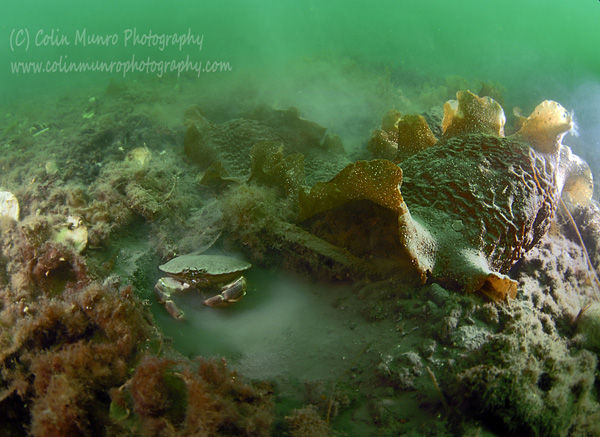
Adults generally live further offshore, down to about 200 metres depth.  Away from rocky areas edible crabs tend to bury themselves in ther sediment.  They’re pretty well camouflaged when they do this, one has to look pretty hard to make out the outline of their shell or see the two beady little eyes watching to see if you’ve spotted them.

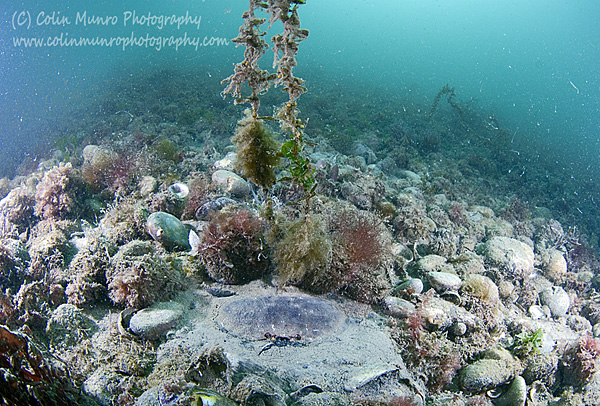
An edible crab, Cancer pagurus, lying hidden in a shallow depression it has dug in the sediment. Colin Munro Photography

An edible crab, Cancer pagurus, lying hidden in a shallow depression it has dug in the sediment. Image No. MBI001178

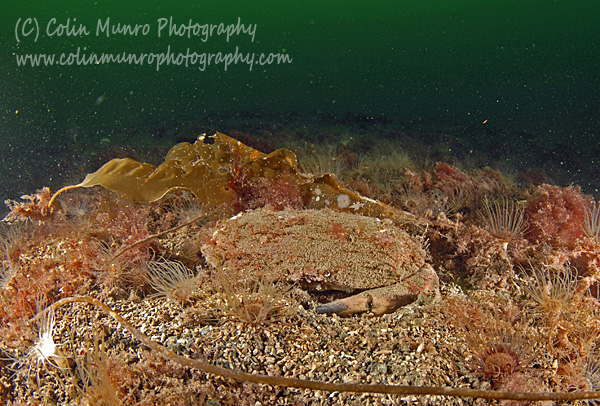
Edible crabs are prodigious excavators of sandy or muddy seabeds.  During the course of a dive one can often observe numerous large shallow ‘craters’ created by edible crabs.

An edible crab, Cancer pagurus, digs in to algae covered sediment to create a depression in which to hide. Colin Munro Photography

An edible crab, Cancer pagurus, digs in to algae covered sediment to create a depression in which to hide. Image No. MBI001171

Migrations
Within the English Channel edible crabs undertake interesting migrations.  Females tend to move west or southwest; they can travel 2-3 kilometers a day, with some travelling up to 200 miles.  They larvae, which are planktonic for 60-90 days, tend to drift east, thus restocking the areas from which the adults migrated (Pawson, 1995).  Mating occurs in spring, shortly after the females have moulted, but the sperm is stored by the females and eggs are fertilised once they move offshore the following winter.

Lifespan and minimum landing sizes
Edible crabs generally live for 25-30 years.  There are various reports of them living up to 100 years but it’s hard to assess how reliable these reports are.  The minum landing size various regionally in UK waters between 130 and 140mm across the carapace.  In Devon, Cornwall and the Scilly Isles this is increased (for male crabs only) to 160mm.

Fun facts
The largest edible crab ever caught in British waters is believed to be one landed, not by a commercial fisherman, but by an amatuer diver.  Paul Worsley landed a 17lb crab with a 12 inch wide shell in July 2008.  This monster was caught on the wreck of the Empress of India, a British battleship dating from the 1890s that lies in deep water in Lyme Bay, Southwest England.

An edible crab, Cancer pagurus, raises its large heavy claws (chelipeds) adopting a defensive posture. Colin Munro Photography

An edible crab, Cancer pagurus, raises its large heavy claws (chelipeds) adopting a defensive posture. Image No. MBI001249

An edible crab, Cancer pagurus, attempting to hide in maerl gravel. Colin Munro Photography

An edible crab, Cancer pagurus, attempting to hide in maerl gravel. Image No. MBI001250

All images copyright Colin Munro
www.colinmunrophotography.com
www.colinmunro.photoshelter.com

All the images in this blog are available to license.  To view a gallery (license images or purchase prints of) these, and more of my North east Atlantic marine invertebrate images go here.  Alternatively you can search all my online stock images at my www.colinmunro.photoshelter.com  site through the search box (top right) here or on my main website here.

References
Pawson, M., G. 1995. Biogeographical identification of English Channel fish and shellfish stocks. Fisheries Research Technical Report (number 99), MAFF Direct Fisheries Research Lowestoft, England. Available from: http://www.cefas.co.uk/Publications/techrep/tech99.pdf

About Me

About Me
Colin Munro Dartmoor Devon in tent before dawn mid-winter

Feeling very motivated. Making coffee still in my sleeping bag, about and hour before dawn, Dartmoor, mid-winter.

I thought it about time I put a bit about me on my website, who I am, what I do, what I’ve done that’s fit to print and what motivates me…why I do it. So here goes.

My twin passions are the marine environment and photography. I’ve been a diver for a long time. I started out a thousand years or so back as an army diver in the British army, however after far too long grovelling around in freezing cold black water in the middle of the night I finally accepted that this wasn’t going to bring me the lifestyle that watching every episode of The Undersea World of Jacques Cousteau had led me to expect. So at 19 I ended up in Africa, Mombasa to be precise, more by accident than design. I spent a couple of seasons there working on the wreck of the Santo Antonio de Tanna a 17th Century Portuguese shipwreck, then a short spell as a ship’s diver on an ocean going salvage tug, but what Kenya did mostly was rekindle my passion for wildlife and wild places.

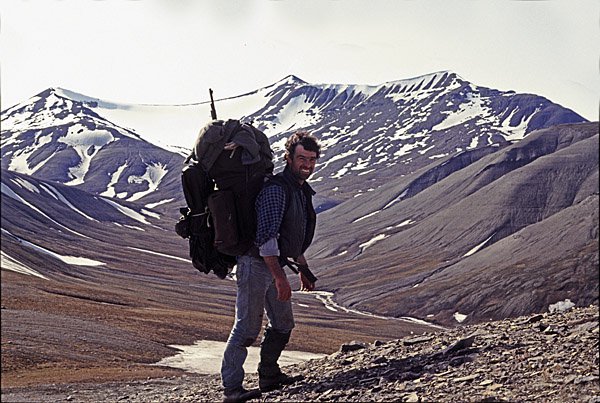
Colin Munro Svalbard expedition

I’ve always loved wild places. Spitzbergen, Svalbard. Wonder why I’ve a bad back now?

Returning to the UK and to university I eventually ended up with a masters degree – they were obviously keen to get rid of me – and so began a 20-odd year career participating in and running biological diving surveys. My photography career has grown in parallel to my marine biological work. Initially because pictures were required to illustrate reports and well…someone had to take them. My first camera was not a land camera but an underwater one, an ancient Nikonos III. Almost completely mechanical and fully manual, I spent many hours lost in concentration under an old wooden pier, gradually improving my skills through trial and error. Mostly error actually. The skills learned there did serve me well though. With no automation, no light meter and no automatic flash control you were forced to learn the fundamental laws of light and optics and the interaction with water. The turbid waters of the Clyde Estuary were not very forgiving, so one had to pay attention to these laws if you wanted to get any usable images at all out of a 36 exposure film roll.

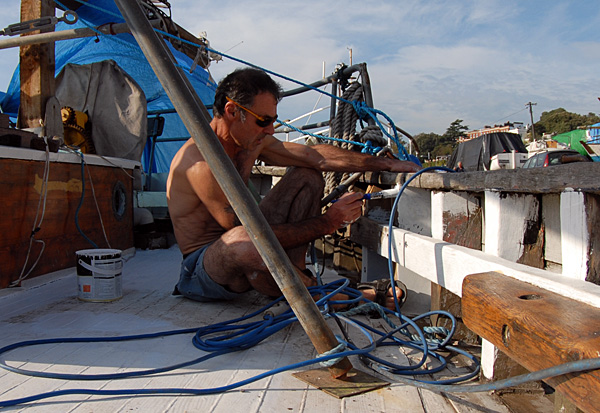
Currently I am based in Exeter, south Devon, England, living on a rather old wooden trawler converted to sail (a ‘work in progress’). I split my time between photography, running workshops and lecturing and marine environmental survey. That is when not head down in the bilges of my boat cursing, effecting some repair, or escaping on to Dartmoor.

Colin Munro painting Maria

An old wooden boat is rather like the Forth Road Bridge. Painting and repairs never end.

Nowadays, where Photoshop is not just a software package but a verb, ‘he/she’s been Photoshopped‘, the concept that ‘the camera never lies‘ is one few of us still believe. But images are still powerful, and they still have the ability to change things. In a World now flooded with images it is unlikely a single image will ever have the same power to change the course of events as Nick Ut’s picture of Phan Thi Kim Phuc. Nevertheless we live in a image-based World and images can still change public perception and attitude to social and environmental issues in a way that dry, dusty reports never will. So for me taking pictures is, of course, about creating beautiful images, and it’s about the satisfaction of creating technically difficult or hard to get images; but the greatest satisfaction comes from creating images that inform or change peoples attitudes however slightly.

You can find me on Google+ , Facebook and LinkedIn.  Most of my stock photography images are available at http://colinmunro.photoshelter.com.  This can also be searched directly from my main website www.colinmunrophotography.com where you will also be able to buy fine art prints of my work and find information on photography training courses I run.
Back to my main website

Lyme Bay Closed Area, a Marine Protected Area success? Part 2.

Lyme Bay Closed Area, a Marine Protected Area success? Part 2.

This post follows on from Lyme Bay Closed Area, a Marine Protected Area success? Part 1, which described the damage first noted on rocky reefs in Lyme bay, Southwest England, from scallop dredging during the 1990s. This post describes the voluntary agreements set up and the ongoing problems.
As described in Part 1, the condition of the reefs in Lyme Bay had begun to deteriorate markedly by the early 1990s, and this deterioration continued more or less unchecked over the next 12 or 13 years. It would however, be wrong to suggest that all reefs were suffering equally or that nothing was happening to change this situation. Some reefs were simply too rugged for any sort of mobile fishing gear to ever be towed across them, however even they suffered from degradation around the edges. Others that were more easily worked were devastated.

The Devon Wildlife Trust had been working hard with local fishermen since the early 1990s, and voluntary agreements had been set up voluntary agreements whereby trawlers and scallop dredgers would not work in the most fragile reef habitats. The first such agreement extended voluntary protection to two reefs (known locally as Lane’s Ground, a boulder reef rich in sponges, and The Saw-Tooth Ledges, a series of limestone ledges supporting abundant seafans, soft corals and sponges). Two additional reefs were added to this agreement in 2006, The East Tennants Reef, a boulder reef supporting high densities of large seafans, and Beer Home Ground, a reef of ledges and rocky promentories composed of softer mudtstone and sandstone amongst harder limestone that had suffered quite badly from reef erosion through the action of scallop dredges. However problems remained. The first was that however sincere most local fishermen were, there was always the problem that some from further afield would see no need to abide by this agreement and, it has to be said, not all local fishermen agreed with the closure. It only took one vessel operating within the voluntary closures, maybe late at night or early morning when they were unlikley to be spotted, to cause damage that would last for years. The second problem was that the four voluntary areas were small and in no way enclosed all of even the most vulnerable reefs. An example of this is the West Tennants Reef. This is an very extensive reef in Lyme Bay terms. It is a low limestone ledge, or series of ledges, that runs parallel to the shore, about 4 miles offshore and roughly 29 metres below sea level. Although only around 10-30 metres wide over much of its length, it runs east-west for over two miles. The ledge is fairly level and free of rocky protrusions, and drops less than a metre to the surrounding seabed, thus it was very easily worked from the top of the ledge, dredges running along, parallel to the edge before eventually dropping of the edge. Strong currents sweep along this ledge, and in the early 1990s a dense band of very large seafans grew along this ledge, along with significant numbers of large axinellid sponges.

Large Axinellid sponge (Axinella dissimilis) and seafans. Most of the West Tennants Reef used to look like this.

The band was not wide, perhaps no more than 8-10 metres across, but extended for nearly two miles East-West. Although the East Tennants Reef nearby had higher densities of seafans but, simply due to its size, the west Tennants Reef supported more large seafans than any other reef in Lyme Bay. Indeed it was one of the most extensive continuous beds of large seafans in UK waters. Unfortunately, by 2007 most of these large seafans (and large sponges) had gone. As part of a wider study, I conducted a remote video survey along the reef in the summer of 2007. Instead of a dense continuous bed of seafans we found isolated patches and extensive areas of bare reef. We also saw many recently detached large seafans lying flat on the seabed and scallop dredgers working nearby. We returned a couple of days later to dive the reef and capture some better video. This can be seen here: West Tennants Reef, 2007.


It was clear that the situation in Lyme bay was continuing to deteriorate. Fortunately major changes to rectify this were also happening. Following a lengthy consultation process, with proposals submitted by the Natural England, Conservation NGOs (in particular the Wildlife Trusts) and the fishing industry, DEFRA announced that an area of some 60 square nautical miles in the central part of Lyme Bay was to be closed to mobile fishing gear by Statutory Order. There have undoubtedly been a few vessels that continued to work inside the closed area at night, especially during the first couple of years. However it’s fair to say that by and large this has been a success, in terms of maintaining an area free from the impacts of mobile bottom fishing gear. So how has that been reflected in changes, or recovery, of the fauna of the reefs within the closed area. In order to assess this two parallel studies were set up, one by Plymouth University using remote video, and one conducted by ourselves (that is my consultancy Marine Bio-images) with divers recording life at fixed stations. Data was collected over three summers; 2008, 2009 and 2010, and the findings of these studies have now been analysed and are about to be published. The next part of this blog will look in more detail at what we found and what seems to have changed since the closed area was established.

Update 10th July 2012, New blog: Lyme Bay, what makes it special?
All images and text (C) Colin Munro Photography.