Lyme Bay Closed Area, a Marine Protected Area success? Part 1.

Lyme Bay Closed Area, a Marine Protected Area success? Part 1.

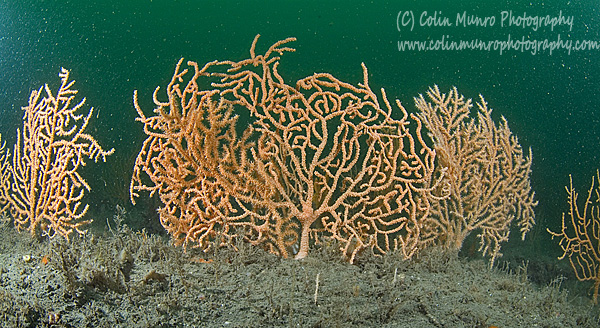
Dense beds of mature pink seafans (Eunicella verrucosa), some almost a metre across, growing on pristine reef in Lyme Bay.

In 2008, the UK Government Department for Environment, Food and Rural Affairs (DEFRA) closed an area of Lyme Bay, some 60 square miles in extent, roughly 10 per cent of the bay, to mobile benthic fishing gear. By mobile benthic fishing gear I mean gear that is towed across the seabed, i.e. bottom fishing trawl nets and scallop dredges. This closure was brought in to protect fragile seabed habitats and the associated marine life, in particular the subtidal rocky reefs and boulder and cobble reefs, known to occur in the central and eastern part of the bay. We’ve known for a long time, at least the late 1980s, that such heavy gear could be highly destructive to some reef species, especially fragile or soft tissued attached species such as sponges and soft corals. Of greatest concern was the increase in scallop dredging. Changes in the quota system, markets and fish prices had lead to the number of boats working with scallop dredges increasing dramatically in the late 1980s. The number of boats operating solely as scallop dredgers had also increased (vessels will often switch gear thoughout the year as fish species migrate and quotas change); thus the overall intensity of scalloping had rocketed. As far back as 1991, I conducted dive surveys for the Devon Wildlife Trust; we had heard reports from recreational divers of swathes of destruction on previously pristine reef areas. What we found was even more disturbing, not only were areas of reef being scraped clean of attached life, the very stucture of the reef was changing.
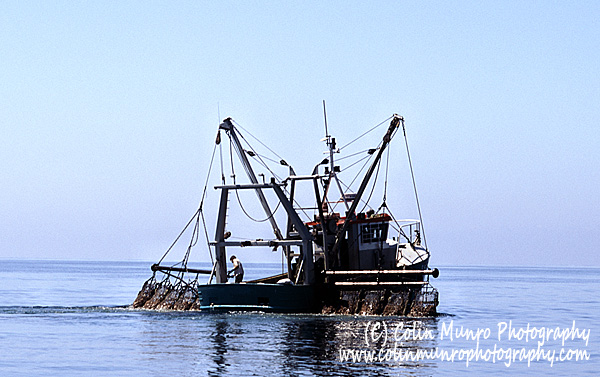
Scallop dredger in Lyme Bay. A scallop dredger hauling dredges (4 each side) to emtpy catch.

Amongst the more interesting reef areas in Lyme Bay are the boulder and cobble reefs and the mudstone ledge reefs. Boulder and cobble reefs are basically level boulder fields, most of the boulders are small, roughly football-sized and so the heavy scallop dredges can bounce and rattle across these boulders without getting damaged themselves, picking up the occasional scallop as they go. What also happens though is that the boulders are lifted out of the sediment, rolled along and banged together. As this happens the sponges and soft corals growing on the boulders are ripped off or ground to shreds. The steel teeth of the dredges rake into the sediment as the dredge travels, stirring up clouds of sediment which then subsequently settles on top of the boulders. The attached species that managed to survive intact are then smothered in a layer of sediment, blocking their delicate filter-feeding organs.


Mudstone reefs are composed of blue lias clay. This is the same hard, slate-like clay that can be seen in the fossil-rich cliffs that line much of the coast of Lyme Bay. As this clay can easily be shattered by a fossil hunters hammer, the effects of half a ton of toothed dredges being hauled across such ledges by a powerful fishing boat are quite devastating. The ledges simply crumble. Now as any good marine biologist knows, most of the larger attached fauna on reefs are filter feeding organisms – sponges, hydroids, soft corals, bryozoans etc., and as every hydrographer (and diver) knows, currents accelerate around the edges of ledges and promentories due to entrainment. So of course all the life clusters around the edges of ledges where the rich feeding currents are. Grind away the edges and you remove maybe 80% of the attached fauna and – most importantly – virtually all the large colonies. The large colonies are the structure-forming ones that provide new niches for other species, they are often the slow-growing species that can take years to re-establish (where possible), and they are also the ones with the largest reproductive potential: for example, a big seafan colony that’s maybe 15 or 20 years old is going to release many time more eggs or larvae than a little one about 5 years old thats only just reached reporductive maturity. So when the big colonies are removed this alone may drastically affect the ability of a species to maintain or re-establish its population in an area.
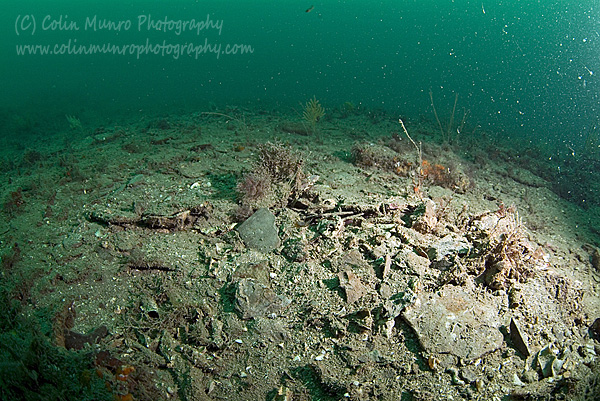
Reef badly damaged by scallop dredgers. Lyme Bay. Colin Munro Photography.

Reef badly damaged by scallop dredgers

So to put it mildly, the situation was not good, and was rapidly deteriorating. It only took one boat working across a reef to remove so much life that it would take years for recovery to occur. Six months of boats intensively working an area could (and did) irreversably change the structure of some reefs. As scallop stocks declined on the so-called ‘clean ground’ (areas of sandy seabed) boast began to work closer to the edges of reefs, nibbling away at the edges. Fish finders and echo sounders improved in quality, so skippers could see exactly which way ledges rose up, enabling them to work close around the most rugged ledges and pinnacles. DECCA became standard for position fixing, then was replaced by GPS, allowing every more accurate positioning of where the roughest points to be avoided were, so boats could work into reefs where previously they dare not enter. The power of vessels also increased, so when dredges did become stuck fast on a rocky ledge or large boulder the solution was often to turn on the power and pull free, often with devastating consequences for the reef. I personally witnessed this many times over the years. Boats would dredge right up the the edge of a reef, gradually extending further and further in to it through the day as the edges were ground down or boulders rolled away. Occasionally a dredger would come fast. You could see it stop dead in the water and list over to one side where the dredges on that side were caught. Watching from a couple of hundred metres away you would hear the engine rev, see the vessel sink deeper on the caught side, then suddenly lurch free to carry on around again.

Scallop dredger heeling over as the dredges on one side catch fast on the seabed. Lyme Bay. Colin Munro Photography.

Scallop dredger heeling over as the dredges on one side catch fast on the seabed.

On one occasion (whilst conducting dive surveys on a reef composed of large limestone boulders) we watched twelve dredgers work around in tight circles clipping in to the reef again and again for over six hours. We took position fixes and returned at dusk with stills and video cameras. It was about forty minutes steaming time to reach this offshore reef and the sun was disappearing as we descended to the reef and swum on a bearing towards where we had seen the boats working. It was quite black without lights when we hit the bottom at around 28 metres, visibility was very poor as the water was still full of suspended sediment from the dredgers working earlier. Even so the transition from pristine to ‘worked’ reef was clear cut and the devastating effects of that one day’s dredging were unmistakable. The entire seabed was carpeted in a layer of fine sediment, detached soft corals drifted loosely across the reef, detached seafans lay flat partially buried in sediment, fragments of the plates of ross coral (a bryozoan) littered the reef. Large boulders lay overturned with still attached seafans protruding from underneath. Only isolated patched of undisturbed reef remained where the dredgers had been working. Video footage taken during this dive, showing pristine reef from the start of the dive and damaged reef encountered later in the dive, can be downloaded from the link below (48Mb, plays in Windows Media Player or Quicktime Player).
East Tennants Reef following scallop dredging 2002


Thus began a long road to the establishment of protection for the reefs. An 18 year long campaign driven by the Devon Wildlife Trust finally lead to stautory protection for the reefs in 2008. So what has this acheived? I’ll address this in Part 2 of this blog.

Update 10th July 2012, New blog: Lyme Bay, what makes it special?
All images and text (C) Colin Munro Photography.


African migrants, the unseen deaths.

African migrants, the unseen deaths.

Late on Friday the 13th of January this year the cruise liner Costa Concordia hit rocks near the island of Giglio, off the west coast of Italy. At the time of writing the confirmed death toll had risen to 17, with a further 21 still missing. This was an undoubted tragedy for all directly involved and their loved ones. It has reverberated around the World; the tiny island of Giglio has been overrun by correspondents and camera crew from CNN, ABC, BBC, Al Jazeera and just about every other major broadcaster and news media company; our television screens, radios and internet news has been flooded with images of the stricken ship and the survivors. It is an event that very few in the western world will be unaware of. Yet on the other side of the Mediterranean, off North Africa, a greater tragedy has been steadily unfolding, one that receives very little publicity.

In 2011, according to the UN Refugee Agency, at least 1500 people died or disappeared trying to cross the Mediterranean from North Africa to a new life in Europe. This included 25 who died of asphyxiation due to being crammed in to a tiny, unventilated engine room. The boat, a mere 15 metres long, was carrying 271 refugees. This happened in August last year; anyone remember it making news headlines? Fifteen are believed to have drowned already in the first month of 2012, attempting to cross from Libya. The Mediterranean can be a forbidding place to be in a small vessel in the middle of winter. It takes no small measure of courage and probably an even larger measure of desperation to set off in an open wooden boat of dubious seaworthiness to cross hundred miles of sea to a destination you know little about. The wind will often rise suddenly off the coast of Libya; a mirror smooth sea will transform into a confusion of whitecaps in a couple of hours. The vessel that appeared large and robust in harbour now appears small and flimsy in such conditions. The fear that mounting seas in an open boat generates is a visceral thing, even when one is used to spending time at sea. In darkness, in winter, in what for most would be their first time at sea, the feeling of panic would be hard to control.

These small fishing boats carry no lifejackets, no flares, no radios, no lights. They are not guided by GPS; the ones I have been on do not even carry a compass. when we do hear of refugees drowning whilst heading for Southern Europe it is generally no more than a brief, factual snippet in the news. No camera crews are despatched, no interviews with survivors that are picked up. The mainstream media collectively determines it is probably of little interest to most of us, so we learn little about it from them, and thus it remains of little interest to us. A drip, drip of people dying trying to reach here, of which we are largely oblivious.

About four years ago I was working in Libya when one such, migrant-carrying, fishing boat capsized. It was a small boat, desperately overladen with people, many of whom probably could not swim. In any event it is unlikley the ability to swim would have saved them. The boat was still filled with fishing gear, monofilament line and attached hooks, most likely stashed loose in the middle of the boat. As the boat overturned in rough seas during the night, people, lines and hooks were tossed in to the black water. One can only guess at the horror as terrified men, women and children thrashed wildy in the darkness, only to become ensnared by fishing line and to have unseen fish hooks bite in to their flesh. Jerking like dancing marionettes tethered by unseen nylon strings. But not dancing. Drowning.

The next morning arrived warm, bright and perfectly calm. We were motoring out off sabratah port early when we spotted the first bodies. The bloated corpses bound in fishing line continued to wash ashore and be picked up by the authorities for several days. I don’t know the final count but certainly more than thirty. There were no known survivors. The tragedy made not a ripple in the western media. Local people were desperately sad, but sanguine. This was not the first such event they had known, it certainly would not be the last. Those dying are not Libyans, they come primarily from sub-saharan Africa: Senegal, the Gambia, Sierra Leone, Liberia, Mali, Côte d’Ivoire, Ghana, Nigeria, Cameroon and the Democratic Republic of Congo, and the horn of Africa, Ethiopia and Somalia. Thus this was not the start of their bid for a new life but the final stage of a journey that probably began many months, possibly several years before.

The problem is far from unique to Libya; probably most deaths of migrants from Africa occur making the crossing from West Africa to the Canary Islands. Nor is it just an African problem, the poor are moving worldwide. Thousands are believed to have perished in the Arizona desert, crossing from Mexico. Figures are sketchy, but the US Border Patrol estimates just under 2000 deaths between 1998 and 2004. In the first six months of 2010 the office of Pima County Medical Examiner Dr. Bruce Parks (Arizona) received the bodes of 134 illegal migrants found in the desert.

We have a huge problem in this country regarding our perception of migration, illegal or otherwise. In the month (January just passed) when eighteen mostly Somali bodies, including women and children, washed up on the Libyan coastline (Libyian Coatsguard data, cited by UNHCR), the Daily Mail headline (12th Jan, 2012) was Average migrant worker earns more a year in the UK than British born , subtitled Childless couples from beyond Europe enjoy better standard of living than British. No mention was made in the article about hardship, poverty or deaths.

Update: At the start of this article I stated that fifteen irregular (as they are termed) immigrants had already drowned this year leaving Libya. More details. On Wednesday 25th January fifteen bodies, twelve women, two men and a baby girl, washed up on the shores of Libya, near Misrata. They boat they were on is believed to have been carrying between 50-55 immigrants. There are no reports of any survivors. All were beleived to be Somali refugees. (UNHCR, Migrants at Sea/AFP).

How and why: creating a customised Copyright Logo in Photoshop

How and why: creating a customised Copyright Logo in Photoshop

A clear but unobtrusive logo helps identify the image as yours.

Why add a copyright logo?
Posting images online is a great way to get your images seen but (there’s always a but) it does leave you open to image theft and unauthorised use. While there are various tricks around – disabling right-clicking, placing images in Flash displays etc., if someone knows what they are doing and are prepared to put a tiny bit of effort ito it they can lift your image. For a photographer it is not always desirable anyway to prevent people doing this; potential buyers may want to store a copy of some images to browse later or as a reminder. In this way photographs can be like business cards, and we don’t ask for those back as we leave the conference hall do we? But like any form of advertising we want the (potential) client to remember where the image came and, most importantly, who it belongs to. Now this can (and should) be done adding to the image metadata, however this is not immediately obvious and must be actively searched for (it can also be stripped out, unintentionally or otherwise, by some programmes). A simply logo has the advantage that it is immediately obvious so is like branding – the more your image is shared around the more people associate it with your name and or website.
What should it include?
There is more than one way to do so, this just happens to be my preferred way. Thekey information I want included are 1. my name; 2. clear identification of my copyright 3. a quickway the viewer can locate me, and 4. a quick way for the viewer to find more of my images. This obviously has to be done as succinctly as possible, no-one wants to look at an image covered in screeds of text. 1 and 2 are easy to combine as (C) Colin Munro Photography; it helps in my case that my business name includes my own name so there is no confusion as to exactly where the copyright lies and no need to repeat both seperately. With 3 and 4 I could include both my email and website, but as my email is very clearly displayed on my website I chose to keep things compact and just go with my website.
Ok, so to creating a logo.
These instructions apply to Photoshop, however the workflow is similar in other editing packages. You have you final image, resized for the web and suitably sharpened. Decide on the colour you want the text to be (generally white or black) and set this as the foreground colour using the set foreground and background colours icon in the toolbar. Click on the Horizontal Type Tool. The icon is a capital T, located in the toolbar. This will change the horizontal toolbar at the top of the window to change and display font, font size, formattint etc. Select the approximate font size you’d like (you may have to experiment here). Clicking on the type tool will also create a new layer (visible in the layers sidebar) which will be the active layer in which text will be created. Then simply position the cursor approximately where you’d like the text to start and begin typing. Once your text is all typed out it may not be ideally positioned, or it may appear slightly too large or too small. To rectify this click on the ‘move’ tool (the cross with arrowheads at all four compass points). This will make the text a selection which can be be moved, shrunk or expanded using the cursor. However if you do re-size you will need to apply the transformation (by clicking again on the move tool and then selecting ‘apply transformation’ in the pop-up box) before you can complete other tasks. Sometimes you may not want your copyright logo too prominent; one way to change this is to reduce the opacity, making is partially transparent. This can be done using the opacity slider in the layers dialogue sidebar. Once your text is suitably sized, positioned and has the right level of opacity, your final task is to flatten the image, merging your text with the underlying picture. Simply click on the layers tab; right at the bottom of the drop-down menu you will see ‘flatten image’. Select this, save and your image is ready to upload. Of course we can automate this process by creating batch processing actions in Photoshop, but that’s for another blog. For those based in Exeter, Devon, I am currently running Digital Photography classes later this month and will also be running Photoshop classes subject to demand.


The advantages of winter photography

The advantages of winter photography

A friend of mine recently complained that she wished winter would hurry up and end so she could get out and start taking photographs again. No, no! I contradicted, winter is a fantastic time for taking photographs; all those heavy, brooding skies, the low sun, those stormy seas and frost-coated landscapes. It’s true I’ve never been a fan bright sunny scenes; give me grey, moody, atmospheric vistas any day. A sun high in the sky rarely makes for great photographs, even in summer landscapes generally appear more interesting shortly after dawn or close to sunset when the sun is low.

Sunrise over Cockwood Harbour at low tide, Exe Estuary, Devon.

Dawn over Cockwood Harbour on a frosty December morning.

In winter the sun follows a lower arc across the sky, thus a greater proportion of the available daylight produces what is, in my view, a more interesting light. A corollary of this is that the sun rises later and sets earlier, thus one does not have to drag oneself out of bed at five in the morning, or hang around until almost 10pm, to get those sunrise and sunset shots. It is true that some wildlife shots become trickier when one has to work with slower shutter speeds and wider apertures, and sometimes one has to rely on a tripod, not exactly condusive to high mobility for stalking some flighty subject. However, on the flip side, many animals become markedly less wary in winter, when hunger overrides normal timidity.

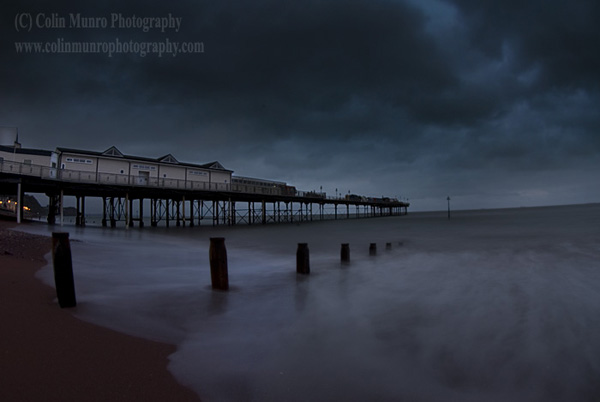
Heavy rain clouds above Teignmouth Pier, Teignmouth, Devon, England, UK.

A long exposure shot of Teignmouth Pier on a winter’s afternoon. Teignmouth, Devon.

I have always been fond of long exposure shots of moving water, producing beautiful soft, fluid and slightly surreal effects on waterfalls or waves on the beach. This does require low light levels entering the camera though, and in summer (even at minimum apertures) one must either stack neutral density filters in front of the lens, or get up really early or wait really late to get those shots around dawn or dusk. In winter it is so much easier, light levels are much lower anyway and as the sun rises and sets at a more acute angle to the horizon so the period of gloomy light lasts that much longer. This can be crucial if you are rushing between spots to try and find the best angle for you ‘money shot’. So dig out the winter boots and woolly hat and make the most of these chilly and gloomy landscapes. If nothing else it’s such a great excuse to eat lots of chocolate and warm up in a pub afterwards.

Moorland streams on Christmas Day – how to do things the hard way.

Moorland streams on Christmas Day – how to do things the hard way.
A small stream Dunsford Wood, Teign Valley, Devon, England.  This is a long exposure images taken to produce a fluid, surreal look to the flowing river. Colin Munro Photography

A small stream Dunsford Wood, Teign Valley, Devon, England.

Like all photographers I am sometimes asked how I created certain images, and how difficult getting certain pictures were. The answer in most cases is ‘not that difficult provided you’ve planned it and are well prepared’. But sometimes I just make things difficult for myself.

The above picture is a long exposure, 30 seconds in this case, used to blur movement (in the above picture the flowing water) producing a milky, fluid and slightly surreal look to the flowing stream. Obviously the amount of light hitting the camera sensor has to be limited to compensate for such a long exposure. Stopping down to a very small aperture helps but will only get you so far, rarely all the way to 30 seconds exposure. Stacking neutral density filters in front of the lens is one way, but a simpler way (especially this time of year when days are short) is to shoot at dusk, when light levels are naturally low and long shutter speeds are not merely desirable but also necessary.

Late Christmas Day I made a snap decision to get out on to Dartmoor, go for a walk and get some nice images. I left in a rush, trying to multi-task ineffectively as usual. The moor was not inspiring – low grey cloud and steady drizzle do not make for great pictures, so I turned around and reluctantly headed home. Light was fading fast when I found this little stream in the steep, wooded valley of the River Teign. I pulled over and decided to try and get some shots. This was where my rushing and lack of preparation came home to roost. I realised I had left my walking boots by the entrance to my boat and had only the city shoes I was wearing with me. Worse still, upon opening my tripod case (not checked before I left) I discovered that somehow the tripod head had snapped in two (I’ll be writing to Manfrotto shortly). Luckily I also had a small, six inch, tabletop tripod with me, but that meant actually getting in to the stream and perching it on top of boulders if I were obtain any useable shots. By the time I found a suitable spot along the stream it was about 4:15pm and getting gloomier by the minute. A quick scan around confirmed that there were no suitable boulders at the edge of the stream on which to mount the tripod; there was no alternative, shoes and socks had to come off and I had to wade out in to the middle of the stream. Thirty minutes later I stumbled to the side. The light had well and truly gone, so it was time to pack up. I had by then also lost all feeling below the ankles. It was not until i started driving home again that feeling began to return to my feet, doing so in painful waves as flow returned to constricted blood vessels. I had ample time to reflect on the stupidity of my lack of planning. My first actions the following day were to buy a spare tripod and place wellingtons and thick socks on the boot of my car in readiness. Hopefully that is at least one mistake I won’t repeat. Meanwhile I have now place some of these images in my art images of Devon Landscapes Gallery. This can be viewed (and prints purchased) here. Hopefully it was worth the effort. Colin

Drought and suffering in Garissa

Drought and suffering in Garissa

I last visited Garissa more than 30 years ago. It was a fairly wild journey to get there; three days waiting in Isiolo for an armed convoy to pass through, clambering on top of a load of grain sacks in the pitch dark early hours to join twenty-odd displaced Ethiopians, Kenyans and Somalis crouching precariously on an overloaded and ancient truck; hours spent standing alone in searing heat before being picked up by a passing Norwegian family working for VSO, then 90 long minutes hanging on the the cab rail on the back of a pickup driven by two crazy young Indian traders driving as if Somali shifta were on there tail (who knows maybe they were, few risked driving in this region without military escort at that time). I arrived in Garissa late afternoon, with still a couple of hours daylight remaining. I was young and brash then, I knew little of the politics of the region or the hardships of the local people; I was pissed because there was no beer in the town to be bought. I was coated in a layer of red desert dust and, after 10 hours on the back of open vehicles felt as dessicated as if I’d been in a drying oven. As far as I was concerned Garissa was just a transit point for me, one I hoped I wouldn’t be spending too much time in. I wandered past the truck stop, chatted to a few drivers and quickly ascertained that no-one was going anywhere soon, so I wandered to the end of town to pitch my tent. I was quickly disabused of this idea when a military truck pulled up and several soldiers informed me that it was too dangerous to camp out here. A little over an hour later I was sipping coffee sitting in my tent inside the military compound, surrounded by ten foot barb wire fences, surveying my supplies: coffee, margarine and some rather old bread. Jeez, this is going to be along night, I can’t even wander in to the local chai shops and chat to the truck drivers. As it happened I was quite wrong. I had barely finished my coffee when a young soldier walked up and announced that the camp commander wished to see me. This are going from bad to worse I thought; now I was about the get a dressing down for my stupidity and probably have my papers scrutinised in minute detail for errors. Not so! The commander was a young guy, no more than ten years older than me, from Nairobi; he appeared to feel as out of place here as I did and had seized upon the opportunity to discuss things other than the price of cattle or the latest incursions of shifta with someone from outside this dry and dusty world. I had a most entertaining evening learning about George Adamson’s encampment nearby (Kora, where George released lions was just a few miles away); Joy Adamson’s temper and temperatment and the problems cre3ated by lack of security in the region. A quite surreal touch was added when I first arrived at the commander’s lodge by a young Somali prisoner who was also in the building being questioned. He immediately began protesting that his handcuffs should be removed, as it was embarressing to be so shackled when a foreigner (especially a white person) was present.

I have always retained fond memories of Garissa, despite seeing little of the town. Garissa appears to have expanded enormously in that time; tarmac road have appeared and multi-storey buildings. But life is now probably harder than ever. Security is still a problem, twin grenade attacks on a local restuarant and the local prison occured in the town just four days ago, but that is not the main problem. Northern Kenya is in the grip of the worst drought in half a century. Displaced pastoralist tribespeople live in makeshift huts around the periphery of the town. Cattle, the sole income for many, are dying in their hundreds, thousands of families are now dependant on food aid, children no longer go to school as families move in search of water. In the attention-deficit disorded media world, such slow grinding misery rarely makes the news, yet the drought goes on. There are however, projects working to change this situation. One of the best seems to be the Tana River Drought Recovery Project, managed by Kenya’s Red Cross (Facebook album)

More information at dowser.org

Colin

Stripey Howling Hancock, Exeter busker

Stripey Howling Hancock, Exeter busker
Stripey Howling Handcock busking, Exeter city centre, Devon, England.

Stripey Howling Handcock busking, Exeter city centre.


Nigel ‘Stripey howling’ Hancock is almost a landmark in Exeter.  His distinctive guitar style, a blend of ragtime, blues and celtic, can be heard somewhere in the city centre on most days.  Stripey doesn’t just play in Exeter though; at different times of the year he can be heard in Poland, Switerland and other European countriesw, taking part on busking and street art festivals, most notably the buskerbus tours.  Stripey has his own page, while his music can be bought here or simply ask him for a CD if you’re in Exeter.

For those interested in the technical aspects, this is an HDR image, created from a single RAW image, then converted to monochrome and slightly tweaked in Photoshop.  If you are interested in Photoshop training please contact me ,

Diving the trawl 2: filming the trawl net underwater

Diving the trawl 2: filming the trawl net underwater

A couple of years ago I wrote a piece called lessons is stupidity: diving the trawl , describing the first time I dived on a commercial fishing trawling net.  I’ve done this a few times over the years, most recently a couple of days ago.  We re-did this because cameras improve and the quality of images improves, so we need to re-shoot.  We also wanted to get some slightly different images this time; in particular we wanted to get images as the trawl net underwater, as it was being hauled, just below the surface.

As events transpired the weather conditions were against us. Strong winds prevailed through most of August and much of September.  It was not until the last week of September, with equinoxal gales just around the corner, that we finally found a brief window of opportunity.  Due to vessel availability and other logistical constraints we had only one day available that week in which everything came together.  The weather was marginal but we were now well into autumn with precious few opportunities remaining this year, so we decided to take a chance and go for it.

Trawl net close up as it is hauled to the surface, Lyme Bay, Southwest England, Colin Munro Photography

Trawl net close up as it is hauled to the surface, Lyme Bay, Southwest England,

We began to load the trawl net on to our vessel on a bright but chilly morning.  A stiff breeze was whipping whitecaps on the sea beyond the shelter of the harbour, but the latest forecast indicated this should die away during the morning.  By the time the net had been hauled aboard and rigged and all our gear on deck it was midday; Lynsey, John and I were hot, dirty and sweaty but pretty satisfied everything was as ready as it could be.  The wind had not abated.  But we were now committed, so warps were unhitched and we nosed out into the bay.  A 60 square mile exclusion area for bottom towed fishing gear (trawls and scallop dredges) has been established within the centre of Lyme Bay to protect the fragile reefs found there (this came about in part due to our earlier work looking at the impacts of bottom-fishing gear).  We therefore had a two hour steam to get to a suitable location beyond this closed area in which to set the trawl.  That gave us two hours for the wind to die down and the sea state to drop away.   If we were lucky the wind would not yet have stirred up the seabed enough to destroy the visibility.  The longer the wind continued the more our chances of success diminished.

Filming the trawl net being deployed

John does all the hard work while I film the trawl net being deployed

We reach a shallow bay outside the closed area, about 20 metres depth, shortly after 2.30p.m.  The wind was still fresh and we knew it was not looking good for getting workable conditions on the seabed.  We decided to have a test dip to check out visibility before deploying the trawl.

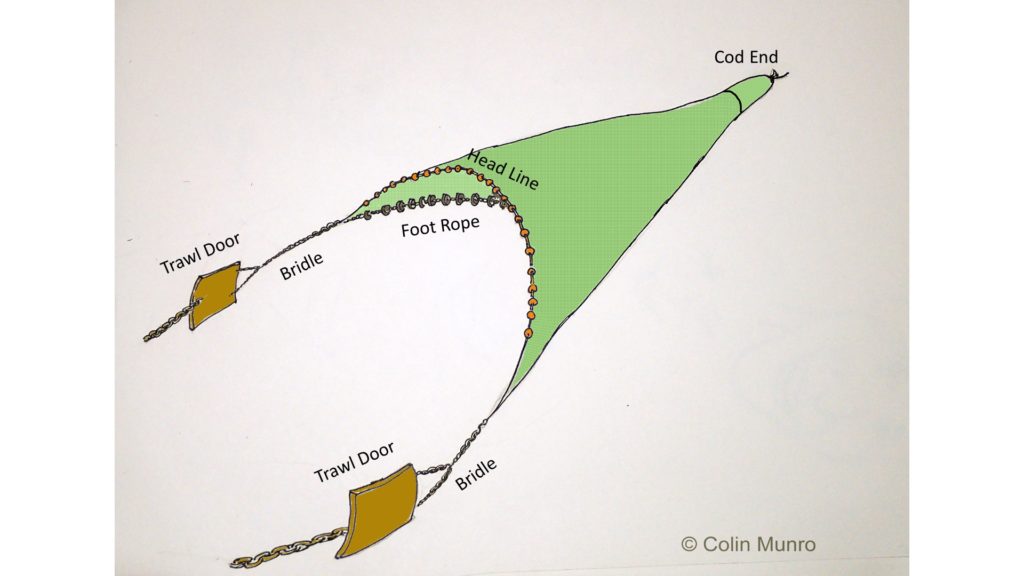
A bottom trawl, otter trawl. © Colin Munro

Diagram of the bottm trawl used (not to scale)

I wanted to stay dry in order to do some surface filming of the trawl being deployed, so this task fell to my dive buddy Lynsey.  A quick dip was enough to convince her it was no-go.  Seabed visibility was no more than one metre.  Quite apart from it being impossible to film the trawl operating in such conditions it would also have been too dangerous to be around heavy moving fishing gear.  Reluctantly I called the dive off and we reverted to plan B.

Setting up the Gates camera housing in the trawler’s tiny wheelhouse is always a bit of a challenge.

I also wanted to get footage of the trawl as it was being hauled, a little below the surface.  This we could do as the near-surface visibility, although far from perfect, was much better than that close to the seabed.  However, there were the added logistical problems that the trawl net had to be hauled with the boat steaming forward at a speed of several knots, way too fast to swim or hang on holding a large camera.  We had worked a method where I would be dropped off close to the net as it reached the surface, and drift back alongside it, filming as I went.  It sounded plausible – I mean what could possibly go wrong?  Before this we set up some surface and just below shots at speed, working from a small inflatable.

John and Lynsey in deep discussion as we trawl for a couple of hours.

John and Lynsey in deep discussion as we trawl for a couple of hours.

Poor Lyndsey had the unenviable task of heaving cameras across the tubes to me and hanging on to my legs as I dangled head-down in the water trying desperately to: a) get the vaguest impression of what I was filming through the spray and turbulence, and b) stop my camera from being ripped from my fingers.  From the surface I must have presented a highly comical sight, legs waving and coughing and spluttering to the surface every few seconds.  From a personal perspective it felt rather like what I imagine being waterboarded by a firehose while suspended upsidedown might feel like.   Having had my sinuses thoroughly irrigated at high pressure, it was now time to get into the water, before I had time to ponder the stupidity of my actions and change my mind.  At any rate, the sun was racing toward the horizon and light was fading rapidly, so it was either now or  call it off and wait ’til next year.    In the event the plan worked almost like clockwork; we were even able to repeat the operation so that I could run one haul taking stills and a second taking video footage.  Given the relatively poor visibility (~ 4 metres near the surface) I was quite pleased with the results.

You can view video footage from these dives here.

The stupid grin you wear when it all works out.

Nothing got broken (apart from a torn shoulder muscle – my stupidity when the trying to work parallel to the waterflow) and everything worked pretty much as it should.  October gales have now set in so there will be no more dives on fishing gear this year.

Note:  As with my previous blog on this topic, this is NOT in any way designed to be a ‘how to’ guide to diving on trawl nets.  I have deliberately ommitted key elements to try to avoid giving this impression.  Diving around nets and heavy moving fishing gear obviously involves a significant element of risk if not approached with great care and planning.  I have presented this in a fairly light-hearted manner and should be taken as such rather than a technical guide.

Book-Cycle delivery to Ghana

Book-Cycle delivery to Ghana
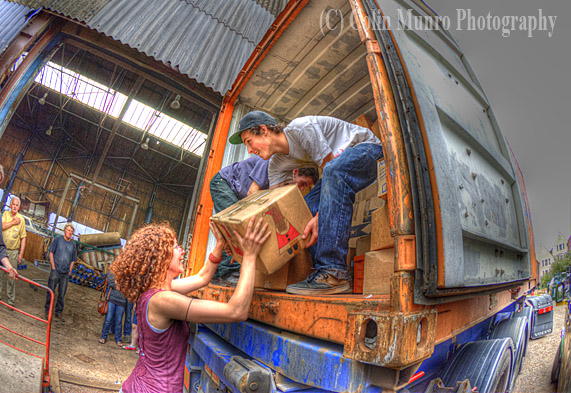
Book-Cycle volunteers load up container with books for Ghana. Colin Munro Photography, image no. MBI000947

Book-Cycle volunteers load up container with books for Ghana. image no. MBI000947


Book-Cycle (www.book-cycle.org) is a dynamic young charity based in Exeter, Devon that collects donated books and allows you to choose how much you pay for them (they have a bookshop in West Devon Street, near the Cathedral in Exeter).  The charity is run on an entirely voluntary basis, with all the cash raised going to fund their environmental and ‘fairer World’ projects.  Perhaps one of the most exciting, for me at least, is that many of the donated books are delivered to swchools in developing countries such as Ethopia, Kenya, Tanzania, Uganda and Madagascar.  Yesterday was quite a big day; a container truck was being loaded up to deliver books to Ghana, and I was lucky enough to meet up with Ant. and some of the other guys behind book-cycle , and basically lounge around taking the odd picture while they sweated away loading the container on a very hot afternoon.  From the warehouse in Exeter the books travel to Thamesport deepwater container port.  They are being sent to the rural ashanti region of Ghana to help build library facilities, primarily for local children.  If you’re in the Exeter area their bookshop (next to the ‘house that moved’ ) is well worth a browse, or check out their website (www.book-cycle.org) for other outlets in Exeter and along the south coast.

Book-Cycle volunteers loading boxes of books into a container truck at their warehouse in Exeter, Devon. Colin Munro Photography. Image No. MBI000944.

Book-Cycle volunteers loading boxes of books into a container truck at their warehouse in Exeter, Devon, for delivery to Ghana. Image No. MBI000944.

Book-Cycle volunteers loading boxes of books into a container truck at their warehouse in Exeter, Devon, for delivery to Ghana. Colin Munro Photography. Image no. MBI000948.

Book-Cycle volunteers loading boxes of books into a container truck at their warehouse in Exeter, Devon, for delivery to Ghana. Image no. MBI000948.

Setting sail at sunset, Crosshaven, Ireland

Setting sail at sunset, Crosshaven, Ireland
Leaving harbour at sunset. Crosshaven, County Cork, Ireland. Colin Munro Photography. Image No. MBI000943

Leaving harbour at sunset. Crosshaven, County Cork, Ireland. Image No. MBI000943

walking along the harbour edge just before sunset on a warm evening, late summer,  I watched a small yacht motor out, sails not yet raised, as it headed towards the Atlantic.   Crosshaven harbour on the west coast of Ireland.  Crosshaven is a stop-off point for many yachts heading around the wild west coast of Ireland, or crossing the Atlantic.  A high resolution version of this image is available on my Photoshelter site (see link on right) within my sunrise and sunsets at sea gallery.  If you would like an art print or to licence use of the image please email me.