Sex and death in the seagrass

A common or European cuttlefish, Sepia officinalis, trapped in monofilament bottom set nets, Brixham Harbour. Each year nets are set around seagrass beds (Zostera marina) where cuttlefish come in to breed. Colin Munro Photography
A common or European cuttlefish, Sepia officinalis, trapped in monofilament bottom set nets, Brixham Harbour.  Each year nets are set around seagrass beds (Zostera marina) where cuttlefish come in to breed. Colin Munro Photography

A common or European cuttlefish, Sepia officinalis, trapped in monofilament bottom set nets, Brixham Harbour. Each year nets are set around seagrass beds (Zostera marina) where cuttlefish come in to breed. Image No. MBI000305.

Intelligent life. Few divers who have ever encountered an octopus or cuttlefish underwater cannot have been struck by a sense of an alien intelligence staring hard at them, assessing whether you are friend or foe and what you are likely to do next. That cephalopods (octopi, cuttlefish, squid and their kin) are bright has now become common knowledge; yet this is still something that sits uneasily with their molluscan nature. Great apes, whales and dolphins are easier to accept; they are mammals and so not that distantly related to us. But cephalopods? They are not even vertebrates; first cousins to slugs, snails and slipper limpets. Their blood is greeny-blue not red as the oxygen carrying molecule is copper-based rather than the iron-based haemoglobin in all mammals. They really are shape-shifting aliens from inner space. And yet, when a cuttlefish rises out of the sand or seagrass to hover in front of you, you get a real sense of cogs turning and a logical decision-making process taking place. That may, of course simply be down their binocular vision; we tend to almost intuitively associate this with intelligence (it is designed, after all, to assess distance, form mental 3D images of the World and judge when and how to strike at prey). That there is real intelligence behind those eyes is most elegantly demonstrated by the octopus, which has joined the elite group of animals that have demonstrated the use of tools to manipulate their environment in the wild. The veined octopus has recently been filmed collecting and stacking discarded coconut shells halves to use as a shelter. So far it is the only invertebrate to do so.

Cuttlefish breeding. The seagrass beds of South Devon have long been a favourite dive habitat of mine. They provide gentle, sunlit dives where one can float along in the hope of encountering a pipefish, mating sea hares and, at the right time of year, cuttlefish arriving to lay eggs. Watching a female cuttlefish lay eggs is a fascinating experience. Each pointed black egg is attached to a tuft of seagrass or weed one at a time. The female will hover before it, then after a few minutes contemplation will move forward to firmly grasp the stem with her tentacles and pull it towards her. After a minute she draws back again, to reveal a new shiny, pointed black eggs bound to the stem by a band extending out of the egg case. This process with continue for over an hour, until the stem is wrapped in what resembles a bunch of black, pointed grapes.

A common or European cuttlefish, Sepia officinalis, trapped in monofilament bottom set nets, Brixham Harbour.  Each year nets are set around seagrass beds (Zostera marina) where cuttlefish come in to breed. Colin Munro Photography.

A female common or European cuttlefish, Sepia officinalis, trapped in monofilament bottom set nets, Brixham Harbour. A male hovers nearby and will eventually also be entangled. Other males hover in the background. Image No. MBI000270.

While the eggs are laid a gang of males hover in attendance. When cuttlefish mate the male transfers the spermatophores (sperm packages) to within the females buccal cavity, using his modified fourth arm (the hectcotylus). The hectocotylus is then used to break open the spermatophores, releasing the sperm which is then temporarily stored within the female’s buccal cavity. If she subsequently mates with another male it will direct jets of water into her buccal cavity to attempt to flush out earlier sperm deposits. Consequently the most recent mate will hover above her, warding off other males that will hang around, to ensure that it is his genetic material that is passed on rather than that of his upstart rivals.

Cuttlefish in nets. Cuttlefish are, of course, a valuable catch for fishermen. They are caught in trawls out at sea and also in set nets deployed around their inshore breeding grounds. Cuttlefish grow quickly and most die shortly after breeding, so those caught after they have laid their eggs will not have any real effect on future populations. Unfortunately however, nets are often laid around the edges of breeding grounds such as seagrass nets, thus cuttlefish are caught not only when leaving the breeding ground but also when arriving, before they breed. The nets do not kill them, but they are often quite badly damaged as they twist and the fine line cuts into their flesh. Indeed I often wonder how they can be sold after their flesh is so ripped up. If a female is caught then inevitably a number of males arriving will hang around her until they too are caught. A trapped female may remain their for up to twelve hours before the nets are hauled, so the potential for catching large numbers of breeding cuttlefish is quite high. So far, this practice does not seem to have noticeably affected local cuttlefish populations. It is nonetheless rather disconcerting to watch such lovely animals twisting and turning for hours on end.

Update. In the past couple of years I, and other local divers, have seen notably fewer cuttefish hanging around in the shallow bays of South Devon during the breeding season.  This may simply be due to factors like the lousy weather we’ve had during the past couple of summers; it may also be due to the almost impenetrable ring of nets set on the edge of these bays.

Images. All the images in this blog are available to license.  You can search all my online stock images at my www.colinmunroimages.com  Cuttlefish images, Sepia officinalis images, fishing images, stock images.
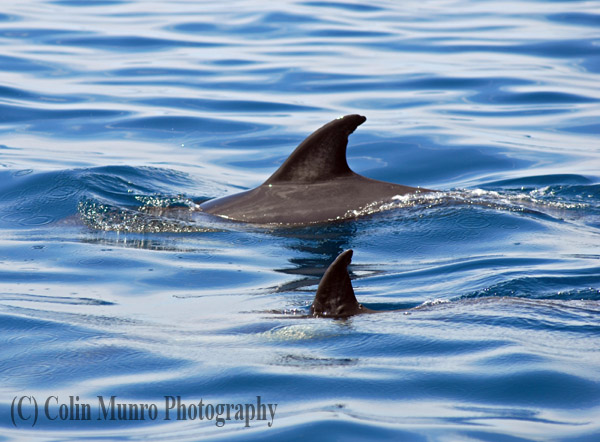
Common Dolphins, mother and calf

Common Dolphins, mother and calf
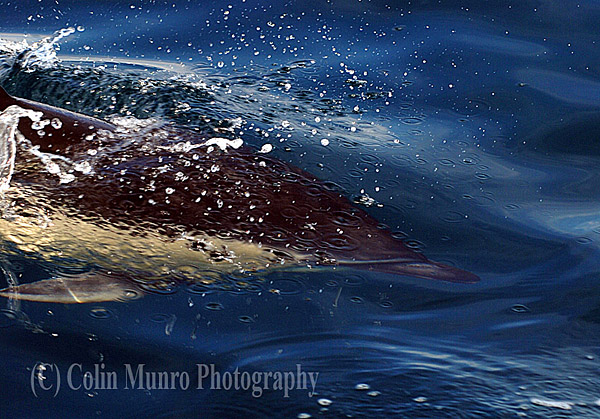
Mother and calf common dolphins (Delphinus delphis) swimming in close harmony. Colin Munro Photography. Image No. MBI000335.

Mother and calf common dolphins (Delphinus delphis) swimming in close harmony. Image No. MBI000335.

 These pictures were taken during a recent trip to look for blure sharks (Prionace glauca) off the north coast.  Although we did find one blue, we had no luck with pictures (next time!).  However we did come across a large group of common dolphins (Delphinus delphis) feeding.  Each summer substantial numbers of commons dolphins can be found around the coasts of Devon and Cornwall as they follow the mackerel shaols.  Hopefully I’ll be adding to these images this summer.  As ever, these images can be licenses for reproduction and are also available as fine art prints.  Email me , telling me the image number and what you require for further details. You can also search for additional images either from my main website homepage or using my Photoshelter website. Links for both are given in the sidebar.

Common dolphins (Delphinus delphis) swimming, showing tooth rake marks on back. Colin Munro Photography, Image No. MBI000333.

Common dolphins (Delphinus delphis) swimming, showing tooth rake marks on back. Colin Munro Photography, Image No. MBI000333.


Common dolphins (Delphinus delphis) swimming, head on. Colin Munro Photography, Image No. MBI000339.

Common dolphins (Delphinus delphis) swimming, head on. Image No. MBI000339.


Common dolphin (Delphinus delphis) swimming at high speed. Colin Munro Photography, Image No. MBI000337.

Common dolphin (Delphinus delphis) swimming at high speed. Image No. MBI000337.

Samba funk fusion band Wara performing at Exeter Respect Festival

Samba funk fusion band Wara performing at Exeter Respect Festival
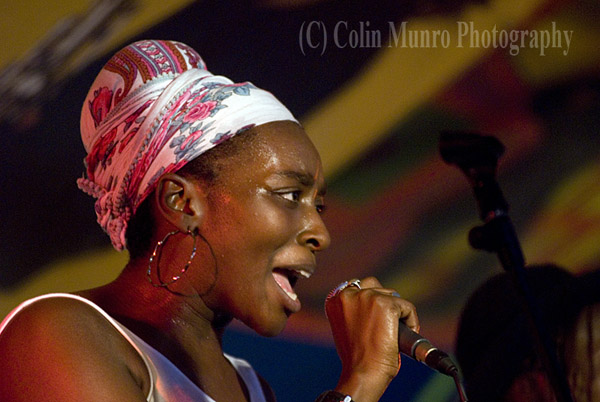
Nana Clara Aldrin-Quaye singing with London based cuban samba, timba and funk fusion band Wara at Exeter's Respect Festival, 2011. Image No. MBI000925.

Nana Clara Aldrin-Quaye singing with London based cuban samba, timba and funk fusion band Wara at Exeter's Respect Festival, 2011. Image No. MBI000925.

Juanita Euka, singer with London based cuban samba, timba and funk fusion band Wara at Exeter's Respect Festival, 2011. Image no. MBI000923.

Juanita Euka, singer with London based cuban samba, timba and funk fusion band Wara at Exeter's Respect Festival, 2011. Image no. MBI000923.

Slightly left field for me, but good fun.  Had a great day at the Exeter Respect Festival with my son earlier this month but have only now got around to doing something with the pictures from then.  A highlight was watching London-based samba/funk/fusion band Wara perform; real high energy, get-up-and-dance stuff.  The marquee covering the stage was kind of gloomy so I was pushing iso’s and working with wide open apertures and as slow a shutter as I dared to get some half-decent shots (not always succesfully).  Here are a few that worked. 

London based cuban samba, timba and funk fusion band Wara performing at at Exeter's Respect Festival, 2011. Image No. MBI000926. Colin Munro Photography.

London based cuban samba, timba and funk fusion band Wara performing at at Exeter's Respect Festival, 2011. Image No. MBI000926.

If you’d like to know more about them this is there myspace link http://www.myspace.com/waralondon

Start Point and Start Bay, South Devon

Rocky headland, Start Point, South Devon, England. Image MBI000921.
Rock Ridge and sky, Start Point, Rock Ridge and sky, Start Point, South Devon, England. Image No. MBI000920. Colin Munro Photography

South Devon, England. Image No. MBI000920.


Rocky headland, Start Point, South Devon, England. Image MBI000921.

Rocky headland, Start Point, South Devon, England. Image MBI000921.

 A very blustery day in late June saw see scrambling around the rocks on Start Point with my son.  The southwesterly wind was whipping white horses off the wave tops on the western side of the headland; to the east, sheltered by the high rocks of Start Point, the water within Start bay was almost mirror smooth, disturbed only by surface ripples.

Start Bay from Start Point,  South Devon, England. Image No. MBI000922.

Start Bay from Start Point, South Devon, England. Image No. MBI000922.


As ever, these images are available to reproduce as rights managed images or as art prints on a variety of media.  If you’d like to use any of the images in a publication, display, website etc., please email be (colin ‘at’ colinmunrophotography.com) noting the image number and where you’d like to use the image.  If you are interested in a print, please visit the prints page for options then email me. Thanks, Colin Munro.

Exeter Midsummer Party, Quayside, 17th June 2011

Exeter Midsummer Party, Quayside, 17th June 2011
Exeter Midsummer Party marking start of Exeter Festival, Exeter Quayside, 17th June 2011. Pyrotchnics on the River Exe. Colin Munro Photography.

Exeter Midsummer Party marking start of Exeter Festival, Exeter Quayside, 17th June 2011. Pyrotchnics on the River Exe. Image MBI000919

 A few quick images from the party on Exeter’s quayside last night. It was the most spectacular sunset, but of course I didn’t have my camera with me (Doh!).  I did grab it in time to get some pictures of the finale, which was quite spectacular. 

(If you would like to reproduce any of the images on my site, please email me, colin ‘at’ colinmunrophotography.com, giving the image number and the intended use)

Exeter Midsummer Party marking start of Exeter Festival, Exeter Quayside, 17th June 2011. Pyrotchnics on the River Exe. Colin Munro Photography

Exeter Midsummer Party marking start of Exeter Festival, Exeter Quayside, 17th June 2011. Pyrotchnics on the River Exe. Image No. MBI000918.

Exeter Midsummer Party marking start of Exeter Festival, Exeter Quayside, 17th June 2011. Pyrotchnics on the River Exe. Image No. MBI000917. Colin Munro Photography

Exeter Midsummer Party marking start of Exeter Festival, Exeter Quayside, 17th June 2011. Pyrotchnics on the River Exe. Image No. MBI000917.

Fishing canoe (pirouge) being landed at sunset, Senegal

Fishing canoe (pirouge) being landed at sunset, Senegal
Pirogue fishermen at sunset, Senegal, West Africa Image. MBI000914

Pirogue fishermen at sunset, Senegal, West Africa Image. MBI000914


Fishing canoe (pirouge) being landed at sunset, Senegal. Image MBI000914. Please email me, quoting this number if you’d like to license use of this image or purchase a fine art print.

A wooden fishing canoe returns from a day at sea, and men haul the boat and engine up the sandy beach as the sun sets.  M’bour, Senegal.

Fishing boat at sunset, Eastern Mediterranean, off Egypt

Fishing boat at sunset, Eastern Mediterranean, off Egypt
Egyptian fishing boat at sunset, Eastern Mediterranean Sea. Image MBI000912. Colin Munro Photography

Egyptian fishing boat at sunset, Eastern Mediterranean Sea. Image MBI000912.

Fishing boat at sunset, Eastern Mediterranean, off Egypt. Please email me, quoting this number if you’d like to license use of this image or purchase a fine art print.
I spend a couple of weeks working off in the eastern Mediterranean Sea, a few miles off the Nile delta, a while back.  It was mid-winter, and we spent much of the time dodging gales.  Although we were in a fairly substantial boat, waves piled up high in the shallow waters off the delta, so work was completed in brief sorties, then running back to port with four or five metres waves chasing us.  When the sea was calm however, it was absolutely beautiful, with the most stunning sunsets.  Calm weather also brought out large numbers of fishing trawlers.  At one time I counted twelve trawlers all within sight of us; it seems highly unlikely that such fishing is sustainable and indeed I saw precious little catch when nets were hauled.  As the sun set all nest were hauled and the boats headed back to port leaving us with the sea to ourselves until the sun rose again.  I watched this boat inch past the dipping sun, with an almost blood red sky as a backdrop.  There has been vistually no editing to this image – the sky really did look like that.  Sometimes you have to really work to get great pics, and sometime you just need to be there.

Kitesurfer and dramatic sky, Exmouth beach, Devon, England

Kitesurfer and dramatic sky, Exmouth beach, Devon, England
Kite surfer against a dramatic sky, surfing the Exe Estuary between Pole Sand sandbar and Exmouth Beach, Exmouth, Devon, England. Image MBI000660.

Kite surfer against a dramatic sky, surfing the Exe Estuary between Pole Sand sandbar and Exmouth Beach, Exmouth, Devon, England. Image MBI000660.

Kitesurfer and dramatic sky, exmouth beach, Exmouth, Devon, England. Image MBI000660. Please email me, quoting this number if you’d like to license use of this image or purchase a fine art print.
Kitesurfers catch the wind, flying along between Pole sand sandbar and Exmouth beach on a blustery summer evening.  Kitesurfing has become hugely popular in the Exe Estuary off Exmouth in recent years; on some evenings I have counted upwards of twenty kites. 

The Port Royal Pub, Exeter historic quay, at night.

The Port Royal Pub, Exeter historic quay, at night.
The Port Royal bar reflected on the River Exe at night. Exeter historic quay, Exeter, Devon, England. Image MBI000910.

The Port Royal bar reflected on the River Exe at night. Exeter historic quay, Exeter, Devon, England. Image MBI000910.

 The Port Royal bar reflected on the River Exe at night. Exeter historic quay, Exeter, Devon, England. image No. MBI000910. Please email me, quoting this number if you’d like to license use of this image or purchase a fine art print.

I took this pic a couple of nights ago. The last of the revellers had staggered home and the quayside was quiet.  It was warm and perfectly still, with a clear starry sky overhead.  Perfect for this type of image. So a little after midnight I pulled my gear together and climbed out of my boat’s saloon.  For a pic such as this, relying solely on distance sodium street lighting and faint starlight the iso needs to be cranked up a bit, but not so much as to make the image very noisy, and, obviously, the shutter speed way down.  Depth of field is not an issue as everything in the picture is distant, so the iris can be (and was) wide open.  I used an old 20mm prime lens, a favourite of mine.  The sodium lighting gives the pub and adjacent buildings an unearthly yellow hue.  I rather like  it this so did not atempt to change this, feeling it added to the rather surreal look.  Clearly the stars and buildings differ massively in brightness. To acheive useable exposure of both required melding two images at very different shutter speeds (four stops difference if memory serves me).  Some post processing of the starry sky was also required. The image was converted in to a grey scale image to remove colour noise, then reconverted back to an RGB image before melding.

The fishermen of M’bour, Senegal

The fishermen of M’bour, Senegal
A fishing pirouge (canoe) is hauled ashore at sunset. M'bour, Senegal. A dramatic sky and silhouetted fishermen. ©Colin Munro Photography
M’bour, Senegal. Fishermen haul a small fishing pirogue (wooden canoe) up on to the beach at sunset.

In November 2008 I spent two weeks in Senegal, living in M’bour, a dusty transit stop and fishing port halfway between Dakar and the Gambia. I spent this time getting to know the fishermen, going to sea with them, learning how they worked, the risks they took travelling up to 20 miles offshore in leaky open canoes without so much as a compass to guide them. I learned how they spent days at sea in tiny canoes, sleeping in the bottom of them, risking storms or being swept out to sea. As there canoes have no lights they also run the risk of being mown down by trawlers at night. Many do lose their lives each year, but economic pressures are causing a growing number of young men to turn to fishing. This brings its own problems; the fishery is poorly documented, but anecdotal reports suggest this is having a significant impact on stocks of some species.  Robust data is hard to come by, given the unregulated nature of this fishery, but the Senegalese Directorate of Marine Fisheries estimated that in 2004 a little over 6000 such canoes were operating along the coast of Senegal.  The main species caught are small sardinella (Sardinella aurita and S. maderenis) and horse mackerel (Trachurus trachurus). In 2008 the fishery off M’bour and nearby Joal Fadiouth was considered over-exploited (source FAO,Fisheries Circular No. 1033, 2008).

Fishing canoe,  or pirogue, being lanched off beach on wooden rollers, M'bour,  Senegal.  Image MBI000628
Our fishing canoe, or pirogue, being lanched off beach on wooden rollers, M’bour, Senegal.

 Now fully laden, our ancient outboard is securely fastened with bailing twine. Note the well balanced ice box perched toward the stern of the canoe.

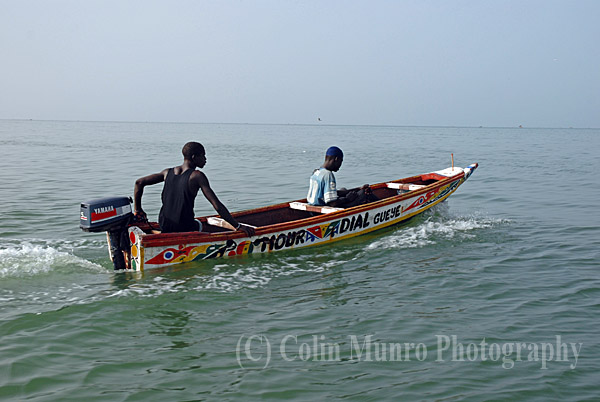
M'bour, Senegal. Two Senegalese fishermen head out to sea in a small pirogue (traditional wooden canoe).  Image MBI000909.
M’bour, Senegal. Two Senegalese fishermen head out to sea in a small pirogue (traditional wooden canoe).

I spent a day at sea on one of these tiny boats. Simply making it through the surf was quite an acheivement; the boat had no ballast and was so top heavy, due to ourselves and the large box of ice we were carrying, that we appeared in imminent danger of capsizing. Fortunately we shipped quite a lot of water quite quickly during a rather sketchy launching. This few inches of seawater inside our boat at least gave us some stability by providing a little ballast, albeit not a recommended way of doing so. Powered by an ancient 15hp, 2-stroke Yamaha outboard engine secured by bailing twine to the transom, we headed out to sea for about three hours, by which time I estimated we were about fifteen miles offshore. For the first 30 minutes or so we saw a few other boats, but they quickly dispersed in different directions; soon we were alone. We had set off in a grey haze that quickly enveloped the land. The sun became a slightly brighter glow penetrating the haze. Both sea and sky were otherwise quite featureless.  As we motored steadily along, I watched with growing alarm as the sky changed, growing dark and heavy, with a stiffening breeze springing up.  Maybe two hours out we came upon another canoe, similar to ours. This one was drifting aimlessly as their equally ancient outboard engine had died.  The delight at our arrival shown by the three fishermen onboard quickly turned to consternation when, Pape, our boats owner and skipper, offered not to towed them to back to shore but to a point at sea where they ‘had a better chance of being spotted’ by a home-bound canoe.  So for half and hour or so we towed them further out to sea (or at least it seemed that direction to me) before leaving them to anchor on what appeared an equally deserted and featureless location.as was the spot we had towed them from.  We never saw them again. I rather hope this meant that they had indeed been towed ashore.

Our unhappy fishermen drop anchor and start their wait for a passing vessel after we tow them to a ‘better’ location.

At one point Pape asked me which direction I thought M’bour lay.  With no visual clues to guide me I based my guess on the heading I thought we had set off on, and pointed on the reciprocal bearing.  Apparently I was almost 180 degrees out.  I asked Pape how he could tell, with such confidence, with no compass or electronic aids. The wind direction he informed me.  So, I enquired cautiously, does it always blow from the same direction this time of year?  No, he cheerfully informed me, sometimes we get lost.  I rather wished I hadn’t asked.

Eventually we arrived at the fishing grounds.  What exactly identified them as ‘the fishing grounds’ I have no idea.  There were no surface features; nothing on the horizon. Hooks were baited with little, frozen prawns from our icebox and handlines set.  A small stove was fired up in the middle of the canoe and sugary tea the colour and consistency of stockholm tar brewed.  A cup was passed around from which we all took small sips; more than this would most likely have resulted in irreversible damage to my intestines.  Tea was supplemented by joints also passed around.  Tea, reefers and small amounts of rice and peanut porridge (gosi) were pretty much all the crew had to survive on apart from whatever they caught.   Around two hours passed, in which time we had caught maybe a dozen fish, mostly sardinella, horse mackerel and a few bigeye grunt (Brachydeuterus auritus).  Barely enough to feed us at sea, let alone provide a wage for all three fishermen.  Around four in the afternoon, by which time the chop on the sea had risen significantly and little whitecaps had started to appear, we finally decided to head back inshore.  Much to my relief, Pape’s sense of direction proved accurate.

The sun was setting when we finally reached M’bour, and there have been few occasions when I’ve been quite so pleased to step on to dry land.  Pape and his crew would probably go to sea again tomorrow, maybe staying out for one or two nights this time.  I thought that night of the meagre catch we returned with after a day at sea, of the broken down canoe we had come across and of the stories Pape had told me of getting caught in a storm and drifting helplessly for three days before sighting land.  Overfishing is a massive problem on the West coast of Africa.  Much of this problem is actually due to poorly regulated fishing by large trawlers from outside Senegal: Russian, Korean, Japanese, Chinese and European boats.  It has been estimated that a large trawler will, on one good day, catch as much as fifty pirogues will in a year.  Vessels are licensed by the Senegalese Government who argue that if they don’t sell licenses then neighbouring countries will; stocks may still suffer and Senegal will lose valuable revenue (Grégoire Allix, le Monde/Worldcrunch, 2011). What is a matter of concern about the long term effects of overfishing for us in the West can be a question of survival for some on the coast of Senegal.

A Senegalese fisherman hand lines for fish in a small wooden pirogue. ©Colin Munro Photography
One of our crew hand lining for fish at the ‘fishing grounds’, waiting for a bite.
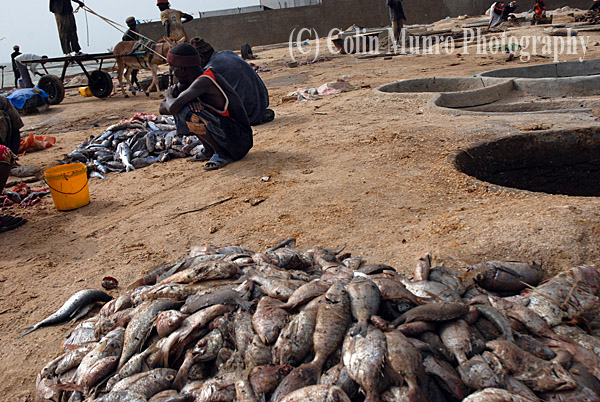
Fish salting pans, M'bour, Senegal. Image MBI000609.
Fish salting pans, M’bour, Senegal.

View more of my images of  Senegal and from other regions of the  World here at my main Colin Munro Photography website.