Stripey Howling Hancock, Exeter busker

Stripey Howling Hancock, Exeter busker
Stripey Howling Handcock busking, Exeter city centre, Devon, England.

Stripey Howling Handcock busking, Exeter city centre.


Nigel ‘Stripey howling’ Hancock is almost a landmark in Exeter.  His distinctive guitar style, a blend of ragtime, blues and celtic, can be heard somewhere in the city centre on most days.  Stripey doesn’t just play in Exeter though; at different times of the year he can be heard in Poland, Switerland and other European countriesw, taking part on busking and street art festivals, most notably the buskerbus tours.  Stripey has his own page, while his music can be bought here or simply ask him for a CD if you’re in Exeter.

For those interested in the technical aspects, this is an HDR image, created from a single RAW image, then converted to monochrome and slightly tweaked in Photoshop.  If you are interested in Photoshop training please contact me ,

Diving the trawl 2: filming the trawl net underwater

Diving the trawl 2: filming the trawl net underwater

A couple of years ago I wrote a piece called lessons is stupidity: diving the trawl , describing the first time I dived on a commercial fishing trawling net.  I’ve done this a few times over the years, most recently a couple of days ago.  We re-did this because cameras improve and the quality of images improves, so we need to re-shoot.  We also wanted to get some slightly different images this time; in particular we wanted to get images as the trawl net underwater, as it was being hauled, just below the surface.

As events transpired the weather conditions were against us. Strong winds prevailed through most of August and much of September.  It was not until the last week of September, with equinoxal gales just around the corner, that we finally found a brief window of opportunity.  Due to vessel availability and other logistical constraints we had only one day available that week in which everything came together.  The weather was marginal but we were now well into autumn with precious few opportunities remaining this year, so we decided to take a chance and go for it.

Trawl net close up as it is hauled to the surface, Lyme Bay, Southwest England, Colin Munro Photography

Trawl net close up as it is hauled to the surface, Lyme Bay, Southwest England,

We began to load the trawl net on to our vessel on a bright but chilly morning.  A stiff breeze was whipping whitecaps on the sea beyond the shelter of the harbour, but the latest forecast indicated this should die away during the morning.  By the time the net had been hauled aboard and rigged and all our gear on deck it was midday; Lynsey, John and I were hot, dirty and sweaty but pretty satisfied everything was as ready as it could be.  The wind had not abated.  But we were now committed, so warps were unhitched and we nosed out into the bay.  A 60 square mile exclusion area for bottom towed fishing gear (trawls and scallop dredges) has been established within the centre of Lyme Bay to protect the fragile reefs found there (this came about in part due to our earlier work looking at the impacts of bottom-fishing gear).  We therefore had a two hour steam to get to a suitable location beyond this closed area in which to set the trawl.  That gave us two hours for the wind to die down and the sea state to drop away.   If we were lucky the wind would not yet have stirred up the seabed enough to destroy the visibility.  The longer the wind continued the more our chances of success diminished.

Filming the trawl net being deployed

John does all the hard work while I film the trawl net being deployed

We reach a shallow bay outside the closed area, about 20 metres depth, shortly after 2.30p.m.  The wind was still fresh and we knew it was not looking good for getting workable conditions on the seabed.  We decided to have a test dip to check out visibility before deploying the trawl.
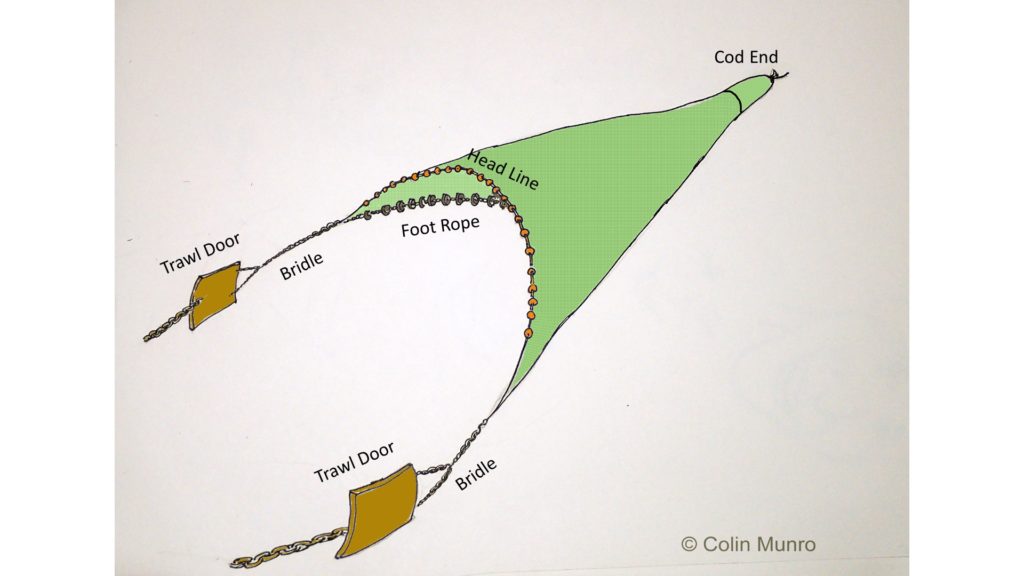
A bottom trawl, otter trawl. © Colin Munro

Diagram of the bottm trawl used (not to scale)

I wanted to stay dry in order to do some surface filming of the trawl being deployed, so this task fell to my dive buddy Lynsey.  A quick dip was enough to convince her it was no-go.  Seabed visibility was no more than one metre.  Quite apart from it being impossible to film the trawl operating in such conditions it would also have been too dangerous to be around heavy moving fishing gear.  Reluctantly I called the dive off and we reverted to plan B.

Setting up the Gates camera housing in the trawler’s tiny wheelhouse is always a bit of a challenge.

I also wanted to get footage of the trawl as it was being hauled, a little below the surface.  This we could do as the near-surface visibility, although far from perfect, was much better than that close to the seabed.  However, there were the added logistical problems that the trawl net had to be hauled with the boat steaming forward at a speed of several knots, way too fast to swim or hang on holding a large camera.  We had worked a method where I would be dropped off close to the net as it reached the surface, and drift back alongside it, filming as I went.  It sounded plausible – I mean what could possibly go wrong?  Before this we set up some surface and just below shots at speed, working from a small inflatable.

John and Lynsey in deep discussion as we trawl for a couple of hours.

John and Lynsey in deep discussion as we trawl for a couple of hours.

Poor Lyndsey had the unenviable task of heaving cameras across the tubes to me and hanging on to my legs as I dangled head-down in the water trying desperately to: a) get the vaguest impression of what I was filming through the spray and turbulence, and b) stop my camera from being ripped from my fingers.  From the surface I must have presented a highly comical sight, legs waving and coughing and spluttering to the surface every few seconds.  From a personal perspective it felt rather like what I imagine being waterboarded by a firehose while suspended upsidedown might feel like.   Having had my sinuses thoroughly irrigated at high pressure, it was now time to get into the water, before I had time to ponder the stupidity of my actions and change my mind.  At any rate, the sun was racing toward the horizon and light was fading rapidly, so it was either now or  call it off and wait ’til next year.    In the event the plan worked almost like clockwork; we were even able to repeat the operation so that I could run one haul taking stills and a second taking video footage.  Given the relatively poor visibility (~ 4 metres near the surface) I was quite pleased with the results.

You can view video footage from these dives here.

The stupid grin you wear when it all works out.

Nothing got broken (apart from a torn shoulder muscle – my stupidity when the trying to work parallel to the waterflow) and everything worked pretty much as it should.  October gales have now set in so there will be no more dives on fishing gear this year.

Note:  As with my previous blog on this topic, this is NOT in any way designed to be a ‘how to’ guide to diving on trawl nets.  I have deliberately ommitted key elements to try to avoid giving this impression.  Diving around nets and heavy moving fishing gear obviously involves a significant element of risk if not approached with great care and planning.  I have presented this in a fairly light-hearted manner and should be taken as such rather than a technical guide.

Sex and death in the seagrass

A common or European cuttlefish, Sepia officinalis, trapped in monofilament bottom set nets, Brixham Harbour. Each year nets are set around seagrass beds (Zostera marina) where cuttlefish come in to breed. Colin Munro Photography
A common or European cuttlefish, Sepia officinalis, trapped in monofilament bottom set nets, Brixham Harbour.  Each year nets are set around seagrass beds (Zostera marina) where cuttlefish come in to breed. Colin Munro Photography

A common or European cuttlefish, Sepia officinalis, trapped in monofilament bottom set nets, Brixham Harbour. Each year nets are set around seagrass beds (Zostera marina) where cuttlefish come in to breed. Image No. MBI000305.

Intelligent life. Few divers who have ever encountered an octopus or cuttlefish underwater cannot have been struck by a sense of an alien intelligence staring hard at them, assessing whether you are friend or foe and what you are likely to do next. That cephalopods (octopi, cuttlefish, squid and their kin) are bright has now become common knowledge; yet this is still something that sits uneasily with their molluscan nature. Great apes, whales and dolphins are easier to accept; they are mammals and so not that distantly related to us. But cephalopods? They are not even vertebrates; first cousins to slugs, snails and slipper limpets. Their blood is greeny-blue not red as the oxygen carrying molecule is copper-based rather than the iron-based haemoglobin in all mammals. They really are shape-shifting aliens from inner space. And yet, when a cuttlefish rises out of the sand or seagrass to hover in front of you, you get a real sense of cogs turning and a logical decision-making process taking place. That may, of course simply be down their binocular vision; we tend to almost intuitively associate this with intelligence (it is designed, after all, to assess distance, form mental 3D images of the World and judge when and how to strike at prey). That there is real intelligence behind those eyes is most elegantly demonstrated by the octopus, which has joined the elite group of animals that have demonstrated the use of tools to manipulate their environment in the wild. The veined octopus has recently been filmed collecting and stacking discarded coconut shells halves to use as a shelter. So far it is the only invertebrate to do so.

Cuttlefish breeding. The seagrass beds of South Devon have long been a favourite dive habitat of mine. They provide gentle, sunlit dives where one can float along in the hope of encountering a pipefish, mating sea hares and, at the right time of year, cuttlefish arriving to lay eggs. Watching a female cuttlefish lay eggs is a fascinating experience. Each pointed black egg is attached to a tuft of seagrass or weed one at a time. The female will hover before it, then after a few minutes contemplation will move forward to firmly grasp the stem with her tentacles and pull it towards her. After a minute she draws back again, to reveal a new shiny, pointed black eggs bound to the stem by a band extending out of the egg case. This process with continue for over an hour, until the stem is wrapped in what resembles a bunch of black, pointed grapes.

A common or European cuttlefish, Sepia officinalis, trapped in monofilament bottom set nets, Brixham Harbour.  Each year nets are set around seagrass beds (Zostera marina) where cuttlefish come in to breed. Colin Munro Photography.

A female common or European cuttlefish, Sepia officinalis, trapped in monofilament bottom set nets, Brixham Harbour. A male hovers nearby and will eventually also be entangled. Other males hover in the background. Image No. MBI000270.

While the eggs are laid a gang of males hover in attendance. When cuttlefish mate the male transfers the spermatophores (sperm packages) to within the females buccal cavity, using his modified fourth arm (the hectcotylus). The hectocotylus is then used to break open the spermatophores, releasing the sperm which is then temporarily stored within the female’s buccal cavity. If she subsequently mates with another male it will direct jets of water into her buccal cavity to attempt to flush out earlier sperm deposits. Consequently the most recent mate will hover above her, warding off other males that will hang around, to ensure that it is his genetic material that is passed on rather than that of his upstart rivals.

Cuttlefish in nets. Cuttlefish are, of course, a valuable catch for fishermen. They are caught in trawls out at sea and also in set nets deployed around their inshore breeding grounds. Cuttlefish grow quickly and most die shortly after breeding, so those caught after they have laid their eggs will not have any real effect on future populations. Unfortunately however, nets are often laid around the edges of breeding grounds such as seagrass nets, thus cuttlefish are caught not only when leaving the breeding ground but also when arriving, before they breed. The nets do not kill them, but they are often quite badly damaged as they twist and the fine line cuts into their flesh. Indeed I often wonder how they can be sold after their flesh is so ripped up. If a female is caught then inevitably a number of males arriving will hang around her until they too are caught. A trapped female may remain their for up to twelve hours before the nets are hauled, so the potential for catching large numbers of breeding cuttlefish is quite high. So far, this practice does not seem to have noticeably affected local cuttlefish populations. It is nonetheless rather disconcerting to watch such lovely animals twisting and turning for hours on end.

Update. In the past couple of years I, and other local divers, have seen notably fewer cuttefish hanging around in the shallow bays of South Devon during the breeding season.  This may simply be due to factors like the lousy weather we’ve had during the past couple of summers; it may also be due to the almost impenetrable ring of nets set on the edge of these bays.

Images. All the images in this blog are available to license.  You can search all my online stock images at my www.colinmunroimages.com  Cuttlefish images, Sepia officinalis images, fishing images, stock images.

Common Dolphins, mother and calf

Common Dolphins, mother and calf
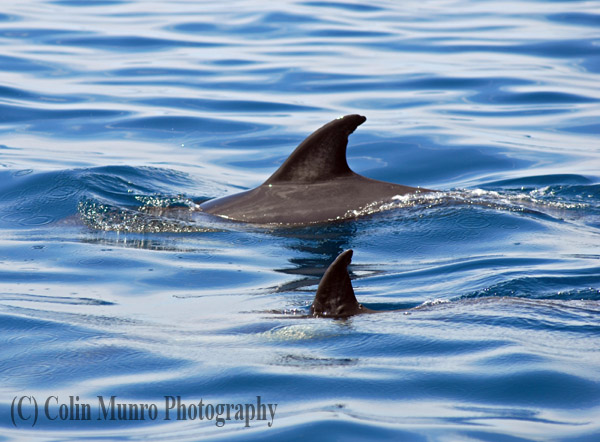
Mother and calf common dolphins (Delphinus delphis) swimming in close harmony. Colin Munro Photography. Image No. MBI000335.

Mother and calf common dolphins (Delphinus delphis) swimming in close harmony. Image No. MBI000335.

 These pictures were taken during a recent trip to look for blure sharks (Prionace glauca) off the north coast.  Although we did find one blue, we had no luck with pictures (next time!).  However we did come across a large group of common dolphins (Delphinus delphis) feeding.  Each summer substantial numbers of commons dolphins can be found around the coasts of Devon and Cornwall as they follow the mackerel shaols.  Hopefully I’ll be adding to these images this summer.  As ever, these images can be licenses for reproduction and are also available as fine art prints.  Email me , telling me the image number and what you require for further details. You can also search for additional images either from my main website homepage or using my Photoshelter website. Links for both are given in the sidebar.

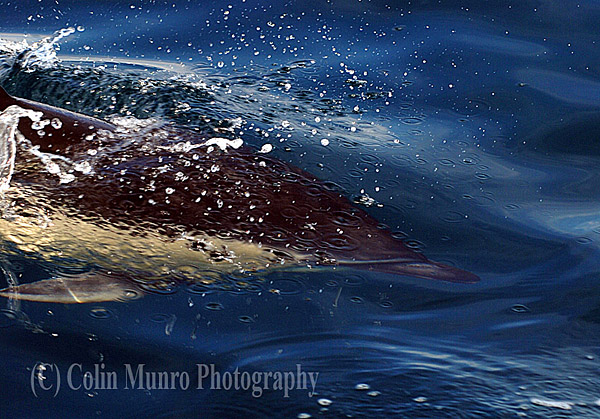
Common dolphins (Delphinus delphis) swimming, showing tooth rake marks on back. Colin Munro Photography, Image No. MBI000333.

Common dolphins (Delphinus delphis) swimming, showing tooth rake marks on back. Colin Munro Photography, Image No. MBI000333.


Common dolphins (Delphinus delphis) swimming, head on. Colin Munro Photography, Image No. MBI000339.

Common dolphins (Delphinus delphis) swimming, head on. Image No. MBI000339.


Common dolphin (Delphinus delphis) swimming at high speed. Colin Munro Photography, Image No. MBI000337.

Common dolphin (Delphinus delphis) swimming at high speed. Image No. MBI000337.

Samba funk fusion band Wara performing at Exeter Respect Festival

Samba funk fusion band Wara performing at Exeter Respect Festival
Nana Clara Aldrin-Quaye singing with London based cuban samba, timba and funk fusion band Wara at Exeter's Respect Festival, 2011. Image No. MBI000925.

Nana Clara Aldrin-Quaye singing with London based cuban samba, timba and funk fusion band Wara at Exeter's Respect Festival, 2011. Image No. MBI000925.

Juanita Euka, singer with London based cuban samba, timba and funk fusion band Wara at Exeter's Respect Festival, 2011. Image no. MBI000923.

Juanita Euka, singer with London based cuban samba, timba and funk fusion band Wara at Exeter's Respect Festival, 2011. Image no. MBI000923.

Slightly left field for me, but good fun.  Had a great day at the Exeter Respect Festival with my son earlier this month but have only now got around to doing something with the pictures from then.  A highlight was watching London-based samba/funk/fusion band Wara perform; real high energy, get-up-and-dance stuff.  The marquee covering the stage was kind of gloomy so I was pushing iso’s and working with wide open apertures and as slow a shutter as I dared to get some half-decent shots (not always succesfully).  Here are a few that worked. 

London based cuban samba, timba and funk fusion band Wara performing at at Exeter's Respect Festival, 2011. Image No. MBI000926. Colin Munro Photography.

London based cuban samba, timba and funk fusion band Wara performing at at Exeter's Respect Festival, 2011. Image No. MBI000926.

If you’d like to know more about them this is there myspace link http://www.myspace.com/waralondon

Start Point and Start Bay, South Devon

Rocky headland, Start Point, South Devon, England. Image MBI000921.
Rock Ridge and sky, Start Point, Rock Ridge and sky, Start Point, South Devon, England. Image No. MBI000920. Colin Munro Photography

South Devon, England. Image No. MBI000920.


Rocky headland, Start Point, South Devon, England. Image MBI000921.

Rocky headland, Start Point, South Devon, England. Image MBI000921.

 A very blustery day in late June saw see scrambling around the rocks on Start Point with my son.  The southwesterly wind was whipping white horses off the wave tops on the western side of the headland; to the east, sheltered by the high rocks of Start Point, the water within Start bay was almost mirror smooth, disturbed only by surface ripples.

Start Bay from Start Point,  South Devon, England. Image No. MBI000922.

Start Bay from Start Point, South Devon, England. Image No. MBI000922.


As ever, these images are available to reproduce as rights managed images or as art prints on a variety of media.  If you’d like to use any of the images in a publication, display, website etc., please email be (colin ‘at’ colinmunrophotography.com) noting the image number and where you’d like to use the image.  If you are interested in a print, please visit the prints page for options then email me. Thanks, Colin Munro.

Exeter Midsummer Party, Quayside, 17th June 2011

Exeter Midsummer Party, Quayside, 17th June 2011
Exeter Midsummer Party marking start of Exeter Festival, Exeter Quayside, 17th June 2011. Pyrotchnics on the River Exe. Colin Munro Photography.

Exeter Midsummer Party marking start of Exeter Festival, Exeter Quayside, 17th June 2011. Pyrotchnics on the River Exe. Image MBI000919

 A few quick images from the party on Exeter’s quayside last night. It was the most spectacular sunset, but of course I didn’t have my camera with me (Doh!).  I did grab it in time to get some pictures of the finale, which was quite spectacular. 

(If you would like to reproduce any of the images on my site, please email me, colin ‘at’ colinmunrophotography.com, giving the image number and the intended use)

Exeter Midsummer Party marking start of Exeter Festival, Exeter Quayside, 17th June 2011. Pyrotchnics on the River Exe. Colin Munro Photography

Exeter Midsummer Party marking start of Exeter Festival, Exeter Quayside, 17th June 2011. Pyrotchnics on the River Exe. Image No. MBI000918.

Exeter Midsummer Party marking start of Exeter Festival, Exeter Quayside, 17th June 2011. Pyrotchnics on the River Exe. Image No. MBI000917. Colin Munro Photography

Exeter Midsummer Party marking start of Exeter Festival, Exeter Quayside, 17th June 2011. Pyrotchnics on the River Exe. Image No. MBI000917.

Fishing canoe (pirouge) being landed at sunset, Senegal

Fishing canoe (pirouge) being landed at sunset, Senegal
Pirogue fishermen at sunset, Senegal, West Africa Image. MBI000914

Pirogue fishermen at sunset, Senegal, West Africa Image. MBI000914


Fishing canoe (pirouge) being landed at sunset, Senegal. Image MBI000914. Please email me, quoting this number if you’d like to license use of this image or purchase a fine art print.

A wooden fishing canoe returns from a day at sea, and men haul the boat and engine up the sandy beach as the sun sets.  M’bour, Senegal.

Fishing boat at sunset, Eastern Mediterranean, off Egypt

Fishing boat at sunset, Eastern Mediterranean, off Egypt
Egyptian fishing boat at sunset, Eastern Mediterranean Sea. Image MBI000912. Colin Munro Photography

Egyptian fishing boat at sunset, Eastern Mediterranean Sea. Image MBI000912.

Fishing boat at sunset, Eastern Mediterranean, off Egypt. Please email me, quoting this number if you’d like to license use of this image or purchase a fine art print.
I spend a couple of weeks working off in the eastern Mediterranean Sea, a few miles off the Nile delta, a while back.  It was mid-winter, and we spent much of the time dodging gales.  Although we were in a fairly substantial boat, waves piled up high in the shallow waters off the delta, so work was completed in brief sorties, then running back to port with four or five metres waves chasing us.  When the sea was calm however, it was absolutely beautiful, with the most stunning sunsets.  Calm weather also brought out large numbers of fishing trawlers.  At one time I counted twelve trawlers all within sight of us; it seems highly unlikely that such fishing is sustainable and indeed I saw precious little catch when nets were hauled.  As the sun set all nest were hauled and the boats headed back to port leaving us with the sea to ourselves until the sun rose again.  I watched this boat inch past the dipping sun, with an almost blood red sky as a backdrop.  There has been vistually no editing to this image – the sky really did look like that.  Sometimes you have to really work to get great pics, and sometime you just need to be there.

Kitesurfer and dramatic sky, Exmouth beach, Devon, England

Kitesurfer and dramatic sky, Exmouth beach, Devon, England
Kite surfer against a dramatic sky, surfing the Exe Estuary between Pole Sand sandbar and Exmouth Beach, Exmouth, Devon, England. Image MBI000660.

Kite surfer against a dramatic sky, surfing the Exe Estuary between Pole Sand sandbar and Exmouth Beach, Exmouth, Devon, England. Image MBI000660.

Kitesurfer and dramatic sky, exmouth beach, Exmouth, Devon, England. Image MBI000660. Please email me, quoting this number if you’d like to license use of this image or purchase a fine art print.
Kitesurfers catch the wind, flying along between Pole sand sandbar and Exmouth beach on a blustery summer evening.  Kitesurfing has become hugely popular in the Exe Estuary off Exmouth in recent years; on some evenings I have counted upwards of twenty kites.